| |
Disclaimer:
This is an informational site and not an official website of Cellwireless
Corporation. Please follow the link on 'The
Company' section to go to the official website.
|
|
|
|
|
|
|
|
|
|
|
|
|
|
|
|
|
|
|
|
|
| |
|
|
Learn how to make money with
your mobile phone!
Article
Entirely Reproduced From an article that first appeared in
NewScientist:15/02/03.
There are many other good related mobile phone articles in
NewScientist
|
IF YOU
own a mobile phone, how do you think you 'd cope without it? A recent
study by the Italian consumer association looked at the effect of depriving
300 volunteers of their phones for two weeks. Nearly 1 in 6 reported
loss of appetite or depression. And a quarter confessed that being phoneless
was a blow to their confidence that led to sexual problems with their
partners.
|
|
It seems
cellphones have become an indispensable part of our everyday lives.
In Britain, around 70 per cent of the population own a mobile, and in
Finland 98 per cent of 18 to 24 year-olds have one. Last year the number
of users around the world surged past the billion mark - outstripping
landlines for the first time. Their impact is hard to overstate, leading
to the emergence of new social behaviours and etiquettes. And the ability
to contact anyone from just about anywhere has helped many a stranded
traveller and saved more than one soul drifting helplessly out to sea
or lost on a mountain range.
But
the revolution isn 't all positive. Mobiles are inviting to criminals
: Britain 's Home Office estimates that a mobile phone is stolen on
average every three minutes. About one third of street robberies in
London involve mobile phone theft. And then there 's the health issue.
Questions remain about the long-term effect of regularly pressing a
mobile phone to your ear, especially for children (see "Is there
a health risk?").
The
popularity of mobiles is arguably a direct result of an industry decision
in 1987 to push ahead with new digital technology in Europe. Until then,
mobile phones - which could only fit into the most roomy, reinforced
pocket - used analogue technology. Now known as first-generation phones,
they worked much like radios that can be tuned into radio stations broadcasting
on a particular frequency, except that they could transmit as well as
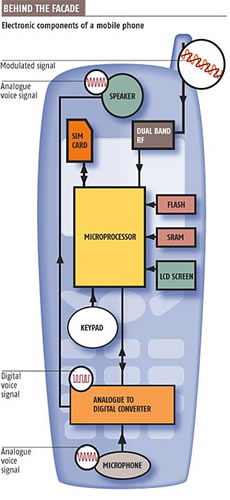
receive. Speech was converted into an analogue electrical signal (which,
unlike digital, carries data as a range of values rather than just 1s
and 0s). This signal was then used to "modulate" a radio wave
called a carrier wave - the wave that actually transmits the signal.
Modulation involves raising or lowering the frequency of the carrier
wave in proportion to the analogue signal. The signal can then be reconstructed
by the receiver by repeatedly checking how much the frequency of the
carrier wave has been changed.
|
 |
But first-generation
phones had major problems. In the early 1980s, many countries developed
their own systems and they were mostly incompatible with each other.
Analogue was also inefficient - like radio stations broadcasting on
a set frequency, only one conversation could be carried on a given frequency.
This severely restricted the number of people who could use a network,
which had the knock-on effect that the cost to each user was relatively
high. Analogue phones were also prone to interference and were easy
to eavesdrop on, leading not only to embarrassing revelations from the
private calls of public figures but also to phone "cloning".
An analogue phone sends information to the network telling it who you
are (so it knows who to charge for the call), but by eavesdropping on
the call, your identity could be stolen and programmed into another
phone. So you 'd be charged for any calls from it.
It became
evident that if mobiles were ever to become ubiquitous, analogue wasn
't up to the job. Going digital was seen as the best way to overcome
the problems, handle the anticipated surge in users and be flexible
enough to allow text messages and other data to be sent.
In 1982,
the European Conference of Postal and Telecommunications Administrations
set up the GSM (Groupe Sp Écial Mobile) to develop a Europe-wide
standard for second-generation mobile communications. After five years
of wrangling and testing, the group voted to pursue digital technology
and, in changing GSM to stand for "Global System for Mobile Communications",
proposed the standard for worldwide adoption.
Although
there are other kinds of digital network in place around the world,
GSM networks are now by far the most common. Catering for more than
70 per cent of all digital mobile phone users, GSM is the only system
used throughout Europe, Australia, the Arab world and sub-Saharan Africa.
It 's the dominant network in Asia and also covers North America and
several South American countries.
|
|
In Europe,
GSM networks and phones send and receive data over radio waves at around
900 or 1800 megahertz. In the US, the frequency used is around 1900
MHz. A lot of mobile phones are designed to work in other countries
and are either "dual band", meaning they work on 900 MHz and
1800 MHz networks, or "tri-band", meaning they can work on
1900 MHz networks as well.
Each GSM
network is allocated two frequency ranges or bands of up to 25 MHz each.
One band is used by phones to contact the network and the other band
is used by the network to contact phones. The capacity of each band
is limited, so if each person registered with a network in France, for
example, had to use a specific frequency to make a call, the two batches
of 25 MHz allocated to French networks would quickly be used up. So
network operators devised ways of squeezing more out of the scarce bandwidth
available.
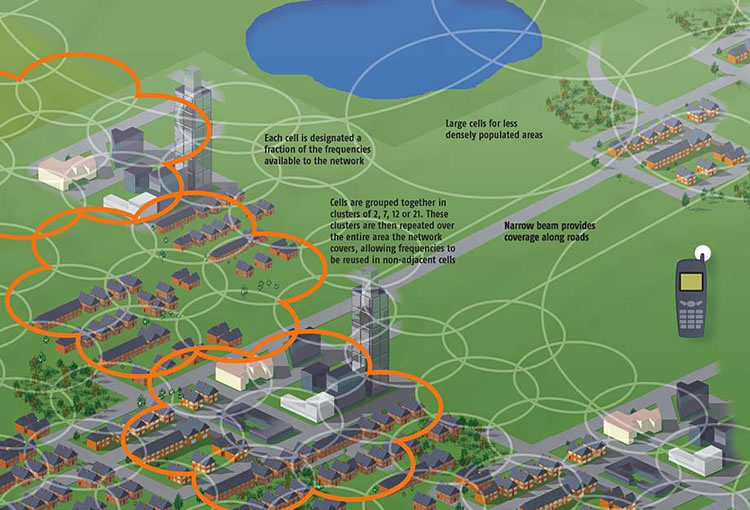
The first
trick was borrowed from the old analogue systems and involves dividing
the entire region that the network covers into a patchwork of cells
(see Figure). People in different cells can use the same frequencies
without their calls interfering. Each cell has a base station that transmits
and receives signals over just a small fraction of the frequencies to
which the network operator has access. To avoid interference, neighbouring
cells must use different frequencies, so the available radio spectrum
is effectively divided up between a cluster of cells. In this way, frequencies
can be re-used in other cell clusters, allowing far more users onto
the airwaves without any risk of their signals interfering.
The power
of a base station determines the size of its cell. In areas with few
people, high-power base stations are used to produce hyper cells that
can provide coverage up to about a 20-kilometre radius. In densely populated
areas such as cities, low-power base stations produce micro cells that
usually cover a 50 to 300-metre radius. While cells are often thought
of as circular, they can also be long and narrow. These selective or
directional cells are produced by base stations that send out narrow
beams at the entrances to tunnels or along roads in rural areas.
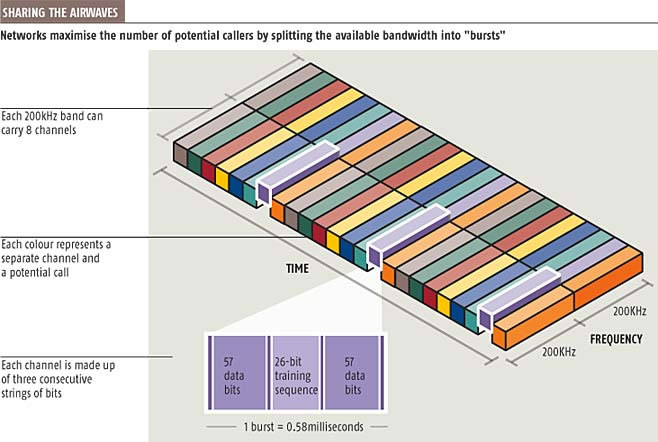
To squeeze
even more capacity out of the available airwaves, each band is divided
up further into carrier waves, each 200 kilohertz wide (see Figure).
Dividing up the spectrum like this is called Frequency Division Multiple
Access (FDMA). Each carrier wave is then split up again, but instead
of being divided by frequency, it is divided into eight equal time slots
called bursts, where each burst lasts less than half a millisecond -
a system called Time Division Multiple Access or TDMA. Each burst represents
a new channel, so up to eight calls can be conducted at the same time
on one carrier wave frequency. Your mobile phone just needs to know
what frequency to tune into and what burst number in the repeating frame
represents the channel it can use.
|
|
|
|
There are
two kinds of channel used in GSM : control channels and traffic channels.
Control channels are responsible for housekeeping tasks such as telling
the mobile when a call is coming in and which frequency to use. Whenever
your phone is powered up, the network records which cell you are in.
When a call arrives, it sends a message to your phone in the cell you
were last recorded as being in, and usually its immediate neighbours.
If you have wandered out of that group of cells, your network will have
registered this. If need be, the location of your phone can be determined
even more accurately, to a few tens of metres. The network does this
by comparing how long it takes a signal from your phone to reach three
or more of the base stations nearest to you.
A call
often has to be "handed over" to a neighbouring cell as the
user moves around, especially in cities where lots of small, low-power
cells are common. To ensure this handover works, the phone constantly
monitors the broadcast control channel of up to 16 neighbouring cells.
The phone works out which signals are strongest and sends a list of
the top six back to the base station to which it is currently connected.
In normal operation, phones continually adjust the power of the radio
waves they send out to be the minimum needed for the base station to
receive a clear signal. If a phone moves so far away from its base station
that boosting the power no longer improves the signal, the network consults
the list and triggers a handover to whichever neighbouring cell should
get the best signal. The system isn 't infallible though, as you 'll
know if you 've ever made a call from a moving train.
Traffic
channels - the second type of channel - are used to carry calls or other
data from the mobile phone to the base station and vice versa. On a
traffic channel, voice or text data is carried in bursts. Each comprises
two consecutive strings of bits (a series of signals representing 1s
and 0s), each 57 bits long. But in between these strings of data, the
burst carries another string of bits called a training sequence that
allows digital phones to overcome one of the problems that plague analogue
phones. Radio waves bounce off things like buildings and hills. This
can cause interference in analogue phones because it means the waves
from the base station follow different paths of different lengths on
their way to the phone, so some arrive later than others. Digital phones
get round this problem by comparing the training sequence they receive
with a copy of the sequence stored in their memory. The phone can then
work out how interference has corrupted the signal and correct it. Interference
in the voice data is removed using the same corrections.
When the
GSM system was being designed, security was a big issue. The upshot
is that whenever you use your phone, a complex series of checks is done
to ensure three things : that you are who you say you are; that your
conversation or other data is encrypted to deter eavesdroppers; and
that should it be stolen or lost, your mobile is useless to anyone else.
What makes a mobile phone unique to you is the postage stamp-sized SIM
card or subscriber identity module that slots into it. Keeping this
safe is paramount because, to the network, you are your SIM card. It
holds secret numbers that tell the network who you are and that carry
out vital calculations confirming your identity and encrypting your
calls.
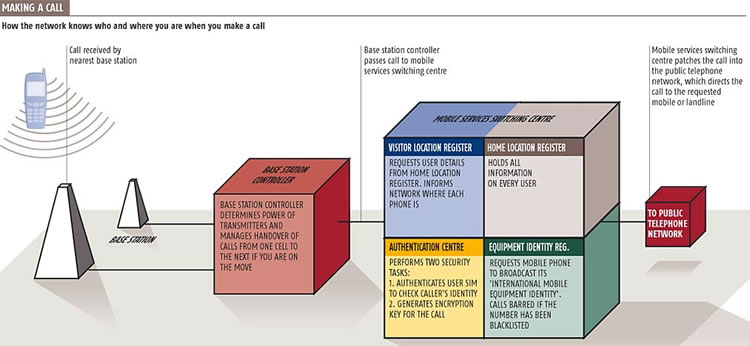
When you
use the phone for the very first time, it sends a number held on your
SIM card called the International Mobile Subscriber Identity (IMSI)
to the network, which looks it up in a database to ensure the card is
registered. If the IMSI is recognised, the network creates another number
called a Temporary Mobile Subscriber Identity (TMSI), which is encrypted
and sent back to the phone. In all subsequent calls, the phone identifies
itself by broadcasting the TMSI. This puts in train a series of elaborate
authentication and security processes (see Figure).
|
|
|
|
Once the
TMSI has been broadcast, the network finds the corresponding IMSI for
your phone, which tells it what services you have signed up for, like
news updates and so on. A part of the network called the Authentication
Centre then broadcasts a random number to your phone. This number and
a secret authentication number held on the SIM card are fed into an
algorithm - a sequence of mathematical functions - to produce a new
number. The phone sends this result back to the network. Meanwhile,
the network runs the same random number and the user 's authentication
code through the same algorithm to give its own result. If the two results
match, the phone is given the all-clear. By using this elaborate "challenge-response"
approach, the user 's identity can be checked without the phone ever
having to send its secret authentication code. If this code were ever
broadcast, or even known to the user, it could be used to set up fraudulent
calls on the network.
To generate
an encryption key for encoding and decoding the data sent and received
during the subsequent connection, the SIM card feeds the random number
from the network and authentication number into a second algorithm.
Another
security check ensures that the user isn 't calling from a stolen handset.
Periodically, the network beams a signal to the phone asking it to send
in the International Mobile Equipment Identity (IMEI) number held in
its memory. The network checks this in an equipment identity register.
If the phone is listed as stolen, the network cuts the connection. In
Britain, all network providers use a common register, so a stolen phone
can be banned from all of them at once. The IMEI is the number you 're
supposed to note down when you buy your phone.
While GSM
networks were primarily designed to handle voice communications, they
increasingly carry other forms of data. Text messaging, which allows
blocks of text up to 160 characters long to be sent, has been a huge
success with 50 million being sent in Britain alone every day. Texting
has led to the evolution of a stripped-down lexicon for communication,
and innovations like text voting and news bulletins - as well as a good
number of scams.
Despite
their tiny screens, it 's also possible to access Web pages from some
mobiles. The first mode of access to be developed was WAP ( Wireless
Application Protocol). But only pages that have been converted to a
WAP format can be downloaded. This severely limits the pages available
and at present only text can be displayed. Because of the slow data
rates - it takes a minute to download a page - "surfing" with
WAP can be time-consuming and expensive (see "Things can only get
faster").
In Japan,
the hugely successful I- mode phones made by a company called DoCoMo
get around the delays WAP users commonly experience by shifting data
differently. Standard GSM phones transmit and receive data by circuit
switching, which means that a dedicated connection between the phone
and the base station must be established. I-mode, on the other hand,
uses a system borrowed from the Internet called packet-switching. Data
transferred is divided into blocks called packets, each labelled with
the address of its final destination. This makes use of all the available
bandwidth, rather than reserving channels for specific users. The result
is that downloads are quicker and the user pays for the amount of data
they receive, rather than the time it takes to download it.
All GSM
networks will soon be able to carry packet-switched calls. But improvements
in technology will not stop there. Phone makers need to find new reasons
for you to upgrade. Right now their hopes are based on camera phones.
After video, who knows what 's next?
|
 |
| Is
there a health risk?
A vast
number of experiments have been performed to see if the electromagnetic
(EM) radiation emitted by mobile phones and base stations can damage
our health. While there is no compelling evidence of a risk, there are
some uncertainties.
Electromagnetic
radiation is certainly capable of damaging biological tissue, but precisely
how depends upon its frequency. High-frequency EM radiation, such as
ultraviolet, gamma or X-rays, can break chemical bonds in living tissue.
Lower frequency EM radiation is too weak to cause this kind of damage
but is still capable of damaging tissue.
Microwave
ovens illustrate what high-power, low-frequency EM radiation can do
to raw meat, operating at up to around 900 watts and using EM waves
of 2.45 gigahertz. GSM mobiles, on the other hand, use lower frequencies
and are limited to a maximum average power output of 0.25 watts at 900
megahertz and 0.125 watts at 1800 megahertz. But most of the time they
transmit at just one tenth of this.
The heating
effect of radio frequencies is due to tissues absorbing the oscillating
field of the wave. EM fields exert a force on charged ions and dipoles
such as water in the tissues, producing heat from electrical resistance
as they try to move or reorient themselves. Computer models have shown
that radiation from a typical mobile phone can cause a maximum temperature
rise of around 0.1 °C in the brain.
Base stations,
with antennas on masts between 10 and 30 metres high, produce more powerful
beams of EM radiation. But the power of the beams falls rapidly with
distance. The main beam from a base station hits the ground around 50
metres away, and at this distance the maximum power from a typical 60-watt
antenna is around 100 milliwatts per square metre. The heating effect
from this is about 5000 times less than that produced by a mobile phone
antenna.
Things
can only get faster
With the
advent of picture messaging, the clamour for improved data transfer
rates has become even louder. Basic GSM phones send and receive data
at a paltry 9.6 kilobits per second (kbps). This has forced the development
of new systems.
One of
the first was called High Speed Circuit Switched Data, which lets users
receive roughly five times as much data by giving them access to more
than one channel. Unfortunately, because multiple channels are devoted
to a single user, HSCSD rapidly eats up available bandwidth for a cell.
Among the
latest ways to achieve higher data rates is a system called General
Packet Radio Service (GPRS). This also allows each phone to use
several channels, but they 're shared among many users. Data is simply
chopped up into packets, tagged with the address it 's being sent to,
and broadcast when a channel is free. The data is then pieced together
at the other end. In theory it can provide rates of up to 171 kbps.
The long-delayed
third generation or 3G mobile phones, which may finally be available
later this year, promise even faster data rates. These will use either
the Universal Mobile Telecommunications System (UMTS) that evolved from
today 's GSM system, or another called CDMA2000 based on the IS-95 standard
common in North and South America. Both systems will be packet-switched
and send data using "code division multiple access", which
enables "bursts" to carry several signals simultaneously.
Maximum rates are expected to be up to 2 megabits per second for UMTS
and 70 kbps for CDMA2000 - in theory making video phoning possible.
Learn how to make money with
your mobile phone!
|
|
|