Home | Story | Layout | Construction | Structures | Operation | Pictures | Animations | Snow Clearing | Links
The fiddle yard
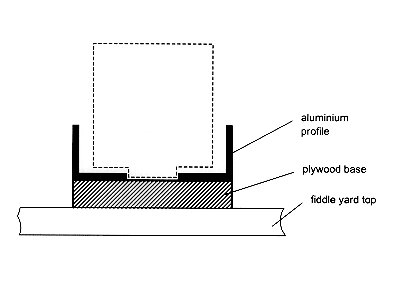
As fiddle yard I use a system working with casettes. These casettes have a plywood base on which L-aluminium profiles have been glued (see Fig.1). The trains move inside these casettes using the L-profiles as tracks.
Fig.1: Casette construction
The fiddle yard is attached to the main layout. The casettes, which slide on a plywood top forming the actual fiddle yard, are aligned in front of any of the two exits. The trains exiting the layout will move from the tracks onto the casettes. For trains being pulled by an engine I use two casettes of different length: a long one for the coaches and a short one for the engine. The uncoupling happens automatically when the engine is moving on the final short casette (see Fig. 2).
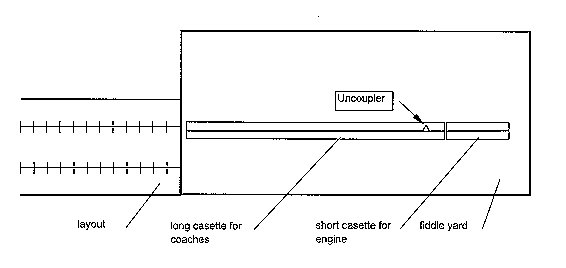
Fig. 2: Casette system
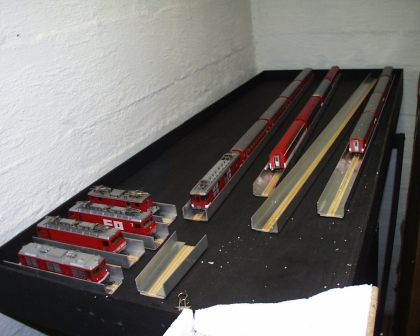
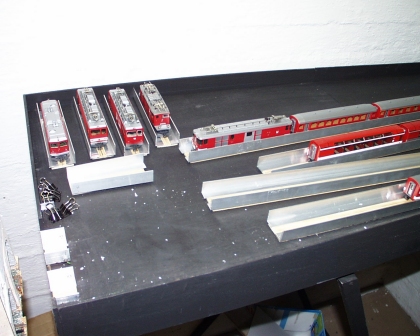
With this system the handling of individual coaches or engines is minimised and by using multiple casettes the exchange of trains is quick. At the moment I use 4 short casettes for engines and 4 long casettes which can take a rake of 5 of the longest carriages. One casette is kept empty to allow the assembling of the goods trains or other "specials". This assembling is facilitated by the use of a special ramp, which makes the task of rerailing a whole train simple.
  |
Home | Story | Layout | Construction | Structures | Operation | Pictures | Animations | Snow Clearing | Links