


In the early 1900s, technology
was advancing rapidly and with this technology came the ability to cross
oceans relatively quickly with steamships. Competition increased
as each company attempted to provide the fastest and most comfortable way
to cross the Atlantic. The White Star Line was one company that intended
to surpass every competitor with the introduction of the Olympic Class
liners. The three ships of the Olympic Class, the Olympic, Titanic,
and Britannic, were designed to be the largest, fastest, most luxurious,
and safest liners afloat.
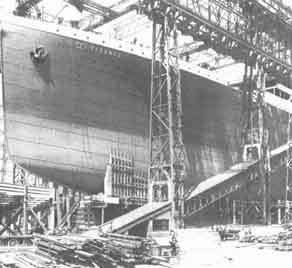
Construction of the Titanic
began on March 31, 1909 at the shipyards of Harland and Wolff in Belfast,
Ireland. On May 31, 1911, lubricated with twenty three tons of tallow,
train oil, and soft soap, the hull of the largest ship in the world was
launched. Although she was not christened, the launch of the Titanic
was a big celebration. Thousands of people, along with the 14,000
workers who built the Titanic, cheered as soon as the ship was afloat.
Many prominent people attended the launching, including Bruce Ismay, chairman
of the White Star Line, and J.P. Morgan, an American who had formed the
International Mercantile Marine, which controlled the White Star Line.
Thus, the Titanic was actually an American ship, although it flew the British
flag.
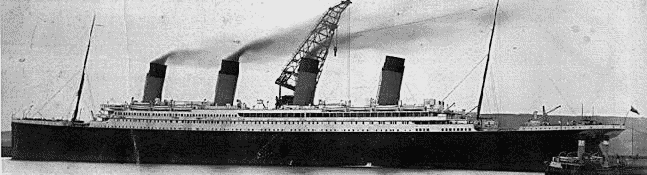
When finished, the Royal Mail
Steamer Titanic was a technological masterpiece that was described as the
perfect ship. Seven and a half million U.S. Dollars and millions
of man-hours had created a truly titanic ocean liner. The 882 foot
long and 92 foot wide steamer had a gross weight of 46,328 tons.
Nine decks gave her the height of an eleven story building just to the
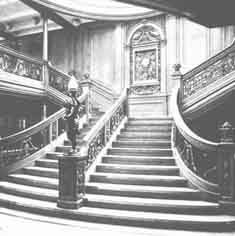
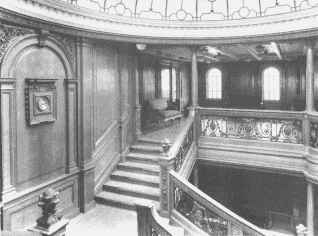
boat deck. The Titanic's first class decks were as fancy as some
of Europe's best hotels. The great ship also contained many luxuries
never before seen on any ship, such as a swimming pool, four elevators,
a Turkish bath, squash court, a cafe, and a gymnasium. Located on
the boat deck, the gymnasium contained odd exercise equipment such as a
rowing machine and an electric camel.
 Below the luxurious staterooms
was some of the latest technology of the period. Twenty-nine 100
ton boilers provided the power to turn three massive propellors.
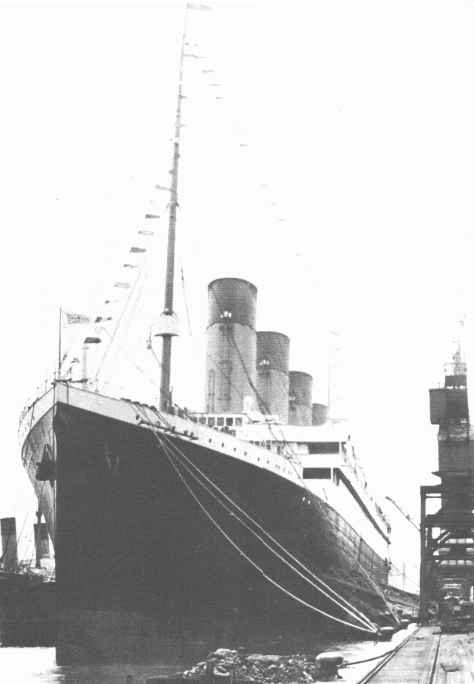
The Titanic used only three funnels, but the designers decided that four
looked better, so a fourth funnel was added as a ventilator only.
Fifteen bulkheads divided the ship into sixteen watertight compartments.
For the convenience of passengers, though, they only extended ten feet
above the waterline. Since a collision at the junction of two compartments
was the worst imaginable damage, the Titanic was considered to be practically
unsinkable.
Below the luxurious staterooms
was some of the latest technology of the period. Twenty-nine 100
ton boilers provided the power to turn three massive propellors.
The Titanic used only three funnels, but the designers decided that four
looked better, so a fourth funnel was added as a ventilator only.
Fifteen bulkheads divided the ship into sixteen watertight compartments.
For the convenience of passengers, though, they only extended ten feet
above the waterline. Since a collision at the junction of two compartments
was the worst imaginable damage, the Titanic was considered to be practically
unsinkable.
Lifeboat regulations in
1912 were badly outdated. The current law, which was twenty years
old, required all ocean liners larger than 10,000 tons to provide enough
lifeboats for 962 people. The size of liners had dramatically increased
since then. The Titanic, designed to carry 3,511 passengers and crew,
exceeded the requirement by providing twenty lifeboats for 1,178 people.
She sailed on her maiden voyage with over 2,200 onboard.
The man chosen as the captain
of the Titanic was Captain Edward Smith. Smith had nearly forty years
of experience on the sea, and his last command had been on the Titanic's
nearly identical sister Olympic. Smith was very popular with other
members of the crew, and even with many passengers who traveled often.
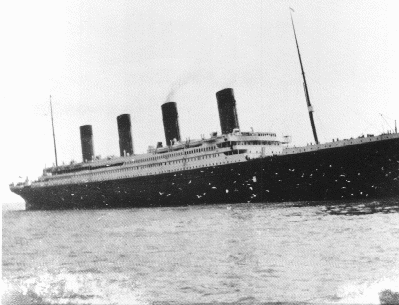
As the Titanic left Southampton
on April 10, 1912, the smaller liner New York broke loose from her moorings
and swung toward the Titanic's stern. Acting quickly, a tug prevented
a collision by pulling the New York's stern away from the passing Titanic.
The reason for this near collision was, that as the water displaced by
the Titanic rushed in to fill the empty space behind the large liner, it
literally sucked the New York in with it. A nearly identical accident
damaged the Olympic the previous year, but the old captain had not learned
from his past mistake.
After leaving Southampton,
the Titanic made a brief stop at Cherbourg, France before steaming toward
Queenstown, Ireland to pick up hundreds of Irish emigrants. Along
with hundreds of families traveling third class to the United States, the
Titanic carried some of the wealthiest and most prominent people of the
time. Ismay, the White Star Line chairman, was also traveling as
a passenger.
On April 12, the weather
was sunny and calm. The Titanic received one warning of ice over
1000 miles away and to the north of her path. The weather was also
good on the 13th and the Titanic was signaled of ice dangers by a ship
headed east. On Sunday, April 14, three ice messages were received
by noon. During the afternoon the temperature dropped and most of
the passengers remained inside. A rapid drop in temperature is one
indication that icebergs may be in the area. By 9:40 p.m., a total
of six iceberg warnings had been received by the Titanic's wireless operators.
Because the sky was extremely clear, no change was made in the ship's top
speed of twenty-two knots.
At 11:40 p.m., lookout
Frederick Fleet was in the crow's nest when he suddenly spotted a huge
iceberg less than 500 yards away. He immediately telephoned the bridge
to relay the information. First officer Murdoch answered the call
and steered hard left, and at the same time reversed the engines.
Thirty-seven seconds later, however, the fifty to one hundred foot high
iceberg scraped along the starboard side of the Titanic's bow. Most
passengers were asleep at the time, but those who were awake recall the
collision as only a faint grinding jar beneath their feet.
Within twenty minutes Captain
Smith knew that the ship was going to sink. Thomas Andrews, the Managing
Director of Harland and Wolff, had surveyed the damage and reported to
the captain. The iceberg had punctured the hull in several places
along a gash nearly 250 feet long. Water was flowing into six of
the sixteen watertight compartments. The total damage caused by the
iceberg amounted to only twelve square feet, but the Titanic would eventually
sink. Andrews told the captain the ship would remain afloat for only
the next two hours.
At 12:15 a.m., the Titanic
started sending a distress call. The liner Carpathia received the
distress calls and began racing through ice fields toward the Titanic's
position, fifty-eight miles away. Thirty minutes later the first
lifeboat was lowered with twenty-eight people onboard. The lifeboat
was capable of carrying sixty-five people. The crew had never held
a boat drill and was not certain that the lifeboats could hold so many
people. The ship's band began playing waltzes to cheer up the passengers.
A total of eight flares were fired because the light of a ship could be
seen less than twenty miles away.
The ship in the distance
also saw the Titanic. At 11:20, the Leyland liner Californian had
been stopped by ice and her wireless operator went to bed shortly afterwards.
Thus, the Titanic's distress was not known. Several officers on the
Californian did notice the flares, but nothing was done. Unknowingly,
these men were watching the world's most famous sea disaster.
By 1:20 a.m., the portholes
on the lower decks and the anchor chain holes had been pulled beneath the
water, adding hundreds of square feet of surface area into which the sea
could flow into the ship. This caused the ship to sink much faster.
At 2:05, the last lifeboat had been lowered, leaving nearly 1600 people
stranded on the liner. The bridge was already underwater by this
time. Water began spilling over each bulkhead as the previous one
filled. The slope of the deck became so great that the Titanic's
band played its last song and then separated. None of the band members
survived. At 2:15, hundreds of passengers moved toward the stern,
which was now completely out of the water at about a thirty degree angle.
No ship has been designed to withstand having its tail 200 feet in the
air, and at 2:18 the giant liner broke in two between the third and fourth
funnels. The stern, having lost the weight of the bow of the ship,
began to rise and settle back on the propellers. Two minutes later
the stern stood on end and disappeared below the water. The passengers
in the lifeboats were not allowed to row back to rescue people from the
freezing water because of the danger of capsizing the lifeboats.
Within an hour, the cries from the water died away as passengers slowly
froze to death.
On April 15, at 4:10 a.m.,
the Carpathia arrived at the scene and began rescuing the 705 passengers
and crew from the lifeboats. By 8:30, the rescue was finished and
the Carpathia headed for New York. The Californian remained in the
area for several hours searching for any survivors in the cold water, but
none were found so she continued toward Boston.
Inquires were held in the
United States and Britain concerning the disaster. The White Star
Line was fined and sued for millions of dollars, but the company only paid
$663,000. As a result of the disaster, several safety precautions
became required by law. Following the sinking, ships were to have
enough lifeboats for every passenger and crew member onboard. A twenty-four
hour radio watch was required. In addition, the International Ice
Patrol was formed to warn ships of ice in the North Atlantic.
For years after the Titanic disaster, many people devised state-of-the-art
methods for raising the immense ship. However, all these plans were
expensive and couldn't work until the ship was found. Several unsuccessful
efforts to locate the ship were attempted in the late 1970s and early '80s.
Locating the wreck over two and a half miles below the surface was extremely
difficult. A combined French and American effort began searching
for the ship in June, 1985. In September, the Americans, led by Robert
Ballard, located one of the Titanic's boilers at a depth of nearly 13,000
feet. Following a trail of debris, the team located the two main
sections of the Titanic. Photographs were taken of nearly every square
foot of the sunken ship. The following year, Ballard returned to
the wreck with a three man submersible called Alvin. Ballard and
his crew did not remove any artifacts from the debris field, but since
the ship lies in international waters, later expeditions from other countries
have collected a few small items. Questions about the Titanic and
her fate are still being asked nearly ninety years after she sank.
The unsinkable ship and the events leading up to the disaster will probably
continue to inspire many generations for years to come.
Check
out my Titanic model here.
Back