
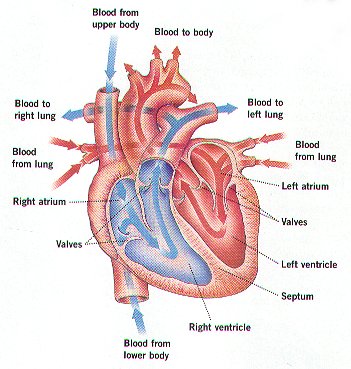
Aorta: carries oxygenated blood to body
Vena Cava: transports deoxygenated blood to heart
Pulmonary artery: carries deoxygenated blood to lungs
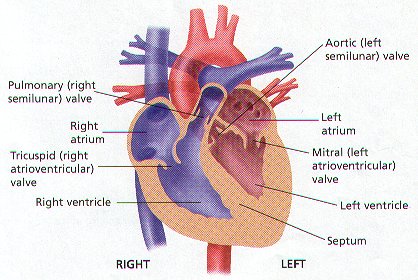
Tricuspid valve: Prevents backflow of blood to right atrium
Semi-lunar valve: prevents blood flow back to ventricle
Bicuspid valve: prevents blood flow back to pulmonary vein
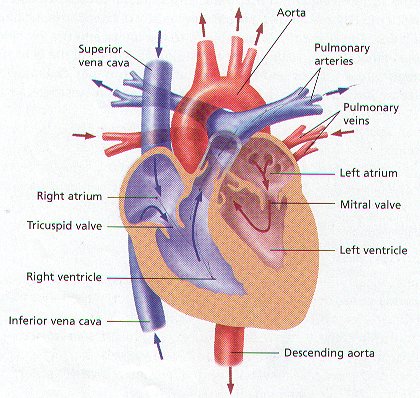
1. Superior and inferior vena cava carry deoxygenated blood to the heart by entering the right atrium
2. Tricuspid valve opens and blood enter right ventricle.
3. Blood is transported to lung by a vessel called Pulmonary arteries.
4. The lung filters out the blood: deoxygenated to oxygenated
5. Oxygenated blood is transported to heart by a vessel called pulmonary vein.
6. Blood enters left atrium.
7. Blood enters left ventricle when the bicuspid valve open
8. Blood transported throughout the body by aorta (largest artery)
9. Blood back to heart again
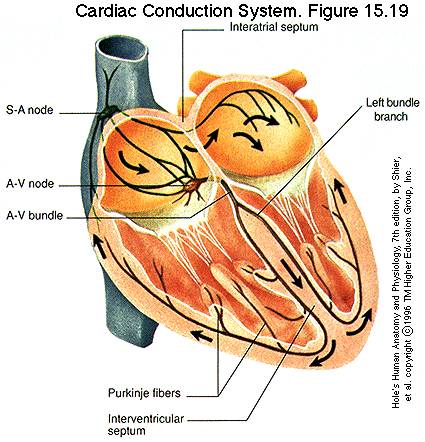
1) Sino-atrial node (S-A node): located at right atrium next to superior vena cava; functions as rhythmic pacemaker (pulse); causes contraction of atrium (70-80 times per minute)
2) Atrio-ventricular node: located at inferior septum between atria; transmits slowly to allow ventricles fill completely; causes ventrivles to contract
3) A-V bundle
4) Perkinje fibers: push blood superiorly
Diastolic: blood pressure during ventricle filling (down)
Systolic: (up) blood pressure when ventricle contracts
Sphygomanometer: used to measure blood pressure
- Hypertension
- Hypotension
- Cardiomyopathy
- Heart Murmur
- Coronary artery disease
- Marfan Syndrome
- Rheumatic Heart Disease
- Enlarged Heart
- Endocarditis
- Mitral valve prolapse
- Arrhythmia
- Congestive Heart failure
1) Heart actions: Stroke volume (amount of blood pushed out ventricle during a concentration), Cardiac output (stroke volume *heart beats)
2) Blood volume: 5 liters in an adult
3) Peripheral resistance: -Vasodilation: opening of blood vessels
- smooth muscle: regulates size of vessels
4) Viscosity: thickness of blood; more cells the thicker it is; high viscosity equals to high blood pressure