1. skeletal
2. smooth
3. cardiac
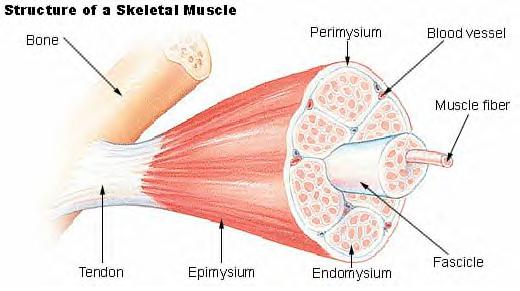
Skeletal Muscle Tissue
*helps maintain posture
*has striations
*many nuclei
*voluntarily controlled
*used in movement of bones
*well-developed transverse tubule system
Functional Characteristics of Skeletal Muscle
*Excitability (responsiveness) - muscles can be stimulated by electrical, chemical, physical means
*Contractility - a muscle responds to stimlulate by contracting
*Elasticity - mucles tend to recoil to thier resting length.
*Extensibility - muscles can be stretched beyond their resting length.
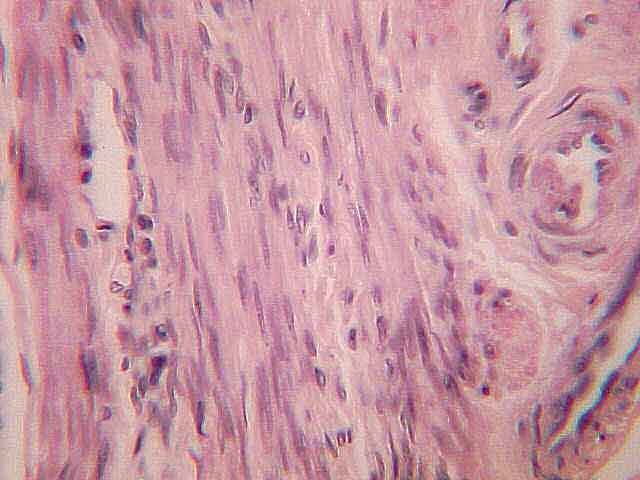
Smooth Muscle Tissue
*Found in walls of hollow viscera (organs)
*used in movement of viscera nad peristalsis
*No Striations
*Single nuclei
*Lacks transverse tubules
*Involuntarily controlled
*Contracts and relaxes
*Peristalsis - involutarity muscle control.
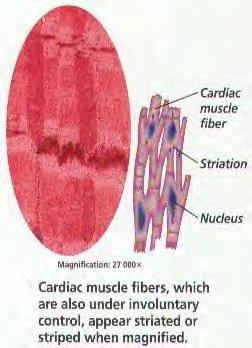
Cardiac Muscle Tissue
*Used in pumping blood in heart + heart chambers
*Striations
*Single nuclei
*Found only in walls of heart
*Fibers branch off one another
*Involuntary
*Intercalated discs.
Muscle Attachments
*Tendons - attach muscle to bone
*Aponeuroses - broad, flat tendinous attachemtns
*Origin - fixed point of attachment
*Insertion - moveable part of attachment
*Muscle action - pulls insertion toward origin.
A muscle can only pull, it cannot push!
The Sliding Filament Mechanism of Muscle Contraction
The shortening of sacromeres, and the resulting muscle contraction, is due to the sliding action of the actin and myosin myofilaments against one another.
Types of Muscle Contraction
*Agonist - the prime mover, the muscle which performs the movement in question.
*Antagonist - the muscle that performs the opposing movement of that of the agonsit
*Both muscles contract (exert tension) regardless of which is the agonist.
*On-center movement - that of hte agonist
*Off-center (eccentric) movement - that of the antagonist.
Knee Extension
*Agonist: the rectus femoris (quadriceps femoris)
*Antagonist: the biceps femoris (hamstrings)
Knee Flexion
*Agonist: the bicepts femoris (hamstrings
*Antagonist: the rectus femoris (quadricepts femoris)
*Synergists - muscles which work together to perform a movement; often differs from the movement either performs when working alone.
*Fixators - muscles which work to keep a part from moving; stabilizers, neutralizers.
This is what happens to cause a muscle to contract!
1. Nerve impulse
2. Neurotrans, released to synaptic cleft
3. Attaches to sarcolemma -->stimluates sacroplasmic reticulum --> releases Ca+
4. Ca+ --> sacromeres in myofibrils to contract
5. Actin & myosin filaments slide and muscle constracts.