
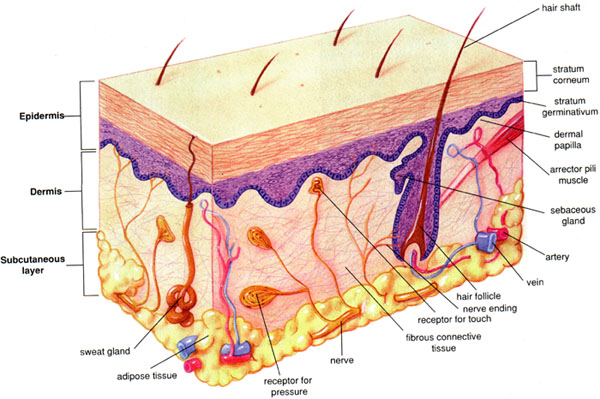
The skin, or integument (covering), is composed of two discrete tissue layers, an outer epidermis and a deeper dermis, resting on a subcutaneous tissue, the hypodermis.
The Epidermis
The epidermis is an avascular, keratinized stratified squamous epithelial sheet. Most epithelial cells are keratinocytes. Scattered among the Keratinocytes in the deepest epidermal layers are the melanocytes, Merkel cells, and Langerhans' cells.
The dermis is the second layer of skin, directly beneath the epidermis. Unlike the epidermis, the dermis has its own blood supply. Because of the presence of this blood supply, more complex structures are able to exist here. Sweat glands are present to collect water and various wastes from the bloodstream, and excrete them through pores in the epidermis. The dermis is also the site of hair roots, and it is here where the growth of hair takes place. By the time hair reaches the environment outside of the skin, it is completely dead. The dermis also contains dense connective tissue, made of collagen fibers, which gives the skin much of its elasticity and strength.
The Subcutaneous Layer
Beneath the dermis lies the final layer of skin, the subcutaneous layer. The most notable structures here are the large groupings of adipose tissue. The main function of the subcutaneous layer is therefore to provide a cushion for the delicate organs lying beneath the skin. It also functions to insulate the body to maintain body temperature.
Integument - the outer covering
Epidermis - the outer layer of skin that encloses the body in a cont. sheet
Dermis - layer of skin under epidermis
Keratin - protein that produces hair, bird feathers, and human nails
Melanin - determines the skin, eye, and hair color
Hair follicle - produces hair
Sweat Gland - secrets water
Sebacious Gland - secrets sebum (oil)
Inflammatory Response - increase blood and temperature in infected area (white blood cells)
Carcinogen - cancer causing substance
Carcinoma - malignant tumor that grows in tissue
Cancer - caused by the rapid growth of cells
Tumor - clamp of cancer cells; spreading of cancer cells (metastasis)
-most frequently caused by excessive chronic exposure to UV radiation
-other causes: mutations, defective tumor suppressive gene, immune system
Types of Skin Cancers
Basal cell carcinoma - most common. Cells in the basal (top layer) are altered and mitosis
malfunctions. They migrate into the dermis and subcutaneous tissues and erode normal
tissues, causing erosive ulcers.
Squamous cell carcinoma - bgins in the stratum (lower layer) spinosum. If untreated metastasis
(transer of a disease from one organ to another not directly connected to it) may occur.
Malignant melanoma - exposure to UV rays. Some forms spread rapidly, other forms are less
virulent. Arise from maloncytes in normal skin or from pigmented moles.


