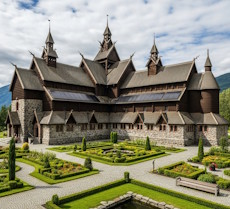
Monasteries
On this page you will find the most important Catholic and Ferna Sed monasteries and monastic orders in Friland and Hiveria, listed alphabetically. This page only includes those that still exist.
Friland
History
The foundation of Hiveria also brought Christianity to the Frilandic archipelago. The first monasteries were founded in the 12th century. At first only in Hiveria, later also in Friland, where a large Christian minority had emerged, especially in Walamark.
Ferna Sed, the native religion of the Frilanders, originally had no monastic tradition and only developed one in the 14th century. Ferna Sed priests in Walamark, driven out by advancing Christianity, fled to remote, well-defensible locations in the hills, mountains, and forests, where they established closed communities modeled on Christian monasteries. These Ferna Sed monasteries not only preserved the faith and traditions of the region but also spread them and developed into self-sufficient religious centers offering education, products, and services.
The layout of Ferna Sed monasteries is also inspired by Christian monasteries; they typically consist of a courtyard, a sanctuary, a hall for teaching, prayer, and discussion, communal and/or private sleeping quarters, guest quarters, sickroom, cemetery, writing room, library, mess hall, cellar/storage, bakery, brewery, monastic gardens (vegetable garden, herb garden, orchard), fields and pastures, watermills, windmills, sawmills, and so on.
Ferna Sed monastic orders

|
Ferna Sed monastic brothers
|
While each order maintains its own vows, the foundation is a vow of sobriety, celibacy, and loyalty to the order's principles. The order uses as little of its income as possible to maintain itself and allocates the remainder to its own set goals. Each monastic community strives to be self-sufficient, although donations are always welcome.
Ferna Sed does not distinguish between monasteries, congregations, or commanderies. It also does not use terms such as "monastery," "monk," or "nun," although this page does so for simplicity and because of the functional similarity. Monks (wimainars) and nuns (wimainarins) are addressed as brother (broþar) or sister (swestar). They form a living community; the monastery (wimain or "consecrated community"), which is led by a wimaintugar(in) ("monastery administrator"). Believers who do not hold a religious office are called þe (servant). Along with monks and nuns, they form an important part of the monastic community.
The main Ferna Sed monastic orders are as follows:
Airundjars ("Messengers")
Airundjar monasteries serve as knowledge centers and have extensive libraries on faith-related topics. The monks also write books themselves and make information available online. The order also offers a low-threshold retreat: anyone, regardless of faith, is welcome to stay for up to a year, free of obligation, to find peace. They participate in daily life at the monastery and can, if desired, learn more about the faith. But non-believers and those of other faiths have also gained a unique experience after their visit. As a sideline, the Airundjars brew Airundjar aluþ ("Messenger Beer").
Isbloþars ("Iceblooders")
This order is named after its founder, high priest Isbloþ Kunredssun ("Iceblood Conradson"). It primarily offers training as a gudar ("priest"), but also for special positions such as weitag ("seer"), wikkar ("wizard"), and ubildreibar ("expeller of evil" or exorcizer). Isbloþar monasteries are therefore also jokingly called "Hogwarts." To finance its activities, the order engages in, among other things, breeding cattle, horses, dogs, and cats, and preserving endangered species.
Traudridars ("Pitiful Knights")
The Traudridars are a chivalric order that provides care to the sick and those in mental distress. Many of its monasteries have clinics specializing in medical, psychiatric, or addiction issues. In addition, many monasteries have a fehtskol ("fighting school"); a remnant of the knights' martial history. Martial arts such as wrestling, judo, boxing, kickboxing, fencing, sword fighting, HEMA, and target shooting are taught here.
|
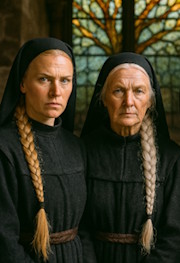
Ferna Sed monastic sisters
|
Þrafstars ("Comforters")
This order offers spiritual and practical support during illness, death, and funerals to both patients and their families. Many Þrafstar monasteries have a hospice. To finance its activities, the order also offers services such as bookkeeping and administration.
Þruskars ("Educators")
Þruskar monasteries focus on protecting and educating young people. They also often serve as maternity hospitals, adoption agencies, orphanages, and/or childcare facilities. They also offer training and courses on a variety of subjects, such as first aid, survival, etiquette, housekeeping, and parenting.
Ferna Sed monasteries
Below is a selection of the largest Ferna Sed monasteries in Friland:
Audhurnwimain
Audhumbla Monastery
|
Þruskar women's monastery in Bergan (Langmark).
|
Brun fan Weisdomwimain
Well of Wisdom Monastery
|
Isbloþar men's monastery in Landwik (Eastern Tern Islands, Southern Domain).
|
Daudanbergwimain
Mountain of the Dead Monastery
|
Þrafstar women's monastery in Twaibak (Medga).
|
Ermansulwimain
Irminsul Monastery
|
Þrafstar men's monastery in Brunhal (Nurþland).
|
Gulþan Wimain
Golden Monastery
|
Isbloþar men's monastery in Sunþfan (Sunþga), near the Gulþan Wi (Golden Temple).
|
Lauganiþ Swerdwimain
Flaming Sword Monastery
|
Traudridar men's monastery in Arinhaim (Sunþga).
|
Leuht þer Þeustarwimain
Light through Darkness Monastery
|
Isbloþar women's monastery in Sowilhaim (Frilandic Tagaloa).
|
Menwimain
Moon Monastery
|
Þrafstar women's monastery in Urþansul (Walamark).
|
Sikura Habanwimain
Safe Haven Monastery
|
Þruskar women's monastery in Isungan (Sunþga).
|
Skalhurnwimain
Seashell Horn Monastery
|
Airundjar men's monastery in Hwarbgard (Frilandic Tagaloa).
|
Skeldmagaþanwimain
Shield-maidens Monastery
|
Traudridar women's monastery in Stolburg (Nurþland).
|
Snaiblomwimain
Snow Flower Monastery
|
Airundjar women's monastery in Logarwik (Wulfmark).
|
Sparwalþwimain
Sparwood Monastery
|
Þruskar women's monastery in Wulfmor (Nurþland).
|
Sturaldsgrabwimain
Sturald Grave Monastery
|
Airundjar women's monastery in Agatfelþ (Berglaft).
|
Sugilwimain
Sun Monastery
|
Þruskar men's monastery in Frosur (Walamark).
|
Sumerwimain
Summer Monastery
|
Þrafstar women's monastery in Fuldand (Skak).
|
Sunblomwimain
Sunflower Monastery
|
Airundjar women's monastery in Storgard (Eastern Tern Islands, Southern Domain).
|
Þemarwimain
Dusk Monastery
|
Þrafstar men's monastery in Segdal (Berglaft).
|
Þeudburgarwalþwimain
Teutoburg Forest Monastery
|
Traudridar men's monastery in Saltwik (Berglaft).
|
Þunarshamarwimain
Thor's Hammer Monastery
|
Airundjar men's monastery in Gronawalþ (Medga).
|
Wentarwimain
Winter Monastery
|
Airundjar men's monastery in Skulmar (Skak).
|
Weraldtrewimain
World Tree Monastery
|
Isbloþar women's monastery in Stordam (Sunþga).
|
Wodanstainwimain
Wodan Stone Monastery
|
Traudridar men's monastery in Skaunsund (Langmark).
|
Wostwimain
Wilderness Monastery
|
Isbloþar men's monastery in Wun (Medga).
|
Ferna Sed monasteries (abroad)
Below is a selection of the largest Ferna Sed monasteries abroad, grouped by country:
Farget-mik-niwimain
Forget-me-not Monastery
|
Þrafstar women's monastery in Solaria (Solaria, Hiveria). Due to the Hiverian ban on the Frilandic language, the monastery is officially called Monastère de ne-m'oubliez-pas.
|
Storlauwimain
Storlau Monastery
|
Airundjar men's monastery in Grand Forêt (Solaria, Hiveria). Due to the Hiverian ban on the Frilandic language, the monastery is officially called Monastère de Grand Forêt.
|
Berhta Tawardwimain
Bright Future Monastery
|
Þruskar women's monastery in Þa Bowarai (Frilandic Kumanga, Kumanga).
|
Elpandwimain
Elephant Monastery
|
Airundjar men's monastery in Berginstad (Frilandic Kumanga, Kumanga).
|
Þehsalwimain
Adze Monastery
|
Isbloþar men's monastery in Tigarwulfhaiþ (Frilandic Kumanga, Kumanga).
|
Blakmarwimain
Blakmar Monastery
|
Isbloþar men's monastery in Chernozersk (Zimagrad, Russia).
|
Wentarburgwimain
Wentarburg Monastery
|
Airundjar women's monastery in Zimagrad (Zimagrad, Russia).
|
Hulanwikwimain
Hulanwik Monastery
|
Isbloþar men's monastery in Daskara al-Kahf (Khadra, Zawiyah). The Agmar name of the monastery is Wayuman Daskar Kaf.
|
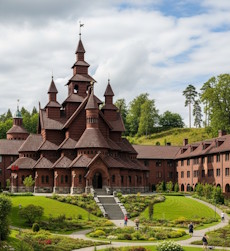
Ferna Sed monastery
Catholic monastic orders
Nearly all important Catholic monastic orders, chivalric orders and congregations in Friland belong to the traditions of the Augustinians (Augustinars), Benedictines (Benediktars), Cistercians (Sitauwars), Dominicans (Dominikars), Franciscans (Fransars), Carmelites (Karmelars) or Carthusians (Kartusars).
Monks (munikan) and nuns (munikinan) are addressed as brother (broþar) or sister (swestar). They have taken vows of obedience, chastity, and poverty, are bound by their monastic rules, and form a living community; the monastery (munistar or sundarhuf), which is led by a prior/prioress (airista/airistin). If the monastery is part of a larger complex, it is called an abbey (abodai), led by an abbot/abbess (abod/abodin). As part of a chivalric order it is called a commandery (komturai), led by a commander (komtur). A congregation is called dagung. Believers who do not hold a religious office are called laikman/laikfro (layman/laywoman). Along with monks and nuns, they form an important part of the monastic community.
Catholic monasteries
Below is a selection of the largest Catholic monasteries in Friland:
Baiþilsundarhuf
Bethel Monastery
|
Augustinian men's monastery in Friburg (Walamark).
|
Beþangardabodai
Bethany Abbey
|
Carthusian women's abbey in Twaibak (Medga).
|
Beþlahaimdagung
Bethlehem Congregation
|
Dominican women's congregation in Welmar (Langmark).
|
Wi-Brigiþssundarhuf
Saint Brigid's Monastery
|
Carmelite men's monastery in Irglanad (Walamark).
|
Wi-Frans fan Asisdagung
Congregation of Saint Francis of Assisi
|
Franciscan women's congregation in Tillau (Walamark).
|
Galeilaiadagung
Galilee Congregation
|
Dominican men's congregation in Dunwik (Sunþga).
|
Gaulgauþadagung
Golgotha Congregation
|
Carmelite women's congregation in Herutlau (Walamark).
|
Jairikdagung
Jericho Congregation
|
Augustinian women's congregation in Isarnhaim (Nurþland).
|
Jairusalhaimsundarhuf
Jerusalem Monastery
|
Dominican men's monastery in Glantfurd (Berglaft).
|
Wi-Johansabodai
Saint John's Abbey
|
Benedictine women's abbey in Glitstad (Skak).
|
Wi-Jorgskomturai
Commandery of Saint George
|
Franciscan men's monastery in Spirdung (Walamark). Originally a men's commandery of the Jorgsridars, who were destroyed in 1580. The name "commandery" has since become incorrect, but was so common that it has been retained in common parlance.
|
Nazaraiþsdagung
Nazareth Congregation
|
Franciscan women's congregation in Isungan (Sunþga). The Sisters of St. Francis are mainly concerned with the nursing of the sick.
|
Oleibasbergabodai
Abbey of the Mount of Olives
|
Cistercian men's abbey in Westarwariþ (Skak).
|
Wi-Paulsabodai
Saint Paul's Abbey
|
Benedictine men's abbey in Arnstad (Sunþga).
|
Penuwelabodai
Penuel Abbey
|
Carthusian men's abbey in Waiþburg (Walamark).
|
Wi-Petarsabodai
Saint Peter's Abbey
|
Benedictine men's abbey in Bergan (Langmark).
|
Ristsundarhuf
Monastery of the Resurrection
|
Carmelite women's monastery in Gennung (Berglaft).
|
Saraiptadagung
Sarepta Congregation
|
Augustinian women's congregation in Erlanhuf (Nurþland).
|
Sijonbergabodai
Mount Zion Abbey
|
Cistercian men's abbey in Mihstskog (Medga). Mihstskog Trappist beer is brewed here.
|
Sinawibergabodai
Mount Sinai Abbey
|
Cistercian women's abbey in Jerna (Langmark).
|
Waldmerskirikabodai
Waldemar Church Abbey
|
Carthusian men's abbey in Herutlau (Walamark).
|
Hiveria
Catholic monastic orders
Just like in Friland, nearly all important Catholic monastic orders, chivalric orders and congregations in Hiveria belong to the traditions of the Augustinians (Augustins), Benedictines (Bénédictins), Cistercians (Cisterciens), Dominicans (Dominicains), Franciscans (Franciscains), Carmelites (Carmes/Carmélites) or Carthusians (Chartreux).
Monks (moines) and nuns (nonnes) are addressed as brother (frère) or sister (sœur). They have taken vows of obedience, chastity, and poverty, are bound by their monastic rules, and form a living community; the monastery (monastère), which is led by a prior/prioress (prieur/prieure). If the monastery is part of a larger complex, it is called an abbey (abbaye), led by an abbot/abbess (abbé/abbesse). As part of a chivalric order it is called a commandery (commanderie), led by a commander (commandeur). A congregation is called congrégation. Believers who do not hold a religious office are called laïc (layman). Along with monks and nuns, they form an important part of the monastic community.
Catholic monasteries
Below is a selection of the largest Catholic monasteries in Hiveria:
Congrégation de Anselme de Cantorbéry
Congregation of Anselm of Canterbury
|
Benedictine men's congregation in Le Moulin (Heunia).
|
Monastère de l'Apôtre Saint Pierre
Monastery of Saint Peter the Apostle
|
Dominican men's monastery in Hameau (Danab).
|
Monastère de Bethléem
Bethlehem Monastery
|
Augustinian women's monastery in Loger Blanc (Solaria).
|
Abbaye de Châteaubrille
Châteaubrille Abbey
|
Carthusian men's abbey in Châteaubrille (Heunia).
|
Congrégation de Claire de Montfaucon
Congregation of Clare of Montefalco
|
Augustinian women's congregation in Paître (Heunia).
|
Monastère de Saint Dominique
Monastery of Saint Dominic
|
Dominican men's monastery in Casouar (Esrayette).
|
Monastère de Saint Étienne
Saint Stephen's Monastery
|
Augustinian men's monastery in Brillant (Danab).
|
Monastère de Saint François d'Assise
Monastery of Saint Francis of Assisi
|
Franciscan men's monastery in St. Gérard (Heunia). Today, only the church building remains of the medieval monastery. The monks live in several apartments spread across the Valmoulin district.
|
Abbaye de Grionne
Grionne Abbey
|
Cistercian women's abbey in Grionne (Heunia).
|
Abbaye Saint-Jean-Baptiste
Abbey of Saint John the Baptist
|
Benedictine men's abbey in Hautville (Solaria).
|
Congrégation de Jérusalem
Congregation of Jerusalem
|
Franciscan women's congregation in Lapider Peu (Heunia).
|
Congrégation du Jourdain
Congregation of the Jordan
|
Dominican women's congregation in Pierrecité (Solaria).
|
Commanderie de la Sainte Lance
Commandery of the Holy Lance
|
Chevaliers de Boniface men's commandery in La Rade (Heunia).
|
Abbaye de Lasieux
Lasieux Abbey
|
Cistercian women's abbey in Lasieux (Danab).
|
Commanderie du Lion d'Afrique
Commandery of the African Lion
|
Chevaliers de Boniface men's commandery in Port Gaudin (Esrayette).
|
Abbaye de Louisville
Louisville Abbey
|
Carthusian women's abbey in Louisville (Heunia).
|
Monastère de Saint Martin de Tours
Monastery of Saint Martin of Tours
|
Carmelite men's monastery in Valtrois (Danab).
|
Congrégation du Mont Scopus
Congregation of Mount Scopus
|
Franciscan men's congregation in Abri-sur-Côte (Heunia).
|
Monastère de Pater Noster
Monastery of the Pater Noster
|
Carmelite women's monastery in Parfleur (Danab).
|
Abbaye de Petit Colline
Petit Colline Abbey
|
Cistercian women's abbey in Petit Colline (Solaria).
|
Congrégation de Robert de Turlande
Congregation of Robert de Turlande
|
Benedictine women's congregation in Barrage (Heunia).
|
Abbaye de Solaria
Solaria Abbey
|
Benedictine men's abbey in Solaria (Solaria).
|
Congrégation de Thomas de Villeneuve
Congregation of Thomas of Villanova
|
Augustinian men's congregation in Brécy (Heunia).
|
Abbaye de Valaise
Valaise Abbey
|
Carthusian men's abbey in Valaise (Danab). Valaise abbey beer is brewed here.
|
Monastère de Vetillan
Monastery of Vetillan
|
Carmelite women's monastery in Port Gaudin (Esrayette).
|

|