1. Public disinformation - what the public was shown
Some two and a half hours after the incident, at 24:00, on its midnight news bulletin Kol Israel - The Voice of Israel - radio made the following announcement (verbatim):
�Prime Minister Yitzhak Rabin was assassinated tonight in Tel Aviv by a gunman at the conclusion of a rally in support of the government and its peace policy which took place in "Malchei Yisrael" Square. A lone assassin shot him at close range as he was waiting to enter his car. One of the bullets fired struck the Prime Minister in the chest and two additional bullets struck and wounded the head of Mr. Rabin's bodyguard detail�.
This news item was never repeated again. What is of interest is the fact that the announcement was made before both the Ichilov hospital's director, Dr. Gabriel (Gabbi) Barabash and the Health Minister, Dr. Ephraim Sneh, made their public announcements on TV. How could the radio station know that Rabin was already dead and that he had been hit by one bullet, while his bodyguard was wounded by two?
*
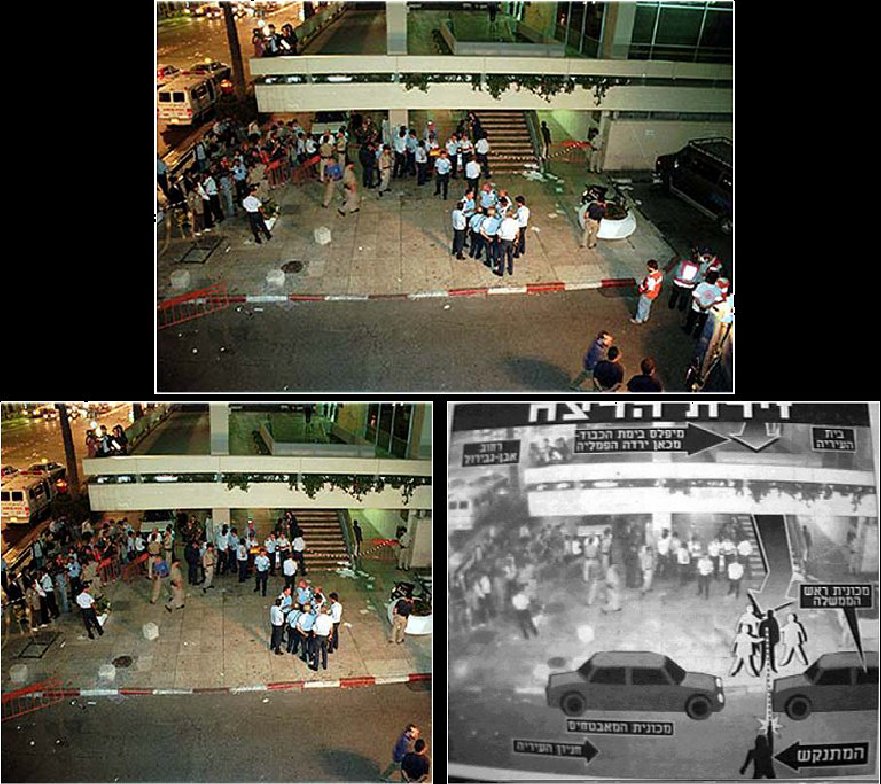
Following Rabin's assassination on 4th November 1995, two of the three wide circulation papers in Israel - Ma'ariv and Yediot Achronot - published their pictorial versions of the incident. Ma'ariv did so a day or two later while Yediot Achronot published a month later the still from Ronnie Kempler's video. The two versions were widely different. A closer evaluation of the material available within the public domain, including footage from Kempler's video (by then co-owned by Yediot Achronot and TV Channel 2), appears to prove that the two versions were not only different, but wrong as well. If that's the case, it appears that for some reason(s) the media had portrayed the event in a misleading manner.
Maariv printed its depiction of events based on its reporter on the scene. On a police photograph, taken some hours after the incident, the paper diagrammed its own version.
Above: the police photo of the
crime scene after the event. Below right: Maariv�s reconstruction
of the crime scene. It has the shooter firing across the narrow road, from the
front!
It
never
happened that way of course. A day later the newspaper had a similar diagram
published,
only this time the shooter was placed �correctly� near the place Amir stood.
Yediot Achronot front page still was published precisely on the day that Amir�s trial had opened in Tel Aviv and observers concluded that such a �coincidence� was contrived to remind the public who the murderer is.
Nathan Gefen analysed the video frames before, during and after Amir is seen shooting. Some of his conclusions appear to be correct. For example, the video clearly shows that after Amir fired, Rabin instantly and instinctively turns his head to his left, to the source of the noise. Far from being jolted forward, as it would be expected by the impact of a close-range 9mm hollowpoint bullet hitting him in the back, Rabin appears to actually hear the noise and turns to see where it came from. Judging by the number of frames between the gun flash and Rabin starting to turn his head to the left, the elapsed time is 0.26 of a second. The average reaction time however, of healthy, young person to the noise of a gunshot is 0.75 of a second. Rabin was 73 years old and possibly his reaction time could have been slower than that of an average young man. The fact that he reacted in a third of a time it takes such an average person to do so indicates to Gefen that some frames were missing, in other words, cut out of the video before it was screened to the public.
According to the calculations of a physicist who had served in the past with the Israeli Police National Criminal Laboratory, the luminosity of a gun flash is equal to that of a standard domestic bulb. That means that if Amir had fired real bullets, at the moment of shooting his gun and hand, as well as the surrounding area - and Rabin's back! - should have been visibly illuminated on the video. But no such phenomenon occurs, the surrounding area remain as dark during the flash as before and after.
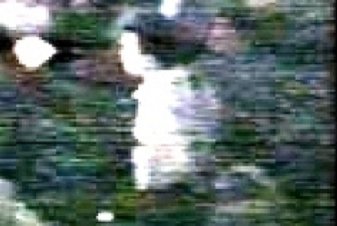
Gefen also compares the still published on the front page of Yediot Achronot and the same frame from the video. He concludes that the front page still had been tampered with and that the two don�t match. Barry Chamish also commented on the abnormally long arm Amir seems to possess on the front page and the fact that he is seen firing with his left hand. Gefen could not duplicate the �enhancements� visible on the front page still and apply then to the video frame. Despite various computer techniques employed, the video frame remained dark and did not reveal Amir�s arm or gun (visible in the newspaper photo) nor did it reveal Amir himself.
It has been nevertheless possible to enhance the video frame with some remarkable results. With the aide of computer technology and some patience it is possible to extract more details from the video frames. Starting with the still published on the front page, the photo was first analyzed for correct geometry. Newspaper pages tend to deform and slightly stretch one way or another during the printing and cutting run. Also, the Yediot Achronot still seemed to be a somewhat cropped version of the frozen video frame and therefore both images were checked to contain the same information, especially at their peripheries. Here is the front page again, enlarged, in black and white. Some of the digital processing involved included turning both frames into B/W (grayscale actually) in order to analyze differences.
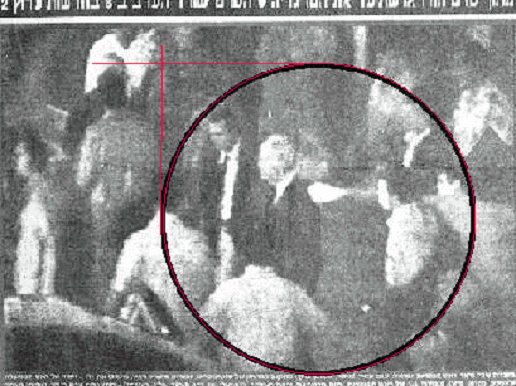
1. Yediot Achronot still is
first checked for geometrical accuracy. The original
printed still is tilted left by several pixels. The xy ratio is 1.465:1.
As Chamish
and others pointed out, Amir does appear to fire with his left arm.
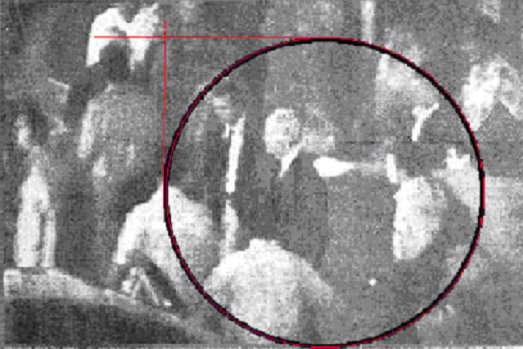
2. Tilt corrected. The xy ratio now is 1.33:1, identical to the video frame below.
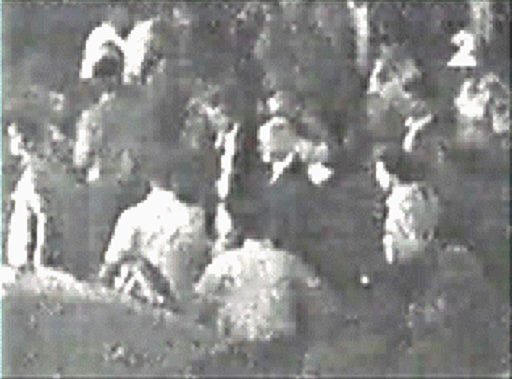
3. The video
frame with it�s xy ratio of 1.33. The two photos also need to be scaled
to the same size. When so done, the still showed that it was heavily
cropped top and bottom.
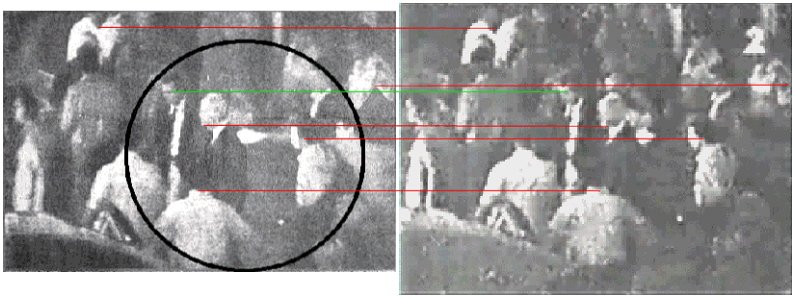
4. The
front page still on the left. To ensure that both photos are geometrically
identical and of equal size,
identical reference points in both are checked horizontally (in red). The same
could be done vertically
too, but that is less consequential. (The green line � the eye line of Rabin�s
chief bodyguard Yoram
Rubin � is the initial reference point to which both photos were first aligned).
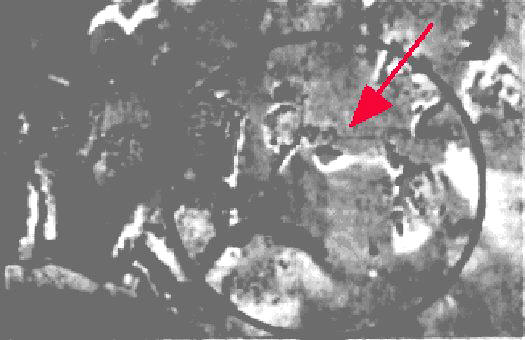
5.
In the next step the video frame was turned into negative, after both stills
were
deliberately turned BW (grayscale). The video frame was then aligned on top
of the still and superimposed onto it. The black stain over the white gun flash
is the inverted video frame flash. The two flashes clearly differ in size and
shape. Note: if both photos included precisely the same amount and shades
of gray, this technique would result in the entire �disappearance� of both
photos � save the black circle and flash area � as the positive and negative
pixels would cancel each other out. But the two pictures do not contain the
same amount nor the same shades of gray, thus some content is still visible.
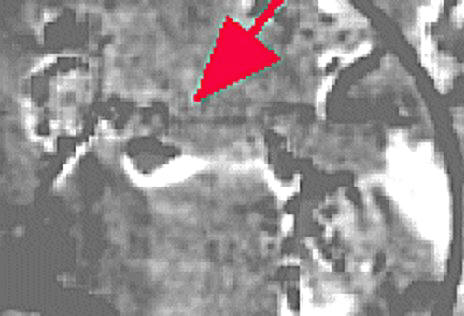
6. The same flash as above, enlarged.
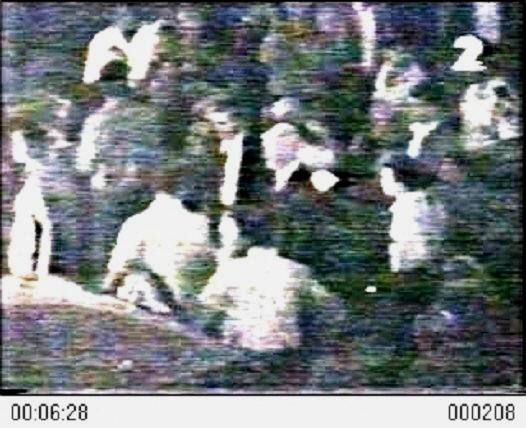
7.
Frame 208 at timing 00:06:28 from the video. Timing here is not
relative to real time, but a clock reference generated by the digitizing
software; it indicates elapsed time between frames. The photo has
been computer enhanced by increasing color saturation and by
subtracting selected shades of gray. Traces of the colored video,
normally masked by the poor lighting conditions, become visible.
Suddenly Amir�s body outline becomes more discernable.
8. Section of the frame above, enlarged.
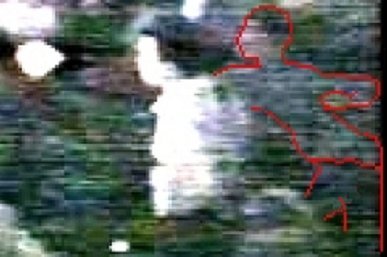
9.
Same enlargement as above. Amir�s body outlined in red.
So delineated, Amir appears to lean forward in a natural
shooting posture for a right-handed man, holding the gun
with his right.
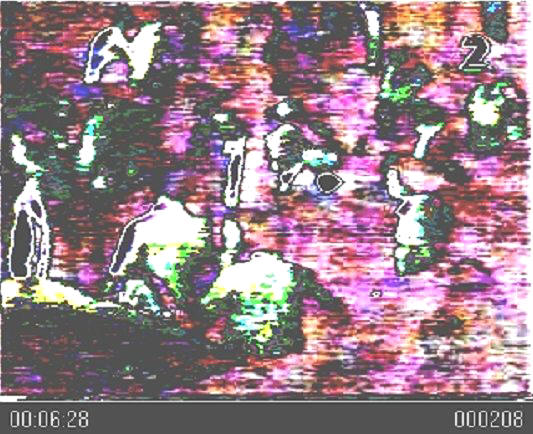
10.
Same frame (208 at 00:06:28), enhanced with a different technique
to reveal different details. The gun flash appears as a dark spot.
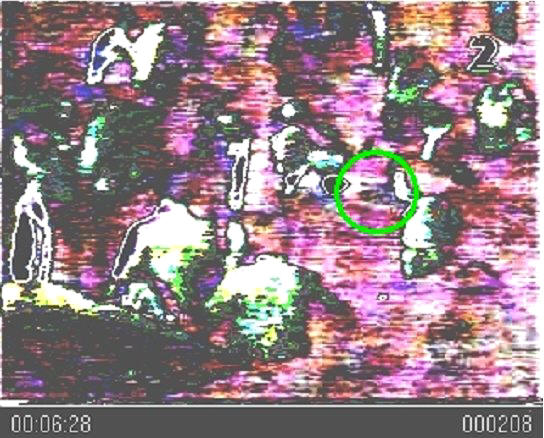
11. Benefits of this
technique: Amir�s gun becomes visible (green circle). Yet, as
stated before, the surrounding area is not illuminated with an intensity
equal
to that of a light bulb. From the various enhancements of frame 208, the
firing range � barrel muzzle to Rabin�s back � appears to be c.30cm.
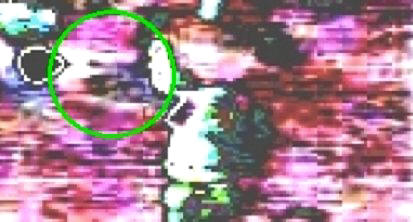
12. Section of the frame above, enlarged.
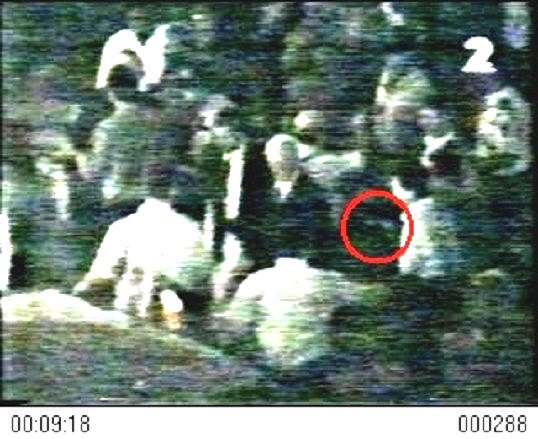
13. Frame 288 at
timing 00:09:18 from the video after the first shot
was fired. Amir drops the gun lower, though still perpendicular to
the ground as in frame 208. Rabin starts turning his head to the left,
to the source of noise, as the entire sequence on video shows. Yoram
Rubin, the PM�s bodyguard still walks beside Rabin and to his right.
No attempt is seen by him to jump on the PM or otherwise to protect
him as he later testified that he did. No reaction discernable from any
other security officer to pound Amir.
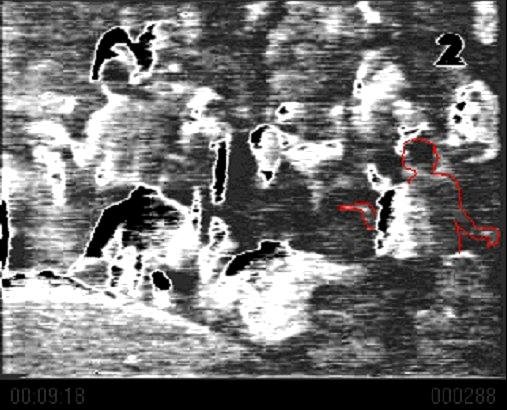
14. Same frame as above,
negative and gray shades subtraction.
Amir�s gun visible, as is his body (both outlined in red). He stands
up, gun is dropped lower, Rabin�s head turning left.
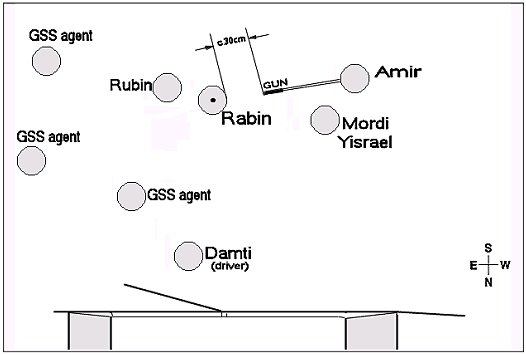
Diagrammatic depiction of approximate location of individuals at the moment of shooting.
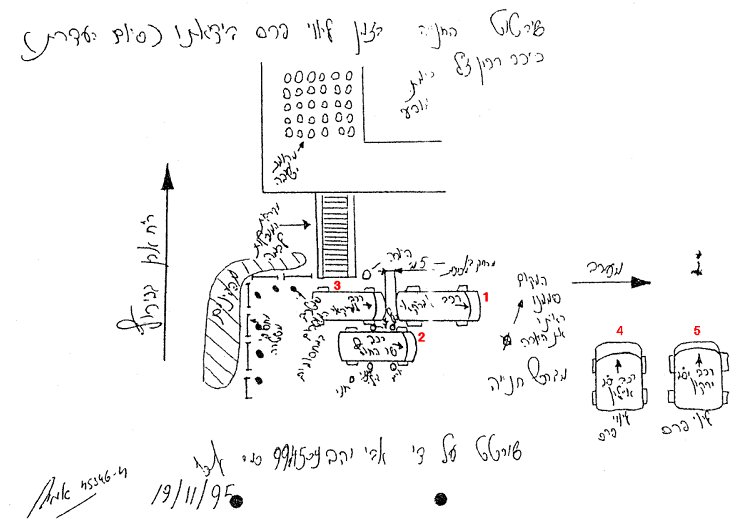
Diagram drawn by police officer
Avi Yahav, depicting the moment of Peres� departure.
The depiction is inaccurate. The staircase location relative to cars 1 & 3
is incorrect and
it
doesn�t stretch to the end of the sidewalk; the two vans (4 & 5) noted as
Foreign
Minister
escort vehicles � 4 is an ambulance in fact, albeit designated as
command
vehicle;
Peres� car (2) was never
parked parallel to Rabin�s car (1) and it�s GSS
escort (3)
behind - but in front
of both, all three facing westward; distance between
cars 1 & 3
(Rabin�s
and the GSS� isn�t 5m, more like 1.5-2m ( diagram appeared on back cover
of Fatal
Sting by Nathan Gefen).
2. Public disinformation - what the public was not shown
When a pistol is fired - such as Yigal Amir's 9mm Beretta, gunpowder residue is always found on the hand that held the gun and fired. Residue gun powder escapes through the ejection window and from the muzzle and dissipate in all directions. Unless the shooter uses gloves - and Amir didn't - gun powder will be found on his hand.
About half an hour after the incident, Amir's hand was inspected and tested for gun powder residue by an officer equipped with the necessary kit. These were the findings:
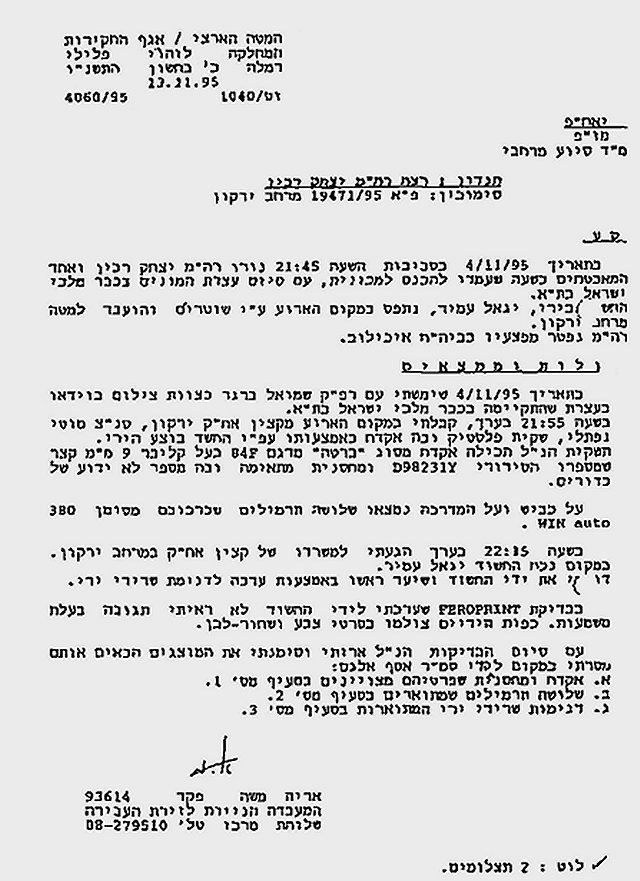
Dept. of Criminal Identification - Ramle 13/11/95
Subject: Murder Of Prime Minister Yitzhak Rabin
Background: On 4/11/95, around 21:45, Prime Minister Rabin and one of his bodyguards were shot while about to enter their vehicle at the end of a rally in Kings Of Israel Square. A suspected shooter, Yigal Amir, was caught by police and transferred to the Yarkon Division police station. The prime minister died of his wounds at Ichilov Hospital.
Test Results: On 4/11/95 I was part of a video crew led by Superintendent Shmuel Berger at a rally in the Kings of Israel Square. At approximately 21:55 I was given a plastic bag with a pistol inside, suspected of being used in a shooting, by Deputy Superintendent Moti Naftali. The pistol was a model 84F Beretta, serial number D98231Y that utilized short 9 mm bullets, which included a clip with an undetermined number of bullets within.
On the street and sidewalk, three 380 WIN Auto cartridges were found.
At 22:15 approximately, I arrived at the office of the commander of the Yarkon Division police station. The suspect Yigal Amir was present. I checked samples from his hands and hair with the firing residue sampling kit.
I could find no significant results from the Feroprint examination that I undertook of the suspect's hands. His palms were photographed with a BW film.
On completion of the check I packed and tagged the following items which I gave on the spot to Sargent Major Asaf Elbaz�..
Detective Arieh Moshe 93614
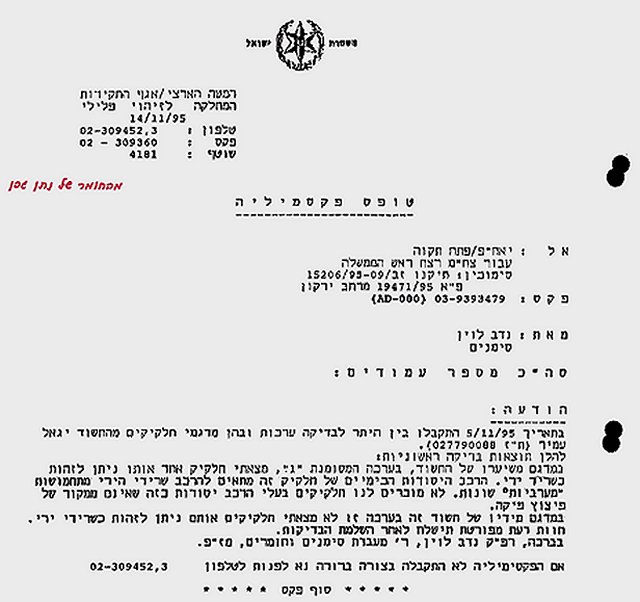
Israel Police Headquarters/Investigations Division
Dept. Of Criminal Identification
Written by Nadav Levine - Trace Evidence
On 5/11/95 I received evidence for testing, including samples taken from the murder suspect Yigal Amir, (identity number 027790088).
Here are the initial test results:
In the suspect's hair sample, I found one particle that could be identified as a gunshot remain. We are unaware of any similar compound not used in the explosion of cap primers.
In the sample from the suspects hands, I found no particles which that could be identified as gunshot residue.
Detective Nadav Levine, Trace Materials Laboratory
Two astonishing documents then, produced by the Israeli police. On Feroprint test there were no significant results while the Trace Materials Laboratory found one particle in Amir's hair that could be identified as a gunshot residue. None was found on Amir's hands. Yet Amir is supposed to have fired live shells three times. One would expect that the Shamgar Commission of Inquiry and Amir's three judges at his trial would be at least surprised at these findings - or rather lack of them.
They were not. This evidence was never presented to court. Nor to the public.
"On 4/11/95 I was part of a video crew led by
Superintendent Shmuel Berger at a rally in the Kings of Israel Square". -
Detective Arieh Moshe 93614
It seems that the police itself had video taped the event. This is standard police procedure in mass demonstrations. The police video however, was never shown to the public.
IF YOU HAVE ANY
INFO PLEASE
SEND YOUR COMMENTS
