Introduction
What went wrong at the peace rally in Tel Aviv? The answer of course depends on who is asking it. Some elements within the security services no doubt know what happened and from their point of view nothing actually went wrong. The majority though can justifiably pose the question.
The security operation in and around the peace rally was codenamed Operation Sunshine by the GSS. Despite the fact that for many it really turned into 'operation sunset' the irony, and possibly the contrived choice of name, should not be lost on the reader. The original Operation Sunshine took place over 35 years previously and was carried out by the world's first nuclear-powered submarine, the USS Nautilus. The submarine's nuclear plant enabled the boat to remain submerged for weeks, even for months. In Operation Sunshine in 1958, Nautilus demonstrated her capabilities when she daringly sailed beneath the Arctic icepack to the North Pole, emerging on the other side and broadcasting in the process the famous message "Nautilus 90 North". The original Operation Sunshine was a deep water, covert journey carried out undetected at great depth. Much like 'Champagne'.
*
On the night of November 4, 1995 some shots were heard at the end of a mass rally held in the Kings of Israel square in Tel Aviv. The electronic media announced that Prime Minister Yitzhak Rabin had been taken to Ichilov hospital with serious gunshot wounds. About two hours later the PM Defence Ministry office director Eitan Haber faced TV cameras to officially announce the death of Yitzhak Rabin. The suspect was apprehended on site by the police. He was a young, Yemenite law student from Herzlya, a small town just north of Tel Aviv. His name was Yigal Amir.
Since that grim evening, a number of people and astute investigators went on to research everything that was known and less known in the Rabin affair. Two of the most prominent ones are undoubtedly Barry Chamish and Nathan Gefen. Both published their findings in their respective books Who Murdered Yitzhak Rabin and Fatal Sting. Chamish�s book was subsequently the case of a lawsuit against Labour MK Ofer Pines who called it a pack of lies. The book was temporarily banned from sale in some book shops at Pines' request. Both researchers sport their own individual styles. Journalist Chamish tends to ask probing questions and to be more florid in his descriptions, albeit amassing an impressive amount of data. His research is wider in scope than Gefen�s, a former IT man, who sticks to the assassination incident and to facts. But Gefen is equally impressive and in some cases perhaps more, in the quality of the material that he had managed to collect independently, through his research.
Both authors make the point that political assassinations usually follow rules of their own. For one, if the assassins escape alive � that is, they are not shot on sight by the security entourage - they try to escape. When they do so, it is usually discovered that an escape plan was envisaged beforehand including means, routes, destination and then activated. Sometime these escape plans are found to be very elaborate and to include several alternative routes and destinations. Regardless of the emotional state in which the assassin is at the moment of shooting, there is usually some logic to be found in the preparations for the murder attempt and in the evasion plan (if successful).
If, however, the murderer is caught, as was the case in the two Kennedy assassinations and in the attempt to shoot Ronald Reagan, the perpetrator usually display a high level of emotions, is highly animated, verbose and on occasion denying, at least initially, the actions attributed to him (Oswald).
Political assassinations are usually motivated either by the perpetrator�s personal vengeance against a particular political figure, or his desire to change by means of murder the political agenda or course of events.
Rabin�s assassination did not follow any of the known, or expected, rules. When Yigal Amir was apprehended he manifested none of the emotional turmoil associated with a man who had just shot another. In fact he appeared quite cool and collected; he made no attempt to escape from the scene; he denied none of the facts but surprisingly, he did show some surprise at being arrested.
Amir had acted in full view of the GSS (Shabak) security detail, which included the PM�s bodyguards, special anti-terror police units (Yasam) and police officers, not to mention a large crowd of onlookers. Despite the large number of the well-trained security people around, Amir wasn�t shot on sight but apprehended and arrested instead. Apart from this deviation from security norms, a chain of unexplained events started to unfold from that moment on that haven�t yet been explained away, not by the almost instantly-appointed Shamgar Commission of Inquiry into the murder, not by the trial of Yigal Amir himself, nor by anyone else throughout the intervening years. Probably the first Israeli to point out the how senseless and inexplicable was the murder, was the Tel Aviv university historian, Michael Har-Segor, who hinted at the security service complicity in the act.
The various units on the scene belong to well established security arms in Israel. On the night there were about twenty security agents in the area while the personal security detail in charge of the PM�s safety, commanded on the night by Yoram Rubin, included seven agents. They all belong to the VIP Protection section/unit of the General Security Service (GSS) or Sherut Bitachon Klali (the Shabak). The GSS is Israel�s domestic security service dealing with internal espionage and intelligence, akin to the FBI in the USA or the MI-5 in England. The Special Anti-terror Unit (Yasam) is a police force which deals with special, often armed, operations. The GSS is recognised both internally and worldwide as a highly trained, efficient and successful service. Similarly, the Yasam is a highly trained police unit, usually employed in special domestic security operations.
So the first question must be: why did these highly trained and efficient security forces fail to fulfil their duty for which (as we shall learn later) they constantly train for, and that is to shoot on sight anyone who manages to aim at, or shoot, the PM?
Amir was a third year law student at Bar-Ilan university, an intelligent and articulate young man. It is therefore improbable, despite his later admission during interrogation, that he hoped to stop a political process (the peace process that followed the Oslo accords) by eliminating or incapacitating the PM. Like most citizens in Israel and many abroad, he must have known that by killing or otherwise injuring Rabin, an equally if not a bigger and more ardent advocate of the peace process than Rabin - the cabinet�s Vice Prime Minister and Foreign Minister Shimon Peres - will become the automatic leader of the government, at least until the nearest elections. Amir would thus have achieved nothing by incapacitating Rabin.
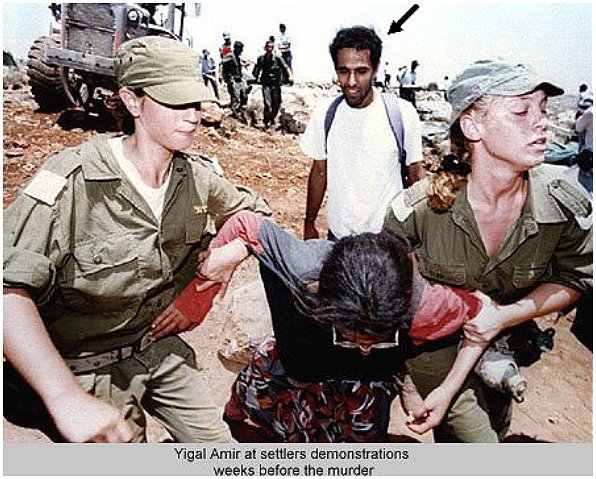 Nathan Gefen rightly points
out in his book Fatal Sting that political assassins do not tend to expose
themselves to the media prior to their attempt to commit the murder. Yet Amir
had done precisely so on numerous occasions before the November 4. He was seen
and photographed at numerous rallies and demonstrations together with other
students and West-Bank settlers, protesting against the peace process and the
government�s policies. It was not a particular safe way, to say the least, to
preserve his anonymity and increase his chances of success on the night of the
murder, yet none of his earlier media exposure seems to have hindered his
success.
Nathan Gefen rightly points
out in his book Fatal Sting that political assassins do not tend to expose
themselves to the media prior to their attempt to commit the murder. Yet Amir
had done precisely so on numerous occasions before the November 4. He was seen
and photographed at numerous rallies and demonstrations together with other
students and West-Bank settlers, protesting against the peace process and the
government�s policies. It was not a particular safe way, to say the least, to
preserve his anonymity and increase his chances of success on the night of the
murder, yet none of his earlier media exposure seems to have hindered his
success.
Immediately after the murder, the GSS had descended on Amir parents� home in Herzlya, where the suspect was living together with his brother Hagai. According to all media reports, a large cache of ammunition was found hidden in the house which included several guns and a large quantity of bullets, mostly stolen from the army. Many wondered if it is conceivable that a would-be assassin of the prime minister would keep at home such an incriminating arsenal of weapons, the first place the police is likely to search after the event. As we shall see, the man who was supposed to have supplied the brothers with this weaponry had allegedly done the only logical thing - he got rid of his arsenal of weapons as soon as possible.
Having apparently breached all rules commonly found in other political murders, it becomes clear that Amir�s actions may be explained, if at all, by abandoning accepted wisdom and rely instead on a religious background. (It is an alluring option, but this line of reasoning can be meaningful only to believers to whom God�s impositions are final and irrevocable; the law however, does not distinguish between those who do and those who don�t.) Yet even if Amir had supposedly acted out of religious convictions, he failed to follow recognized patterns set by other fanatical assassins. Those who act out of fanaticism have typically no regard for their own wellbeing or their own life - the aim of their actions is the first and only priority. Amir was uncharacteristically careful, as he testified, to immediately drop the gun after he had fired for fear that he might be himself shot by the security guards. Nor did he entertain the idea of spending his whole life in jail, as he told the prosecutor at his trial: "I'll be out of here well before I'm forty".
Yigal Amir wasn't a common political assassin nor a typical religiously-motivated one. The whole assassination did not fit the usual patterns, all of which caused the Shamgar Commission as well as the judges at Amir's trial considerable anxiety and had pushed them to extraordinary feats of mental gymnastics in order to reconcile contradicting evidence. Facts were 'stretched' or bent; evidence that could not be explained was discarded; normal judicial procedures were either overlooked, distorted or denied; some of the trial was conducted behind closed doors; almost a third of the Shamgar Commission report remains secret to this day.
Most of the contradicting evidence in this case will be re-examined in the following pages and some additional information will be revealed. All the accumulated research and known facts point to that Yigal Amir wasn't a common political assassin nor a religiously-motivated one - because, it would appear, he wasn't an assassin at all.
IF YOU
HAVE ANY INFO PLEASE
SEND YOUR COMMENTS
