 Fischer:
Can the VIP Security Unit pick itself up after the failure to protect Rabin?
Fischer:
Can the VIP Security Unit pick itself up after the failure to protect Rabin?The Shabak - GSS
Operation Sunshine - The assassination. prima facie
On November 4th of 1995, one of the biggest demonstrations in Israel�s history took place at the Malchei Yisrael [now Rabin] Square in Tel Aviv. More than 100,000 people attended the event. Prime Minister Rabin and Foreign Minister Peres stood in the gallery which was part of a municipal building at the Malchei Yisrael Square. Their limousines were parked in a blind side street behind the municipal building. More than 1,000 security personnel were deployed for the protection of the event. They included at least 20 GSS agents from the service's VIP security unit, hundred of police officers, special Yasam combatants and Police Border fighter soldiers. Several private security agencies were also employed, to supply additional security manpower. Counter sniper teams took positions on roofs, and hundreds of apartments around the square were controlled - some were vacated by its inhabitants. Roofs were illuminated and parking and traffic bans were imposed. Road blocks have been erected within a wide radius.
At 5:45 pm, Amir allegedly loaded his handgun with hollow point bullets and went by public bus to the Malchei Yisrael Square. There, he apparently passed himself off as a VIP Driver and waited unimpeded by any security officer near Rabin�s limousine. At 9:40 pm, Rabin went downstairs from the gallery to his car. At the moment when Rabin was two meters from his limousine, Amir apparently shot three times. Rabin was hit by two bullets to his thorax and abdomen. The leader of his protection detail Yoram Rubin was shot in the arm. During the struggle someone, or several people, shouted �They are only blank, it is an exercise!� and "It's a toy gun". The wounded Rubin pulled Rabin into the limo and the driver drove to a hospital while Amir was arrested by security officers. At 11:10 pm, Rabin�s chief of staff announced the death of the Prime Minister to the public.
It would appear that while there were extensive and strict security measures elsewhere, security around the back stairs to the gallery of the municipal building was inexplicably lax. According to the original operational plan, Rabin was supposed get out of the limo behind the municipal building, then go inside the building via a back door and to the first floor. From there he was to continue inside the building on a secured route which was inaccessible to the public, out to the gallery (located at first floor level) without using the stairs outside. Significantly, it was also planned that Rabin should leave the gallery after the event to get back to his car by the same route! Had this original plan been applied, the Prime Minister would have walked only about two meters to his car, unexposed to the crowd gathering at the top of the street, some 20-30 meters away. The area could have been secured easier and the limo could have been parked just in front of the entrance through which he came in. For unknown reasons, this good planning with its advantages was not applied. Gaps in the security system made the assassination attempt possible. Fifteen minutes before the end of the event, a member of the VIP protection unit controlled the security measures at the stairs to the gallery and the sterile area where the limo was parked. Discovering that contrary to the plan the area around the limo was not secured by the GSS, he ordered police officers to secure the area. Amir of course was already lingering inside the sterile area near the limo and had been there for over half an hour. A police officer asked him why he was there and Amir pretended to be a VIP driver who was supplementary ordered but nobody bothered to check if this was true. Thus, the end of the event Rabin�s protection bodyguards believed that, according to the plan, the area from the stairs to the limousine would be free from unauthorized people and would be under the GSS control. In reality it was the police that was ordered to take the area under its control. By the time Rabin�s personal protection detail was informed by radio that the area was not controlled by the GSS but by police, The PM was already on his way down.
Although the gallery of the municipal building has no direct access from the Malchei Yisrael Square (save a front staircase which was blocked on the night), all the while Rabin stood up there he was exposed to a sniper attack. Bodyguards could well have felt relief when the rally was over without an incident and wanted to get him out quickly after the public function. (Yet misplaced relief have been proved to be counterproductive since many attempts on politicians in the past had occurred precisely at this point - President Reagan, German Minister Schauble, Lafontaine, etc.). When Rabin started exiting the gallery, police officers in the strile area around Rabin�s car had not been informed that Rabin was en route to his car. They formed no security corridor from the end of the stairs to the car.
The side road on which Rabin�s limo was parked is very blind and insufficiently illuminated, contrary to standard operating procedures. At the moment when Rabin was two meters from his car, a police officer stood one arm length inside, behind Rabin [detailed later in a photo]. Yoram Rubin walked beside Rabin to his left, and another agent was about one and a half meters inside, right behind him. Two additional agents, part of the inner protection circle, removed themselves too soon from Rabin and one rear agent is seen stopping in his track, opening a wide gap to the PM. It was at this moment that Amir approached from the back and fired through the opened gap. When he was nearly between the back side police officer and the close protection officer, he shot at Rabin. At this moment, he was one and a half meters from Rabin, and the muzzle of his handgun was just 60 cm away from Rabin�s back.
After he fired his gun - and far from being shot on sight by the bodyguards - Amir was apprehended by the police, wrestled to the ground, immobilized and arrested. It would appear that after the event many claimed the honor of having disarmed the shooter and overpowered him into submission. Note that Amir made no attempt to escape or otherwise show any resistance to being manhandled. In fact he specifically stated that after he fired the gun, he let it drop to the ground so that the bodyguards would not shoot him (not that this detail matters, since according to their rehearsed routine and standing procedure they should have shot him in any case). Unusually, his first words to the police after he�d been arrested were: �Why do you arrest me, I did my bit, now do yours�. Equally unusually, policemen asked Amir several times: �Did you fire blanks?
This is some of the evidence given by the security personnel quoted in the Israeli weekend magazine �Sof-Shavua�. Three of the of the PM�s seven(!) men personal security detail, commanded by Yoram Rubin, gave their evidence to police Internal Security Unit officer Yoav Gazit on 16 and 17 November 1995, respectively.
S.N. (possibly S.G.) evidence: �I am a Defence Ministry employee. On 4.11.95 I was on duty. At the end of the rally, on the way out to the vehicles, I accompanied the PM, walking in front of him. When we approached the vehicle [car] I heard three shots, during which salvo I heard distinct shouts �Not real, not real�. I didn�t hear who shouted that, it was in the background, and it was very clear. During the salvo I jumped towards the PM and his personal bodyguard (Yoram Rubin). I didn�t hear any cry of pain from the PM or from his bodyguard and I didn�t notice any traces (signs) of blood. I and the personal bodyguard put the PM into his car and Rubin jumped with him inside and the car quickly exited the area. At this stage it wasn�t clear to me whether the PM or the bodyguard were hit or not�.
S.H. evidence: �I am a security man from the Prime Minister�s Office. On 4.11.95, when I was on duty at the peace rally at the then Kings of Israel Square, at approx. 21:45 the PM Mr. Rabin approached his vehicle. I stood behind the PM�s personal bodyguard Yoram Rubin, at a distance of approx. one and a half meters, when suddenly I heard one shot from my left side. I saw a dark haired young man, dressed in a blue shirt, slim, short, holding a black gun in his right(!) hand. There was another shot, I saw the muzzle blast from his gun as he fired into the PM�s back. Immediately I jumped on him, grabbing him by his neck (throat) and by his aiming hand, and while pulling him backward towards me, I floored him on the ground, while forcefully neutralizing him. I fell with him to the ground, and then additional forces of policemen and security men jumped on us. His neck was held by my arm and I prevented him from moving, and the others grabbed his hands and feet. We turned him around, me and the policemen, and one of the Yasam guys handcuffed him. I�d like to say that even before the stage when I neutralized him and people held him, I drew my gun and cocked it with the aid of the belt, because I feared that he might have additional weapons, and then the policeman handcuffed him. As to your question regarding the gun that the suspect held in his hand, I didn�t see what make it was, and when I wrestled with him and floored him, his gun wasn�t in his hand anymore, I�m certain that the gun fell.
Yoram Rubins evidence: �Approx. one 1.5-2 meters before the car I heard a shot from here, just behind and (from the) left. It was clear to me that it was a shot, I jumped on Yitzhak, caught him in a sort of fashion, I don�t remember, and we both fell on the ground.... When we were lying I heard another shot. Now people here say a quick salvo, I am certain that when I was on the ground there was another shot, therefore I don�t know how quick this salvo can be in this instance�.
The three security men in the immediate vicinity of the PM are all trained experts in fire arms. One of them heard one shot only, Yoram Rubin himself who stood closest to the PM, heard two shots (in this testimony, that is!) and a third guard heard three shots. Note that agent S.N. (S.G), the only one of the three who heard three shots, walked IN FRONT of the PM, thus he was the closest member of the unit to the car. We know the facts of the car�s 'magic' rear right door closed 'itself', as if someone already sat in the car and closed it from inside. Did S.N. (S.G.) hear a third shot coming from inside the car?
Note also that after the shooting all three bodyguards, according to their own evidence, take one and the same action: they jump. Agent S.N. (S.G.) must have turned around in order to jump, as he says, towards the PM and Rubin. Yoram Rubin himself jumps on Ytzhak. Agent A.H., who walked behind, jumps on Amir and wrestles him to the ground. None of them did what any security service is trained to do first and foremost - draw the gun and shoot the shooter. In fact it was Amir � himself trained at one stage in fire arms by the Shabak for a mission in Riga � who asked his interrogator this very puzzling question in order to prove that it was all a setup: �Why hadn�t any of the bodyguards shoot at me in order to save Rabin?� Recalling � rather belatedly � standard procedure, only agent S.H. makes a flimsy attempt to embellish his evidence with the fact that before he joined the �jumping� dance, he had drawn and cocked his gun. If it was in his hand, cocked and ready to shoot, why did he jump instead of fire? And with gun held in one hand how was he able to grab Amir with one arm by the neck and grab with the other hand Amir�s hand and immobilize it (�I prevented him from moving�)? No doubt, agent S.H. is a very able man. Beyond that, like his other mates, S.N. is also an agent who had failed his job - and a liar to boot. The Kempler video shows clearly that he didn't jump on Amir after the first shot. But when he told his story on 17 November he couldn't envisage that the videoed evidence would be made public three weeks later.
So they have all failed. Corroboration to this undisputed fact came from three retired GSS agents with much experience in the field. About a year and a half after the assassination, Anashim Magazine published an interview with two former officers of the Shabak's personal security unit, Tuvia Livneh and Israel Shai.
"For the first time since the assassination of Yitzhak Rabin, two former officers of the unit assigned to protect him are speaking out. They are aghast at the behaviour of their successors in the unit who failed to prevent the murder and the ease with which the assassin,Yigal Amir entered the sterile zone and shot at the former prime minister from arm's length. For the past seventeen months, not a day has passed when the thought does not occur to them that the murder wouldn't have happened had they not stood down."
�With us, Rabin wouldn't have been murdered,� says Tuvia Livneh. �When Israel and I heard the news of the murder we became infuriated at the fact that there was a contingency plan for just such an attempt which we practiced endless times�.
This is not a case of wisdom after the fact, but scandalous wisdom well before the event which is being published for the first time: when the two commanded the unit at the beginning of the 1990s, they prepared a detailed contingency plan for a political assassination at Kings of Israel Square, including the possibility that the assassin would act from the exit stairs behind the stage, precisely where Yigal Amir waited for Yitzhak Rabin. The plan was transferred to field command where it was practised in dry runs. [So much for Carmi Gillon's insistence that no contingency plan existed for an assassination attempt at Kings of Israel Square. An exact contingency plan existed, so exact in fact, that one wonders if it was used in reverse. Shabak officers had rehearsed an assassination attempt "endless times" at the precise spot Amir awaited Rabin. Not only were they not likely caught off guard, they were uniquely prepared to prevent the assassination... ].
What pains Livneh and Shai no less, is that Amir remained alive and well despite shooting three bullets in peace and quiet. A basic principle of theirs was that even if an anonymous killer penetrates the first line of defense and gets off a shot one way or another at the prime minister or anyone else, it will be his last shot. Immediately after Amir's first shot, the prime minister's bodyguards had to take two actions, both of which had been rehearsed an infinite number of times: first, the prime minister had to be covered by his guards' bodies and rushed away, second, the assassin had to be shot. Films of other political assassinations, for instance those of Ronald Reagan and Anwar Sadat showed that the bodyguards followed those rules, but in Israel, which is considered an exporter of top class security systems throughout the world, the killer managed to shoot the prime minister three times, one shot more damaging than the next, and he remained standing happily on his feet, alive throughout.
�For years you trained your people to kill the assassin but when the real thing happened, they didn't do a thing.� I suppose that when an unknown man shouted, `They're blanks,' he stopped the guards in their tracks.� Livneh is looking for an excuse to explain the failures of the men he trained.
�I stress that I have no personal information but it's reasonable to assume that one of Amir's co-conspirators, whether known or unknown, stood near him in the crowd and aided him in this way. Or maybe it was Amir, after all.�
Liveneh and Shai were pleased when the Shamgar Commission was formed and waited patiently to be called to testify. Both were considered the leading experts on personal security in the country; both served for years in the unit and were the personal bodyguards of such central figures as Golda Meir, Moshe Dayan, Ezer Weizman and of Rabin himself during his first term in office; both knew the service inside out and rose through the ranks until they became its commander, first Livneh, then Shai. But the Shamgar Commission ignored them completely. Both have strong suspicions about why. However, at this point, they refuse to publicly elaborate. The most likely reason, of course, is that Livneh and Shai would have given honest testimony that would have destroyed the credibility of the version of events given by the Shabak officers who failed to protect Rabin. Livneh concludes with a hint of what he would have testified.
�There was nothing new about the murder, nothing we hadn't taken into account in the past. The fact that the murderer was able to complete his mission and walk away was the humiliating fault of those responsible for personal security that night. That's all I'm willing to say.� �
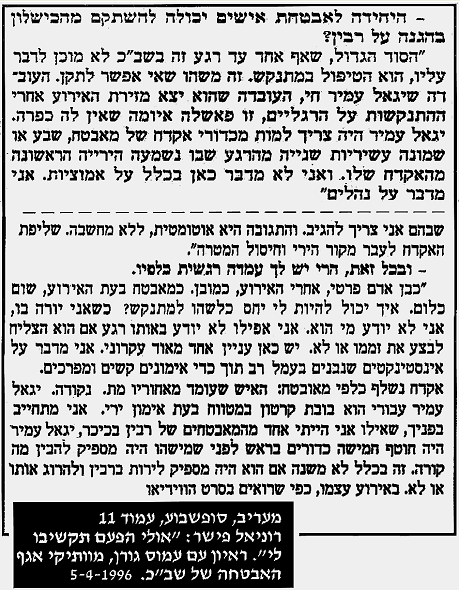
Another veteran of the GSS security branch and presently the owner and director of a private security firm, Amos Goren, was interviewed by Ma'ariv reporter Roniel Fischer just as Amir�s trial was coming to an end (the boxed excerpts from the interview appeared in Nathan Gefen�s book). Goren voiced similar opinions.
Fischer:
Can the VIP Security Unit pick itself up after the failure to protect Rabin?
Goren: The big secret, that to this moment nobody in the Shabak is willing to talk about, is the treatment of the assassin. It�s something that cannot be repaired. The fact that Yigal Amir is alive, the fact that he emerged from the incident�s scene walking on his feet, this is a terrible failure without repentance. Yigal Amir should have been fell by bullets from a bodyguard�s gun, six or seven tenths of a second from the moment the first shot from his gun was heard. And I do not speak here about emotions. I am speaking about procedures �.The reaction is automatic, without thinking. Drawing the gun in the direction of the source of fire and elimination of the target.
Fischer: Nevertheless, you do have an emotional attitude toward him.
Goren: As a private man, after the event, of course. As a bodyguard during the event, nothing. How can I have any attitude toward an assassin.? When I shoot him, I don�t know who he is. I don�t even know at that moment if he succeeded to carry out his attempt. There is a very important principle here. I am talking about instincts that are developed over long periods of time during extensive and difficult training. A gun is drawn toward a protected target: the man behind the gun is dead. Period. For me Yigal Amir is a cardboard puppet in an exercise at a firing range. I can assure you, that were I one of the Rabin�s bodyguards in the square, Yigal Amir would have been hit by five bullets in his head before anyone could realize what was happening. It doesn�t matter at all if he managed to shoot and kill Rabin or not�.
What a humiliating failure for all those well trained Shabak guards. And yet none of the agents entrusted with Rabin's security was tried, court martialled, or imprisoned. The worst punishment meted out was forced resignation. And the man who presumably had to bear the overall responsibility for the failure of the GSS, it�s director Carmi Gillon, went on to enjoy a prosperous career. He left the GSS and was appointed head of the Foreign Ministry's negotiations with the Palestinians. The man who gave him the job was the Likud Foreign Minister, David Levy. Later he was appointed by Shimon Peres as director of the Peres Center for Peace in Jaffa, before receiving the diplomatic accolade as Israel�s ambassador to Denmark. This is how the well-oiled wheels in Israel revolve.
Did Rabin know what his security service is up to? Journalist Uzi Benziman of Ha'aretz set out on 14 November 1997 to find out precisely that. Considering that Rabin was the ultimate chief of the GSS and that the Shabak head reported directly to him, it could be reasonable to assume that Rabin was informed about agent Raviv and his inciting activities.
�With the publication of the secret appendix of the Shamgar Commission report on the murder of Prime Minister Yitzhak Rabin providing the backdrop to the shameful spectacle of the Likud Central Committee convention, Ehud Barak, who now leads the Labor Party, can chalk up one success to his credit. In recent weeks, he has made a conspicuous effort to hold Benjamin Netanyahu responsible for the atmosphere of incitement that led to the murder. Barak's incessant pestering helped to jog the memories of several right-wing leaders, who in turn pressed the prime minister to study the secret appendix. The ultimate result was yesterday's publication of the document. The Shamgar Commission findings provide Likud leaders with a pretext for asking some very painful questions regarding the actions of the Shin Bet. The most difficult questions of all are: Did Rabin himself sanction Avishai Raviv's employment as a Shin Bet informer? To what extent was the prime minister aware of the double agent's incitement against him?
The key sentence in the secret appendix is: "His (Raviv's) incitement, especially where it involved physical acts of violence against Arabs, and where it drew the public's attention to the existence of violent and extremist political groups, was indirectly damaging to well-known legal political groups. His operators could not have overlooked this fact." What this means is that Raviv's acts of extremist incitement affected the public perception of the entire right-wing camp, including the Likud, and also furnished fuel for the left-wing counterattack before Rabin's murder.
This conclusion leads one to ask a question that is so horrific that it is in fact difficult to put down on paper. Was Yitzhak Rabin, who paid with his own life for the brave peace policy he pursued, a victim of his own actions? In the past, his close associates used to rail against the disdain with which he entertained their warnings of possible risks to his physical safety, but now a different question arises. Was he a party, knowingly or not, to Raviv's incitement activities? Did he continue to respond to incitement from the right even when he knew that it was stoked, or at least partially so, by the provocative acts of undercover agent Avishai Raviv? And if this is the case, did Rabin do so because it gave him a casus belli to flay his political adversaries?
On Wednesday, I asked Ya'akov Peri, who headed the Shin Bet when Avishai Raviv was recruited, whether he had told Rabin about Raviv's double-agent role. Peri says he does not remember. I then asked him if the director of Shin Bet routinely reports to the prime minister on the recruitment of such an agent, and Peri replied that it would not necessarily be reported, except in a case where it meant that criminal charges against the said agent would be dropped. In the case of Raviv, quite a few such charges were dropped. Does that mean that Rabin in fact knew of Raviv's dual identity? We do not know.
There is a macabre aspect to the entire discussion. A great man was killed by an assassin, and the country is now being asked to ponder the questions of how responsible he was for his own death, and to what degree he treated his political adversaries - who allegedly created the atmosphere that led to his assassination - fairly. The questions will not die down, at least until the next political scandal comes along.
Ya'akov Peri said Wednesday night that it would be wrong to place the blame for the entire right-wing attack on Rabin and his policies on Avishai Raviv. He pointed out that the incidents in which Raviv was involved took place against a background of daily anti-Arab attacks perpetrated by extremist Jews against Arabs. The Shamgar Commission report specifies several instances, some of which were criminal activities, in which Raviv took part: attacks against Arabs and against Tamar Guzinsky MK, damage to property, racist incitement against the Druse chairman of the student union at Tel Aviv University, violent attacks against Arabs and spraying slogans against peace. These actions did not directly affect the incitement campaign against Rabin and it is therefore unrealistic to attach any real influence to them - neither on the anti-Rabin political climate that was the handiwork of the right, nor on the response of the left. The problem, of course, is that Raviv also played a part in the direct incitement against Rabin.The secret appendix mentions three roles that Raviv played, all of which without a doubt were instances of dangerous incitement against the then prime minister. The first was the characterization of Rabin as a "rodef," a biblical term for someone who is about to kill, and should be killed before he can do so; the implication being that it was all right to attack him. The second was the close cooperation between him and assassin Yigal Amir in organizing student demonstrations and Sabbath retreats for students in settlements in Judea and Samaria. The third was the distribution of the poster in which Rabin was photomontaged into an SS officer. The report also claims that at the request of his Shin Bet operators, Raviv painted graffiti slogans opposed to the peace process.
Raviv was, then, a double agent who overstepped the limits, who did not differentiate between his function of supplying information to those who sent him and his efforts to ingratiate himself with those whose trust he was supposed to secure. Leaders of the right will in the next few days make widespread use of the findings of the Shamgar Commission to prove their claim that the left was spreading foul libels when it accused them, and especially Benjamin Netanyahu, of creating the atmosphere that led Yigal Amir to pull the trigger. The right will claim that the more extremist demonstrations against Rabin were initiated by Raviv. The left will assert that although Raviv's employment as a Shin Bet agent left much to be desired, the Shamgar Commission did not find any evidence that might diminish the role played by Netanyahu in the heated atmosphere that led to Rabin's murder.
Yossi Sarid MK said on Wednesday that the secret appendix did not contain anything that might cause him to reassess his opinions regarding Netanyahu's part in the incitement. Benny Begin MK said that in their propaganda campaign against the Likud and the current prime minister, Labor and Meretz have made use of slogans that we now know were instigated by Avishai Raviv. Begin added that Yossi Sarid needs to do a little soul-searching of his own. When Arabs were murdered in Halhoul three years ago, the Eyal group, of which Raviv was the head, boasted that it was behind the deed. Sarid called for the expulsion of the entire population of Kiryat Arba. When it later turned out that the murders were committed by Palestinian neighbors of the victims, Sarid did not apologize, and declared: "I did not cast aspersions on upstanding people. In Kiryat Arba, there are no upstanding people." Begin summed it up on Wednesday night: Sarid was a member of the ministerial committee responsible for the Shin Bet; his response at the time was a blatantly cynical act.�
*
On November 7 1999, Eitan Haber, Rabin's former aide and MoD office director wrote in the Jerusalem Post under the title The still unanswered questions that: "To the best of my knowledge - and I don't know everything - in Rabin's day, the GSS chief's weekly meetings with his superior, the prime minister, were conducted in the presence of Rabin's military aides, first Azriel Nevo and later Danny Yatom. As far as I know, Rabin was never given a single report of the operation of Raviv as an agent provocateur".
It should be remembered though, that Rabin had always manifested a keen interest in the security services. So much so that veteran officers of the Mossad can still recall the prime minister's insistence, during his first tenure in office, to read raw intelligence material and reports from field agents. Normally, prime ministers are filled in by the service chiefs in weekly meetings and given summarized reports. These usually include the director's conclusions and, when required, advice on course of action. Rabin hated these sanitized reports and wanted to form his own opinions based on raw, not interpreted, material. In the mid seventies the intelligence failure of the Yom Kipur war was still fresh in everyone's mind (although the Mossad had performed well and provided the ultimate evidence for war). But the Mossad loathed Rabin's meddling and interfering with its internal reports. Some say it hated it so much that it was the service itself that tipped off journalist Dan Margalit about the PM wife's foreign account and thus brought about his resignation.
*
So Ya'akov Perry, Gillon�s predecessor and Raviv�s recruiter, doesn�t remember. Yet he hints that Raviv�s activities must have been reported to the PM since it involved numerous criminal charges that were squashed and never brought to court. His selective loss of memory is not credible. So did Rabin know? The rich French tycoon Jean Frydman, who funded and organized the rally reminisced about the preparations.
"I am a member of the real peace camp. I have been so for the past four years at the urging of my good friend Shimon Peres, a man I like very much. We agreed that Israel's military occupation was negating Jewish values and demoralizing our youth. Shimon, a Peace Now man, was with me on the joyous day in Tel Aviv that the Norwegian Foreign Minister, Jorgen Holst, revealed the protocols of the agreement signed with Arafat. Peres didn't believe the agreement would hold and felt it could be derailed. I remember him telling me, "It's now up to Israeli public opinion. We need to quickly form an organization that will sway the Israeli people." I replied, " It's all yours."
After the Taba Accord, I realized that Israeli public opinion was in the hands of the far Right. Then at a rally of the right wing Likud, someone displayed a photomontage with Rabin in an SS uniform. Others shouted, "Death to the traitor Rabin." When told of the incidents, Rabin was furious. He was well past fear but felt an injustice had been done to him. On Saturday, October 6, I was at Shimon Peres's home. I told him,'We cannot leave the streets in the hands of the Likud and far Right. We have to put up a fight.'"
[Comments Barry Chamish: Since the Taba Accord, which gave Egypt a hundred extra yards of sand in the Sinai, became law, it is hard to see how public opinion was in the hands of the far Right. After that, the lies come thick and heavy. The photomontage and death threats came from Shabak provocateur Avishai Raviv and the minions of his straw group, Eyal. Rabin knew this and was not furious at the far Right but at Carmi Gillon for his illegal use of Raviv. According to research by Israeli journalist Adir Zik, Rabin ordered Gillon to his office and let loose a barrage of invective against Gillon, to which Gillon assured him that Raviv and Eyal were under tight control and were his responsibility. So Frydman's account of Rabin's reaction is a flagrant falsehood. Because the State Prosecutor has mounted a cover up of Eyal's crimes, we cannot be absolutely certain that Peres was apprised of them. However, it's a pretty safe bet that Peres knew everything Rabin did plus much more about the Shabak's covert war on the settlers. After all, he and Frydman were organizing the public relations side of things. So, in all likelihood, every word of Frydman's is a conscious lie.]
'On Monday, Shimon and I were in Rabin's office. Rabin asked me one question: "Will you take responsibility for this great event?" I told him, "Yes, on condition that I do it the way you want." Rabin and Peres gave me the green light. "Let's go," they said.
With "Tchich" Lahat, we organized a dozen generals for our Israeli Woodstock, our war for peace. I suggested to Rabin November 4th as the date of the event, but he hesitated. He had an official dinner. Finally, he reorganized his agenda and accepted. I wish I had not arranged things for the day of his death.
We distributed posters reading, Say Yes To Peace, Say
No To Violence, Kings Of Israel Square, Tel Aviv. We constructed a large stage,
and a grand podium. We worked with the security personnel assigning 750 police
officers, 250 border guards, sixty elite sharpshooters and three helicopters to
patrol the skies. This was in addition to the
Shabak forces who permanently protected Rabin
and Peres. We placed special detection equipment at each entrance of the
perimeter.'
So did Rabin know? This is the conclusion Uzi Benziman reaches in Ha'aretz on August 28, 1998 under the title "Weeding out the flowers of evil" - a year or so after he set out to find the answer: "...the precedent of Avishai Raviv, an extremist leader created by the Shin Bet. The authorization for the operation came from Prime Minister Yitzhak Rabin".
Bemziman appears to be slow off the block. Two weeks after the murder it was Yediot Aharonot of November 21 which first reported that "Avishai Raviv sought and received approval from his handlers in Israel's General Security Service (GSS) to set up his extremist EYAL group two years ago". The newpaper notes that the GSS set up the group with the intent of assisting it in gathering information on right-wing extremists. Yediot Achronot states that the establishment of EYAL was approved by Prime Minister Rabin personally, as well as by various other officials in the Ministry of Justice. And Yigal Amir was a member of the EYAL group.
No further guessing required.
After the Shangar inquiry into the questionable Hebron massacre (see Modus operandi), Carmi Gillon, then leading the �Jewish Department� was named head of the Shabak, a strange reward to say the least in view of the Hebron alleged security fiasco. During the year 1994 the Shabak was thrown into some intense internal power struggles. When the new chief of GSS was appointed, heads of departments resigned, leaving a gap inside the organization which were still not closed completely by November 1995. Gillon was not only an unpolpular choice amongst many of his colleagues who chose to leave the service, some in protest some in disappointment, but Rabin himslef, the man in charge with the decision, was not enamored with the candidate either. It took some cabinet pressure to convince him that Giloon is the man - 'advice' proffered mainly by the vice prime minister Shimon Peres. Gillon apparently held well-known far left views which were not to Rabin's liking. He disliked the settlers and was heard referring to them as "neo-nazis." His attitude was revealed in his 1991 Masters thesis completed at Haifa university which analyzed the settler movement from a perspective that bordered on hatred. Two days before the assassination, despite pleas from subordinates not to leave the country before the rally in light of the national mood, Gillon flew to Paris. (A joke that made the rounds after the assassination has Gillon calling Leah Rabin on the night of the murder and offering his deep condolences. She asks him for what. "Oops," he says, "I forgot about the time difference.")
Less of a joke however, were Gillon�s remarks during a press briefing where he told journalists in attendance that the likelihood of an attempt to assassinate the PM is high. �the potential assassin could be, a dark skinned Sephardic student of Bar Ilan University who lives in Herzlia." As a journalist later put it �You couldn�t get a closer description of Yigal Amir even from his mother�. A statistician calculated that the odds of Gillon getting all the information right without knowing who Amir was were some 24 million to one. Yet Gillon uttered these words in August 1995, several months before the assassination! And when he was informed of the murder by phone while he was in Paris, according to Yediot Ahronot of 24 September 1996 he immediately reacted: "It was a Jew."
How did he know? What powers of prophecy were bestowed on him, we wonder.
As is now well-known, the unit's most famous agent was Avishai Raviv whose duty was to provoke unrest and to lead and stage anti-government demonstration. With the Shabak help and funds he formed the Eyal movement (see Avishai Raviv). When Gillon was promoted as the head of the GSS, his position as head of the anti-subversive unit was filled by agent C. [Cheshin or Chezi Kalo?] and he appointed agent Eli Barak as his deputy. Little is known about C. Barak however, is better known. Days after Rabin's murder the local magazine Kol Ha'ir, accused Barak, without naming him, of being responsible for the assassination. Barak is a convicted drunk driver, wife swapper and stalker. After a near fatal accident caused by his intoxication, he lied to the police about who was driving the car. His friend and fellow wife swapper died in mysterious circumstances. And in the most publicized incident of all, he terrorized and stalked a TV and radio Police Affairs reporter, Carmela Menashe. Although the Shamgar Commission had not only summoned but also warned seven Shabak agents involved in the security failure that led to Rabin's death, including C., that they were criminally liable for prosecution, Barak was strangely not even called to testify. A few reporters tried tracking Barak down at his home in Kochav Yair but were rudely turned away by Shabak guards surrounding his block. No doubt one of the keys to uncovering the truth clearly lies with Eli Barak but he has been well-protected by the government.
 In February of 1996, the
Jerusalem correspondent for the London newspaper Observer, Shay Batya,
reported that he spoke with two Shabak agents fired since the assassination.
They informed him that Amir was supposed to fire blanks and that Rabin's chief
security aide Danny Yatom was involved in the preparations for the scam. Yatom
�happened� to live in the same apartment block as the video photographer
Ronnie Kempler. He was later appointed as chief of the Mossad, an incident
eerily reminiscent of Carmi Gillon's rise to head of the Shabak after the Hebron
massacre. If the information received by the Observer correspond is correct,
then Gillon�s absence from Israel on the night of the murder is understandable:
there is no better place to be when a sting operation is in progress than 3000
km away from the scene. Just in case something may go wrong.
In February of 1996, the
Jerusalem correspondent for the London newspaper Observer, Shay Batya,
reported that he spoke with two Shabak agents fired since the assassination.
They informed him that Amir was supposed to fire blanks and that Rabin's chief
security aide Danny Yatom was involved in the preparations for the scam. Yatom
�happened� to live in the same apartment block as the video photographer
Ronnie Kempler. He was later appointed as chief of the Mossad, an incident
eerily reminiscent of Carmi Gillon's rise to head of the Shabak after the Hebron
massacre. If the information received by the Observer correspond is correct,
then Gillon�s absence from Israel on the night of the murder is understandable:
there is no better place to be when a sting operation is in progress than 3000
km away from the scene. Just in case something may go wrong.
*
The GSS had set up an internal inquiry within 48 hours of the assassination. This is not uncommon. Within another two days it completed its work, reached its conclusions - and immediately leaked to the Press. It was a case of a suspected organization investigating itself. It's like if it were allowed to investigate itself, how would have we ever learned about what happened in the "Bus line 300" affair?
As was the case with Bus line 300, many in the Shabak could not live for long with the cover up initiated from within and eventually some of the truth came out. As time passes, the signs of internal struggle for the truth to be exposed appears to gather momentum in the Rabin affair as well. Two so far anonymous sources provided Barry Chamish a glaring document that, if authentic, points precisely into this direction.
The Evolution Of Raviv
Source 1 - We wish you had made it clearer that the Shabak is not a monolith, it's compartmentalized. You are taking down a lot of silent heroes who don't deserve to be associated with the dirty tricks department. We wish you understood the kind of heroism taking place in the service by young men whose committed duty is to prevent mass murder in the country. They're story should be told too. If the public knew the filthy job they were doing and what daily dealings with vile scum terrorists does to their permanent life's perspective, the damage that is about to be exposed publicly could be minimized.
You don't know it but you're on the edge of being proven right about many of your claims. That's going to happen with or without our help. We're just speeding up the process. We took the decision to talk to you because things have gone too far. Even you don't know how serious matters really are.
We'll tell you some things we know and they'll know it had to come from inside. We'll stop short of naming certain names that could get you, or us, killed.
Let's start with Avishai Raviv. You didn't get the whole story. You don't understand how things got out of hand. And you don't know what he was doing before there was an Oslo Accord. Start with 1992: His assignment was to destroy the Techiya Party, the most committed Knesset representative of the settlers. The plan worked like this. He had spent five years infiltrating far right wing groups and now he was ordered to unite them into one party which would draw away enough votes to annihilate Techiya but not enough to actually sit in the Knesset.
He asked the Kach people to join his movement but they turned him down flat. However Gershon Solomon's Temple Mount Faithful initially accepted his proposal. Salomon was going to head the list and Raviv began politicizing for him. But Solomon soon suspected Raviv's motive and backed out. Raviv was furious and asked his followers, who later would form the core of Eyal, to wreck Solomon's car and property. They balked at the idea and Raviv went looking for another party to siphon off Techiya's supporters.
In the end he got desperate and backed a party run by a disgruntled meat company owner, whose plank was to eliminate the income tax authority. Raviv campaigned hard to have the hardline vote support what was known as the Picanti Party and drew off just enough Techiya support to eliminate the party from the Knesset. He did so well, we're told, he even cost the National Religious Party a seat.
You never understood where Raviv came from. He wasn't merely a Shabak information gatherer, he was a pretend right winger planted by the Labor Party to neutralize the political unity of the Right. That's what the leaders of the Shabak were doing with our service even before Oslo. This was a huge breach of the Shabak's mandate, which is to guard internal security from violence and nationalistic crime.
Raviv was a political tool illegally run by our chief commander Ya'acov Perry. But it was Carmi Gillon's Jewish Department, as you rightly reported, which Raviv worked for. After the Hebron massacre Perry was made CEO of the country's biggest cellphone operator and that was no coincidence. He turned it into a surveillance tool of the highest order. Meanwhile, Gillon was made head of the service and he expanded the role of Raviv and others dramatically. From a political manipulator, Raviv was ordered to become a criminal instigator.
You are right that the goal of the instigations was ultimately the forced removal of the Jewish residents of the West Bank and Gaza. Raviv's assignment was to radicalize young people and inspire them to commit a continuing chain of murderous outrages. This would eventually justify the army coming in and removing these criminal residents from their homes.
But the settlers didn't cooperate. Raviv's superiors badly misunderstood the settlers' thinking. Maybe they were victims of their own prejudices but they weren't prepared for how meek these people really are. Today, when the atrocities against them are being turned on high, they still remain almost totally timid. The planners didn't get proper intelligence on the effect of their rabbis either. Far from being firebrands, the rabbis were preaching fatalism. While their best people were being murdered, the rabbis taught that it was the victims' time to die. And though the covert actions carry on with increased sadism, the rabbis are holding courses in etiquette and values. The plan to remove the settlers is way behind schedule and Arafat is going crazy. He thinks he was taken for a ride. The way we were told it happened was that after the Hebron massacre, Rabin was supposed to have the army round up the Jews of Hebron and Kiryat Arba and start the removal process. He refused and that was the moment the plan to murder him was hatched. You didn't get that either.
Source 2 - Another aspect about Raviv that you didn't report is how poor his decision making was. This guy is not terribly clever and we were always having to silence people who caught on to what he was doing. You got the arrest of Shmuel Cytrin right. After he started spreading the word that Raviv worked for us, he was arrested on no charge and kept at a safe distance in prison.
But you didn't find out about the trouble we had with Yehuda Miller, a police officer living near Raviv in Maale Levona. Raviv decided that he could hide his service ties by telling everyone that Miller was his police commander. Miller found out about it and told Raviv to stop the lying. But Raviv just turned up the heat. He even had his mail sent to Miller's address.
Miller, it turns out, was a first rate photographer and he began capturing Raviv in criminal action on film. He had enough to bury Raviv and all his officers, right up to Gillon. In the end we got him kicked out of the police and terrified to tell anyone what he knows. [As a sweetener, he was subsequently given a job as a photographer with the newly founded Mishpacha Magazine where he could exercise his hobby to his heart's content]. I use the word 'we' with reservations. I had nothing to do with these operations and have learned to hate the people who did. Not everyone, there were kids caught up in their duty who had nothing to compare to, I almost feel sorry for them, but their officers were engaged in serious irregularities and they knew better. As for the platoon that did the killing, I have not an ounce of forgiveness towards them.
Rabin's Dead Bodyguards
Source 2 - We knew you would ask so we prepared partial answers. We don't know that much, but we know it's worse than what you wrote.
Source 1 - All we know about Yoav Kuriel was that he was in a Shabak course and taken out. Almost always that means he went into the deep underground on assignment. I never knew him but I do know that after he was buried, we had to talk to the people who buried him. I can't imagine that the commanders thought they could hand a body riddled with bullets and missing internal organs to a legitimate burial society and not expect the undertaking crew to talk about what they saw afterwards. We made it clear to one of the crew living in Bnei Brak, his name was Baruch as I recall, that the loose talk would have to end then and there. He has been most obedient since then. And we had to lean on this guy Biton from Pardes Katz who was blabbing about what he saw.
Source 2 - There were a couple of other of our people who were eliminated; one was from Ashdod or Rishon, I think, another guy named Tzvi, as I recall was buried in Jerusalem the night of Rabin's murder. A minyan was gathered in a hurry to supervise the burial and, of course, someone reported the incident, this time to a Haredi paper in Bnei Brak. This paper was called Hashavuah and they were about to publish the victim's name. We just closed down the paper and confiscated the damning issue. The paper was re-opened under another name right after.
Source 1 - At the risk of repeating myself, my friend uses the word 'we,' when neither of us were involved in the operations. People in the service talk to each other, we are human after all, and that's where this information comes from. There are now enough of us who have had it with the situation that we decided to fight back. I am sure that most of our buddies agree with what we are doing. At first, no one believed your conclusions about the Rabin murder. You were checked out, and it was concluded, now don't be insulted, that you were too weird to ever be taken seriously.
Source 2 - The service really underestimated you. They never dealt with a personality like yours. The intelligence reports painted you as an oddball who could be neutralized with ease through the media. No one anticipated that you had these kinds of persuasive talents. We have guys in the service who are convinced you either have hidden powers or are working at a high-ranking mutineer's behest. Either way, a lot of us have reached the conclusion that it is inevitable the Rabin murder is going to rock the service like never before. We want to make sure the damage won't be permanent. The only people who should be prosecuted are those who killed Jews, and there aren't many of them. We want them purged from our ranks.
Uzi Meshulam
[A rabbi who exposed the kidnappings of thousands of, mostly, Yemenite infants in the early days of the state].
Source 2 - At the same time that the service was being exploited to smear political opposition to the Oslo process, we were being used to snuff out another political threat, Rabbi Uzi Meshulam. I bought the propaganda that he was a dangerous cult leader threatening widespread violence in our society. Most of us did at the time so we cooperated in his silencing. Now we know that his message was honest and that it threatened the very basis of the Labor movement. If it was allowed out, Labor's first heroes were going to be pilloried, the political movement would have no moral imperative to continue and thus the Oslo process would die. We were used again.
As far as the service was concerned, Meshulam's fatal mistake was naming his Shin Bet infiltrator, Ilan Raz. We do not appreciate having our men exposed and their lives thereafter threatened. We planned to move in on Meshulam big-time for that.
But Raz tried to warn Meshulam. He had actually come around to admiring him, and that by the way, is breaking regulation number one: get close to your target but not too close. He told him to stop his campaign immediately or we would come down on him very hard. He even tried bribing him but Meshulam wouldn't budge. We laid siege to his compound with army and police snipers everywhere. They killed one of Meshulam's young supporters. Meshulam was put into prison and now he seems to have forgotten everything to do with missing infants.
And the story gets worse. The Prison Services medical head, Yaacov Ziegelboim was appalled by the medical treatment Meshulam was receiving and was on the verge of reporting the facts to the proper authorities. A bomb in his car put an end to that. Our public relations people shifted the blame to Meshulam's followers. They are like the settlers; they talk big, they used to call protest rallies thinking they could persuade the public to seek justice but they never took murderous actions. Yet the propaganda was so effective that the public believed the bombing was by an extremist Yemenite. I have no proof but I'm convinced, and I'm not alone, that victims like the Amir and Kahalani brothers were chosen because they were Yemenite. Part of the overall operation was to convince the public that Yemenites were unstable and their claims shouldn't be taken seriously.
We Mean It
Source 1 - We worked out a strategy that we can live with. We are going to allow you to report a highly sensitive piece of information. It should show the dirty tricks people that we aren't kidding. Their operations have to stop and now. This will be the last information you get from us. Next time we'll find a more conventional media outlet. That is a promise. You will not be contacted again.
Source 2 - I suggest you take a trip to Hachoresh street in Ramot [Jerusalem] and look at villas around the number 100 block. You'll see one with a special garage door. Suspects from the Ramallah area are taken there for interrogation.
Let them find a new villa. If we don't see a change of policy, the next reporter we talk to will get more, much more information. We are looking for an internal order that lets us know that the Shabak will have only one function from now on, to protect Israelis from their real enemies.
Source 1 - And like I said before, you must report that the Shabak is where our country's finest men serve. Most of us have no role in any of this subterfuge. We are confident that we will be forgiven by the public when the full story comes out. And it will.
The villa in Jerusalem checked out true. Asked if
one of the early informants who broke the Rabin affair, Moshe Pavlov, worked for
the Shabak, neither Sources knew to say.
The story of the Shabak's closing of the Haredi newspaper before it was to
publish the names of two of Rabin's murdered bodyguards also proved correct.
Previous to the closure, one Amnon Noibach visited the publisher and warned him
not to publish the names of the dead bodyguards. The publisher, Asher Zuckerman
refused and Hashavuah closed down for a month. During that time, Noibach,
whose daughter is Israel Channel 1 news reporter Karen Noibach, raised over a
million dollars to found a rival, less politically dangerous haredi newspaper,
Mishpacha. To buy his silence over his filming Avishai Raviv's criminal
activities, officer Yehuda Miller was given an enjoyable job as the new paper's
photographer.
IF YOU HAVE ANY
INFO PLEASE
SEND YOUR COMMENTS
