Yigal Amir
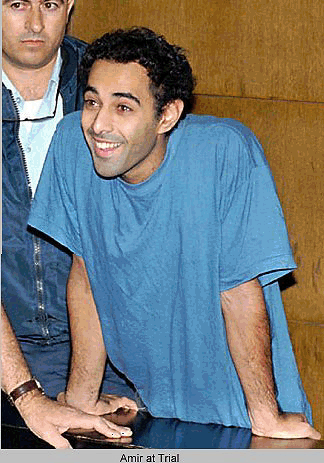 Amir was born the second
of eight children into a pious family at 56 Borochov Street in Herzlya. He went to Wolfson, a
nearby Orthodox elementa ry school belonging to Agudat Israel. His father, a
bearded man with heavy glasses, was a kosher butcher, slaughtering neighbors'
chickens according to Jewish law, and a scribe who hand-printed holy books. His
mother, who covers her hair with a wig as a sign of religious modesty, ran a
nursery.
Amir was born the second
of eight children into a pious family at 56 Borochov Street in Herzlya. He went to Wolfson, a
nearby Orthodox elementa ry school belonging to Agudat Israel. His father, a
bearded man with heavy glasses, was a kosher butcher, slaughtering neighbors'
chickens according to Jewish law, and a scribe who hand-printed holy books. His
mother, who covers her hair with a wig as a sign of religious modesty, ran a
nursery.
The Amirs lived simply.
Neighbors say they were "one of the good families" in a working-class
neighborhood. They didn't lock their doors, and the white stucco attached house
was always full of visitors. Shlomo Amir, a shy man, could be seen at daybreak
walking to the synagogue or at dusk teaching Jewish texts to local men. Geula
Amir bustled around the back yard with the nursery children, talking about
Pinocchio and butterflies.
On November 9 Geula Amir
told Israel Television that she noticed something strange in her son over the
last half year. "I saw it on his face, the skinniness,". "He started to lose
hair a bit. He was serious... We thought he had a problem with women. We thought
that he is seeing someone and didn't want to tell us, so that he is eating
himself inside."
But Geula Amir, a
dynamic and willful woman, kept up a cheerful front. Malka Farkas, her neighbor,
saw her on the street two days before the shooting. Geula Amir told Farkas that
her daughter was getting married and that her son, Yigal, is doing well at law.
"She was happy and said, 'What good children I have,'" says Farkas.
At 14, Yigal Amir began
attending the New Colony, a high school in northern Tel Aviv that prepares boys
for a life of strict black suits and sacred learning. He was a son of immigrants
from Yemen in a school dominated by Jews of Lithuanian descent, but he managed
to bridge one of Israel's great social divides, between the European and Middle
Eastern Jewish communities. Students called him the "Yemenite genius", and
teachers began urging him toward the rabbinate. Yigal Amir spent two years
studying Talmud at Kerem D'Yavne Yeshiva, an hour south of Tel Aviv. At Kerem,
Amir combined Jewish studies with service in the Israeli army. In C Company,
13th Battalion, of the Golani Brigade, his fellow soldiers called Amir "Big
Head" as a mark of his zeal. He carried a rocket-propeller grenade launcher, a
heavy load they gave to men with Amir's strong and wiry build.
After a year and a half
in the Golani Brigade, Amir returned to Kerem D'Yavne to conclude his studies.
But Amir planned to also combine a dual program in Bible studies and law. Just
as Amir started his second year, Rabin stunned the world by shaking the hand of
Yasser Arafat at the end of the Oslo accords. By around that time Amir�s
political involvement and anti-government demonstrations had began. And when
Baruch Goldstein, an American-born Jewish settler, gunned down 29 Muslims at pra
yer in Hebron's Tomb of the Patriarchs in February 1994: "We had a very harsh
argument," one classmate recalls. "I said Goldstein was a vile murderer, and
Yigal said he's a martyr. He said it's to shake the Arabs, to show them that if
they launch attacks on Jews and the government takes no action - here, someone
did."
At one of the Bar Ilan
demonstrations, in May 1994, Amir met Nava Holtzman. He was smitten. Slender and
poised, she came from a wealthy religious family and shared Amir's politics.
Until then he had always told friends he could not find a woman who met all his
requirements: The beautiful ones were not smart enough, he said, and so on.
Secular women, of course, were out of question. Holtzman had everything. They
began attending lectures together and took a chaperoned trip to see Sinai. In
their Orthodox circles, an unmarried couple did not kiss or hold hands - "no
physical contact at all, to put it delicately," one friend says - but the public
attachment they formed amounted to a declaration of intent. Friends said that
Amir planned to marry her. But suddenly, in October, Holtzman broke off the
relationship. The following summer she married Shmuel Rosenblum, one of Amir's
best friends. The breakup happened to coincide with a newly intensified wave of
Islamic militant terror attacks, beginning with a suicide bombing in Tel Aviv
that killed 23. Amir threw himself even harder into anti- government protest -
including for the first time illegal roadblocks and refusals to obey police
orders to disperse. One can only surmise in what emotional turmoil Amir found
himself, what with the break of his personal relationship with Nava and the
political confusion that gripped the country. One friend privy to the trials and
tribulations that he was going through was Margalit Har-Shefi, a fellow
colleague at Bar Ilan.
The government went to
great lengths to hush down Amir�s involvement with Nativ and his mission in
Russia. Writes Barry Chamish:
The heat was turned up
when Alex Fishman of Yediot Achronot reported that Amir was trained by
the Shabak in Riga. Soon after, Army Radio [Galei Tzahal] broadcasted an
interview with Rabbi Benny Elon, a leader of the Jewish settlement movement, who
said, "The Shabak was responsible for the founding and funding of Eyal and its
leader Avishai Raviv. I claim that the Shabak knew Eyal's every move before the
assassination and that the Shabak funded its activities."
With the facts
closing in, the government embarked on a sloppy cover-up of Amir's Riga days. In
order; the government's press office announced that Amir, who spoke no Latvian
and had no teaching credentials, was a Hebrew teacher in Riga for five months.
The head of the Liaison Department, whose name was whited-out of a Maariv
article, then changed the story to read he was a teacher for two to three
months. After this, Minister of Internal Security, Moshe Shahal, told Israel TV
that Amir was a security guard in Riga for two months, which was probably the
closest version to the truth. Finally, running out of ideas, the spokesperson of
the Prime Minister, Aliza Goren, announced in late December that the Prime
Minister's Office is now certain Amir was never in Riga and that any journalist
writing so "was acting irresponsibly." That ploy fell apart when the BBC filmed
a copy of Amir's passport with the letters CCCP clearly stamped in it. But this
wasn't the end of the story of the Prime Minister's strange Liaison Office. In
the months prior to the assassination, the State Controller's Office initiated
an investigation of profound corruption at the Liaison Office and the
unexplained disappearance of a great deal of money in the C.I.S. In late l992,
Rabin announced he was considering closing down the Liaison Office for good.
Founded in 1953
- most likely by Shaike Dan ont the PM's innstruction -
to
help and
rescue Jews from behind the Iron Curtain, the Liaison Department had
become a nest of spies over the years. As the daily newspaper Haaretz
reported a few weeks after Rabin was killed: "The Liaison Department conducts
its own diplomacy and has its own private agenda". The Nativ bureau was actually
active in almost the entire Communist Block, countries like the USSR, Romania
and others. Often, agents attached to the official Israeli embassies and
consulates in these countries recruited local Jewish activists through whom
money and other aide was
funneled
to the poor local
jewery. Example: even if a Jewish family did get permission to emigrate to Israel � normally after
countless requests and
many
years of waiting
�
most actually lacked the resources to
buy their own
travel tickets. Through the network of the local activists,
the Israeli Embassy literally provided the currency to those people to enable
them to travel. Most if not all these activities were monitored by the local
intelligence services and quite a few of the recruited local Jews found
themselves interrogated, tortured and imprisoned for lengthy periods,
often without trial. They were
later recognized by the State of Israel as �Asirey Tzion� � Prisoners of Zion.
Throughout the years
a number of Israeli agents with diplomatic immunity in these
countries had been expelled. On the wider scheme of things, it is clear that the
local intelligence services weren�t that concerned with the money changing hands
but more with the possibility that this relatively benign activity could be a
cover up for a deeper, more sinister one of espionage.
This is how Amir
described his period in Russia in an extract from his testimony to the Shamgar
Commision.
Q:
�We�d
like to hear something about your mission to the Soviet Union in 1992. There are
a thousand and one speculations about this period.. What did you do there?
Amir:
�The
Liaison Office is not so secret anymore. Once it was a secret. They looked for
people who would organize Zionist activities and Hebrew teachers. All sorts of
things. They turned to my military unit to propose people. Every two months
people changed there. I went with a friend of mine, Avinoam Ezer. When we
arrived there, they were working with 15 year old and tried to persuade them to
make aliah to Israel. I thought they were wrong and its better to work with more
mature students. So I went out into the street wearing my kippa and I was a real
attraction. In the end I gathered around me about 100 students in social
activities. It was a huge success.
Q: �Where
there any security people?�
Amir:
�You
are jumping ahead�.
Q: �We
understand you went through a VIP protection course�.
Amir:
�Nothing.
Not at all. Just a short security training. What are you insinuating? We didn�t
have weapons. Just tear gas.�
So Amir did undergo at least a
short security course with the GSS. He had tear gas with him on his mission to
Riga. For what purpose? And why was the government eager to play down Amir
involvement with Nativ to the point of denying he event travelled to Russia? A
plausible reason is that being involved with Nativ establishes Amir�s
connections with the Shabak. It was the GSS that gave him clearance to travel to
Russia and it was the GSS that trained him at least in �a short security
course�. It was only when the BBC made it public that Amir�s passport had the
clear CCCP visa imprinted on it that the government was forced to make a sharp U
turn.
Contrary to what has widely been reported in the
media, Yigal Amir was not the fully co-operating suspect he was portrayed to be.
At least during the period preceding his trial and to an extend during the
judicial proceedings too, his behavior resembled nothing of the self-confessed
murderer the public was persuaded to believe. Although he was kept in solitary
confinement for over a month, when word reached him - apparently through his
solicitor - that a bodyguard had died, his behavior changed dramatically. His
behavior cannot be explained unless Amir himself realised that what he was being
told by the GSS behind closed doors together with what he knew himself cannot be
reconciled any longer with facts that were happening outside prison.
So what news had reached Amir to unsettle him to the
point of starting to fear for his own life?
LONDON OBSERVER (via the
12/5/95 WASHINGTON TIMES): "The breach in security around Prime Minister
Yitzchak Rabin on the fateful night of November 4 was so monumental that, almost
immediately after the assassination, a theory that one of the bodyguards must
have been in on the plot spread like wildfire across the shocked nation. Even
before the reve;lations that the accused killer, Yigal Amir was trained by the
Shin Bet security service, a respected Israeli historian, Michael Har-Segor,
hinted at Shin Bet complicity in the slaying. He wrote that, since ancient
history, 'praetorian guards' have been the ones who have organized most
assassinations of political leaders. Then, exactly 10 days after Mr. Rabin's
death, detectives found a 27 year old former Shin Bet investigator lying with a
bullet in his head & a gun in his hand in his parents' home in the Tel Aviv
suburb of Ramat Gan. Police quickly closed the case, ruling that the man, said
to have had mental problems, committed suicide. But some sources close to the
Rabin investigation insisted that the dead man was actually a Shin Bet officer
on Mr. Rabin's bodyguard detail and that he may have been 'helped' to commit
suicide - possibly to cover up an assassination plot that goes far beyond Amir.
Amir, supposedly without
access to the outside world since the killing, should not have known about the
theory of the bodyguard's complicity - a theory that, by shifting part of the
blame to the Shin Bet, partially exonerates the extreme right militant groups.
'Something is very fishy
here', said a senior government official in Jerusalem... Since the Rabin
assassination, most of the conspiracy theories about Shin Bet involvement have
been put forward by Rabbi Benny Elon, founder of the ultra-right wing settler
movement Zo Artzeinu & a member of the far right Moledet party. At least one of
Rabbi Elon's allegations - that Avishai Raviv, leader of the Eyal extremist
group to which Amir belonged, was a Shin Bet agent provacateur code named
'champagne'--has since been confirmed by government officials".
The mystery of the dead man was kept hushed by the
Israeli media until it was unexpectedly raised by Amir himself. In a bombshell
declaration during remanding hearings in the Tel Aviv court on Sunday in front
of judge Dan Arbel , Amir shouted to reporters, clicking and video photographers
and to over a million people watching,
"Why aren't you investigating Rabin's
murdered bodyguard? The people will forgive me when they
know the truth. After you understand why, you'll see that the whole
system is rotten. Everything
you see is fabricated. I didn't think they'd start killing people."
During the proceedings Amir made another attempt.
"What you've seen up til
now has been a facade. I request to be allowed to explain the background
to my actions. They're killing people. If you listen to the truth,
the whole country will turn upside
down. After you understand why,
you'll see the system is rotten. Everything is set up. What
you're seeing is a facade. I didn't think they'd start killing people.
Since Oslo B... "
[Judge Arbel]: "Don't talk about Oslo B.
You're not the Foreign Minister".
[Amir]: "They're killing people. Don't you
understand that? It's all a lie".
[Judge Arbel]: "What's a lie"?
[Amir]: "That I killed Rabin. I never even
tried to kill him. Everything is set up. What you're
seeing is a facade. I didn't think they'd start killing people.
[Judge Arbel]: "I understand. You are
killing people".
Needless to say, Judge Arbel did not give Amir a
chance to explain himself and he was taken back to his lockup. On November 29,
l995, according to a report published by Ma'ariv in early '96, Amir
complained to the police officer taking testimony, "They're going to kill me in
here."
"Nonsense," replied the officer.
"You don't believe me, well I'm telling you it
was a conspiracy. I didn't
know I was going to kill Rabin."
"What do you mean? You pulled the trigger, it's
that simple."
"Then why didn't Raviv report me? He knew I
was going to do it and he didn't stop me? And why wasn't I shot to save
Rabin?"
Obviously Amir was by now in distress and frightened. He didn't expect "them" to
start killing people. Who is "them"? Nobody had any doubts that Amir meant the
GSS. This was the final, open attempt Amir made to prove his innocence. Later
attempts would be much more subtle and hardly noticeable.
So whose death was the government trying
unsuccessfully to hush up ? Who had committed suicide? The name of the man was
Yoav Kuriel. Probably a Shabak agent, Kuriel was buried two weeks previously and
there were wide spread suspicions of foul play. According to some, Kuriel died
on the night of the murder although the date is given as 15.11.1995, some ten
days later; another informer attests that the date is the correct one. His
hurried burial took place at night at Hayarkon cemetery in north Tel Aviv but
for some unspecified reason, traffic within a wide radius was closed or diverted
for some 90 minutes. When they finallyu admitted that Kuriel died, the
government insisted that Kuriel was depressed after Rabin�s murder and had
committed suicide. The Hevre Kadisha undertaker, who lives in Bnei Brak, later
divulged that Kuriel�s body had some internal organs removed and that his chest
was pierced by seven gunshot holes. Now that�s a really persistent suicider !
His death certificate, acquired by Maariv reporter David Ronen, is
equally puzzling: the reason for his death is given as�. blank.
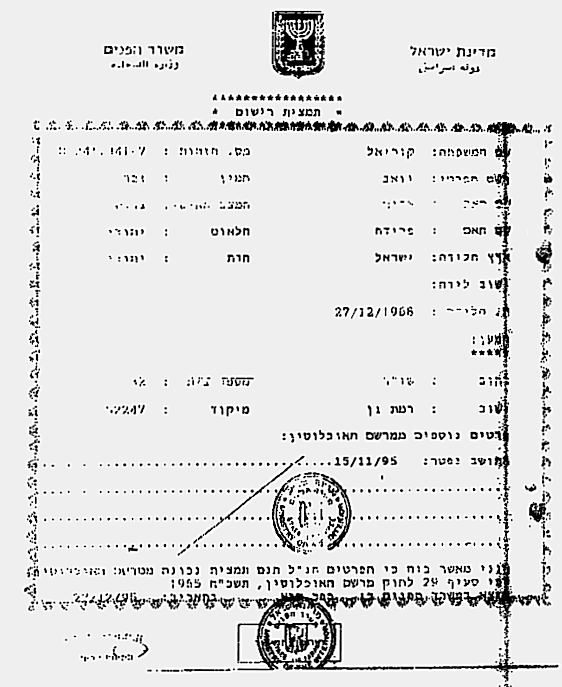
Yoav Kuriel's death certificate. Reason of death not
given.
More details about Kuriel's death came, almost as
usual, from unexpected quarters. After a Chamish lecture at the home of attorney
Dov Even Or, one of the audience members who consistently kept contradicting the
evidence presented, met him on the lawn outside to explain himself. He, it turns
out, was a high ranking investigator for the Israel Police Crime Laboratory. He
apologized for interrupting the lecture then he threw his bombshell.
"I was the ballistics investigator in the
Yoav Kuriel suicide. I was called to a Ramat Gan apartment
to investigate Kuriel's 'suicide.' I wasn't allowed to see the body but
I know who did and you're
welcome to see if they'll talk. I asked to be given the suicide gun for
lab testing and the superior
officer told me the gun was missing. I asked him, 'How does a gun used
by a suicide victim
disappear?' He wouldn't answer but we both knew it couldn't in a real
suicide. You can't publish
my name, just what I said. Some day when it's safe, it will all come
out."
While in solitary confinement then, Amir found out
that an agent was killed. What he did not know however, was that not only Yoav
Kuriel had died. In fact, there were of veritable series of men who disappeared
or otherwise inexplicably 'committed suicide'. Apparently another GSS agent, Zvi
Forster, was killed and was quickly buried in Jerusalem by an undertaker named
Friedman in Givat Shaul cemetary. Friends of David Newman, a fellow Bar Ilan
student and colleague of Yigal Amir, told that he received a call from Avishai
Raviv immediately after Rabin's murder pressing him to "incriminate himself and
become an accomplice" to the murder. He refused. Shortly after David was found
dead in his room; he had 'committed suicide' due to depression.
So after people started committing suicide (much in
the same way that many who knew too much had done so after the JFK murder), here
comes one of the most bizarre accounts of the affair. The author is one, Moshe
Pavlov. Opinions are divided as to whether he was a GSS agent or not - most tend
to think he was. He was also the first person to alert Chamish that something
wasn�t kosher in the Rabin murder. Writes Chamish:
�.Moshe Pavlov chose to
call me on November 17. His first call was brief: "Watch Channel Two News
tonight and you'll see me," he said. "Then I'll call back." He appeared on the
news and was described as one of the country's most dangerous right wing
leaders." Odd, I thought, why hadn't I heard of him before? The next call wasn't
from Pavlov but from my neighbor Joel Bainerman [Chamish�s co-editor of the
magazine Inside Israel]. Though he lived in a most obscure location,
Pavlov found his way to Joel's doorstep and appeared unannounced. Joel said, "I
don't think we should meet here. I'll see you downtown in ten minutes." Though
he aggressively denies it, all, literally all, my sources later tell me Pavlov
is a Shabak agent. In retrospect, there is no other way he could have had the
information in his possession if he wasn't an insider. Joel and I sat in a quiet
corner of the town square of Bet Shemesh, as a terrified and agitated Moshe
Pavlov spewed out reams of, what turned out to be the truth. "Amir was supposed
to shoot blanks," he insisted. "That's why the bodyguards shouted that he did.
He was supposed to. It was a fake assassination. Rabin was supposed to survive
the blank bullets, dramatically go back on the podium, condemn the violence of
his opponents and become a hero. That's how he was going to save the Oslo
Accords. Raviv was supposed to give him the gun with the blanks but Amir got
wind of the plan and changed the bullets."
Pavlov was way off on
this point. Later evidence proved beyond doubt that Amir did shoot blanks and
Rabin was shot elsewhere. Pavlov became nearly hysterical. "They're killing
people to cover this up and they're setting me up for a fall. Already one of
Rabin's bodyguards is dead." He gave us the name of the bodyguard: Yoav Kuriel.
He also supplied his details, including his social security number. A Yoav
Kuriel was reported dead in the media the next day, but of a suicide. It would
be another two years before I spoke with the man who prepared his body for
burial. He died of seven bullets to the chest. No one was allowed to identify
his remains. And then Pavlov gave us information that NO ONE was allowed to
know. To this day, only the man's initials can legally appear in the Israeli
media. "The guy behind the operation is Eli Barak, a lunatic. He runs the
Shabak's Jewish Department. He is Raviv's superior and set up Amir to take the
fall." He added a fact that was positively unknown at the time. "Barak takes his
orders from the head of the Shabak. His first name is Carmi, he lives in
Mevasseret Tzion and that's all I want to say."
It took over a year
before the Israeli public was to learn the name of the Shabak Chief: Carmi
Gillon. Pavlov was insistent: "You have to publish this and my name. Otherwise
I'm finished." Joel and I decided to publish the story in Inside Israel.
When it came out I met Pavlov at the Holiday Inn lobby in Jerusalem. We were
surrounded by policemen. Wherever he went, they followed. That was good enough
proof for me that our faith in Pavlov's version of events was justified.
Most of the information that Pavlov had initially
supplied fuelled much of the speculations that are nowadays within the public
domain. In 1998 I invited Pavlov to put forward his own version of event that
took place on, and following the night of 4 November. In an open letter he
wrote:
�This letter is
dedicated to the memory of Yoav Kuriel, may he rest in peace, who sacrificed his
life for his country and his people.
Following the
funeral of Yitzhak Rabin, when it became obvious to many observers that the Shin
Bet, the Shabak, had attempted a planned sting operation I began a series of
articles giving out detailed facts concerning that operation. The series of
articles �On the Assassination of Yitzhak Rabin� was given out
freely to the foreign and local press and media. When this knowledge was
efficiently distributed and understood, there occurred the tragic death of Yoav
Kuriel. I gave out the details of Yoav Kuriel his ID number and his address and
sufficient information to begin an inquiry concerning his death. I furthermore
divulged the information to the Hebrew news staff of IBA, Israel�s channel one
television, when I was interviewed there on November 23, 1995. I further
discussed the matter with an elite detective squad of the Israeli police. I
discussed the matter with high ranking members of the Likud then in the
opposition. On all these different fronts I attempted to arouse interest in the
tragic death of Yoav Kuriel.
The wheels of
justice move slowly. It was my hope and belief that the information that I had
given out would be sufficient to pursue the matter further. I reasoned that the
foreign journalists would have an interest to pursue the story further. The
police who were not involved to the best of my knowledge in the sting operation
should have been interested in investigating the matter. The Likud should have
been interested in exposing the reality, the true price paid for peace. The case
of Yoav Kuriel was brought forth before the Shamgar Commission. It is not clear
what conclusion they arrived at.
I accuse all of
these bodies of incurring a great injustice and in attempting each one to save
himself. They have all attempted to conceal the truth. The truth will show how
the different political bodies and the organizations subservient to them were
all willing to compromise human life. They begin by playing with the life of the
Prime Minister in their poorly planned sting operation. It was a total disregard
of human life in not protecting the prime minister properly. They ended by
causing the tragic death of Yoav Kuriel and killing one of their own. The
disregard of human life led to cold blooded blotched murder - at the level of
the Mafia. All this in the pseudo pursuit of peace.
For my attempt
to bring out the truth I have been ridiculed and smeared by Israeli Television -
both channel 1 and channel 2 smeared me simultaneously the same night at the
same moment from film they received. (Let them come forth and say where they
received this film. I am a former employee of Israeli Television channel one -
and my former acquaintance Dan Zimmerman called me a couple of days before they
smeared me. He told me and later reiterated again that they received the video
film from Leah Rabin!) Due to the implications in the smear campaign of Israeli
television networks most of the leadership on the right believes that I am a
Shabak agent. In their political trial, the triumvirate leadership of �This is
my land�, Moshe Feiglin, Benny Alon, and Shmuel Sokket all of them separately
gave dozens of testimony against me. Moshe Feiglin specifically said that they
have information that I am either a Shabak agent or a policeman. All of this was
the work of the Shabak which attempted and succeeded in diverting attention away
from me and the facts that I offered then. Since that time no leader of the
right has heard my story although I am claiming to them that it is relevant and
important. I presented facts - what is important is how we and history will
relate to the justice and truth of these matters.
I now come to
the explanation of these matters. The matter of Yoav Kuriel weighs heavily upon
my conscience. Two days after the funeral I collected the facts then available
and deduced that something was amiss, I sent out Part I of my series. Less than
a week later I sent out Part II of my series where I suggested that the Shabak
were interested in catching Amir red-handed after he had fired blank bullets. I
pointed out that they had done this one half year earlier in the case of the
Kahalani brothers. Now assume that you are the man responsible for the caper -
Eli Barak, the problematic and infamous agent of the Shabak who was the head of
the Jewish section of the Shabak and was well known in journalistic circles as a
dangerous and irresponsible individual who had sexually harassed the reporter
Carmela Menashe. You suddenly would realize that you must have a security leak.
Somehow the news had gotten out!
But only one person was to have altered Amir�s clip - only he
knows what happened, and even he did not realize what the nature of the
operation was. Now an explicit plan had been presented to all of the media and
only one person could possibly have let the information out. He is by necessity
summoned for questioning and receives a Shabak interrogation. I hate to imagine
the horror he must have realized for on the one hand he was told that he was
responsible for the assassination and on the other he was expected to tell them
how the information had leaked out. There must have been upon this agent
unbearable pain and pressure. I shudder to consider it.
Now this person who was supposed to change the clip
can not be a Shabak agent nor a policeman. It is too dangerous to use agents or
policeman to break into someone�s home to change clips or guns. This individual
is regularly used for miscellaneous jobs by the Shabak and was the one who
altered the rifle and clip for the Kahalani brothers. There subsequent beating
and persecution that they received in jail is probably due to the fact that they
can recognize this man. This person gets paid in a roundabout manner from the
National Social Services. Now I state categorically as known fact that Yoav
Kuriel was not a policeman as some have suggested nor was he a Shabak agent. He
was for a long while unemployed but received payment from the National Social
Service. The reason many consider him to have been from the police is due to the
fact that the payments received from the National Security Services were
funneled from the police, many journalists have been aware of this fact.
But why did he receive these special funds? Yoav
Kuriel then was the person who was supposed to have altered Yigal Amir�s gun. He
was as I have stated most probably the same person who had success in altering
Kahalani�s gun. Yoav Kuriel was summoned and was interrogated by a non
relinquishing Shabak who had to find out quickly how the information had leaked
in addition as to why the sting had failed. Were they being set up? By whom?
Yoav Kuriel�s dilemma was to admit to being an informant or deny it if he could
be believed. Did he know why the sting did not succeed? He did have the biting
problem of being informed that somehow something had gone wrong and that he was
being blamed for inadvertently causing the death of Rabin, although he had no
way of knowing this beforehand. The Shabak were not about to inform him why he
was to change Amir�s clip. They would just make sure that in fact he had! The
dilemma caused by the pressure of the interrogators was too much for Yoav Kuriel.
He broke, and he committed suicide, his secret as to what had happened went down
with him. He committed suicide with a friend nearby at the second floor of his
home. One could imagine that he confessed to his friend before he died
explaining exactly what had happened, and then he took his own life.
Except his close
friend, those of the Shabak who knew, did not feel terribly bad about this. One
less who knew intimately of the plot. There were now two major problems. What
would the behavior of Yoav�s friend be and the second major problem was to stop
the leak and stop the distribution of information. Now if you cannot stop the
information you must color it. Tactics were needed to divert the focus of
attention from the mock murder thesis and occupy the attention of the media. The
Shabak acted swiftly and immediately revealed that Avishai Raviv was a Shabak
agent and provocateur. They did this on two fronts one through the television
commentator Amnon Abramovitch and the other through the staunch rightist Benny
Alon, who was brought to Israeli Television to reveal Avishai Raviv. It was a
classical diversion tactic to burn Raviv to take the heat off of the real
problem. Now I challenge Benny Alon since he has testified and given out that in
his opinion I am a provocateur why doesn�t he take this to the international and
Israeli Press and media? For if I am a provocateur my activities were far more
varied than Raviv�s. I gave literally hundred�s of interviews to the
international media appearing on CNN, ABC and most of the main networks
throughout the world. Why is Benny Alon and the Israeli media suddenly so quiet
about me if they really believe what they are saying?? Many people had concluded
that Avishai Raviv was a Shabak agent prior to Benny Alon how did he know to
take this to the press and why were they willing to listen to him?? This
information coming from Benny Allon gave credence to the belief that was
expounded later on until this day - provocation yes conspiracy no.
The Shabak still
had the second problem to tend to, the leak. On November 19 the Sunday after the
tragic affair of Kuriel was behind the Shabak they gave over a video to channel
1 and channel 2 simultaneously. The next day or almost simultaneously I was to
receive the information concerning Yoav Kuriel. I was asked to check it out. It
was consonant with the rumors that were spreading throughout Israel that Rabin�s
bodyguard committed suicide. But I knew for certain that Yoav Kuriel was not a
member of the Shabak or the police force. I understood the end link of the
information that I had received was from the Shabak. Due to the earthquake that
occurred on November 22 the broadcast was shifted by both networks to the next
day.
On November 23 I
was smeared in a well orchestrated campaign and until this day have not been
able to respond. I believe that the purpose the Shabak had in leaking the
information to me was to test how I would respond. Did I know Kuriel and would I
testify that he leaked information to me? The Shabak must have reasoned that if
I was the end of a linked chain that was transmitting information from the
Shabak the publicity that I was to receive a total of 15 minutes of prime time
television would convince even the most stubborn informant to stay away from me.
Now although I had been very active in demonstrations prior to the assassination
I had never received any attention from Israel�s television networks. Now
suddenly I had received 15 minutes worth of prime time news. I was now a
questionable public figure. I on my part acted as if I never had heard of Yoav
Kuriel previously as I sent out my third piece, �Who was Yoav Kuriel�. In this
manner my life was saved although my name defamed.
Unfortunately
the Shabak took no chances with Yoav Kuriel�s friend, his handler within the
Shabak, he received a number of bullets in the back and was eliminated without
ever having his name mentioned. Those who know of his death are terrified to
talk. Thus the Shabak had secured their leak and damaged me to the point that I
was unable to convince others in Israel of my story. They had bought time. But
still the conspiracy theories had been tossed in to the air, and there were
enough serious problems concerning the assassination that were unanswered that
people took them seriously, it was therefore now necessary for them to attempt
to negate them. The way to negate a conspiracy theory is to exaggerate it and
proliferate them. This they succeeded in doing remarkably well. Theories spread
of how Peres was involved, of how they put a bullet in Rabin�s chest in the
hospital and other such unbearable junk. It is amazing to my mind that the main
individual who is responsible on the interent in proliferating the conspiracy
thesis is also one who writes about his checking alien abduction in Netanya. One
would think that his theories could be dismissed if this fact were better known.
Why didn�t the Shabak make this fact better known? I suggest the Shabak
appreciated the mess of the conspiracy theories, if they themselves were not
behind it. It creates an affect to the foreign journalist like the Kennedy
assassination - we will never know the truth. But they have not yet succeeded
completely.
This is my
story. For those of you such as Moshe Feiglin who are convinced that I am a
Shabak agent or a member of Israel�s police force I wish you to take seriously
what I write here. For the rest I hope it will not only be taken seriously but
that it will also cause you to ask the right questions, Why did Yoav Kuriel
commit suicide? When was he interrogated by the Shabak? Can the Kahalani
brothers recognize him? Who was the agent who was killed? What was his
relationship with Yoav Kuriel? Why do the people who have come out against me
not take my case to where I can answer to the public? Where did Israeli
television get the video to smear me? What purpose was there in that? Did the
police know that Yoav Kuriel was questioned by the Shabak? These are some of the
questions which need to be put to the authorities involved in this matter. I
hope this article will be taken seriously. We must have an immediate police
investigations into the two murders mentioned here. Was Kuriel pushed to the
limit intentionally by his interrogators. Who murdered Yoav Kuriel�s handler?
Was he acting under orders? It is my wish that the deterioration that began with
a mock murder and playing with a human life and ended with cold blooded murder
be left behind us as a singular unique pathological case in our history. It can
become for Israeli history a localized affair. Should it pass by it will
indubitably leave the seeds of growth for further totalitarian activities and
disregard for human life. It is my desire that the men and women of the Shabak
purge the undesirable elements from their midst. If they refuse to do so the
rotten elements will destroy them and they will fall. It is my fervent hope that
the journalist who reads this will realize that he can make a difference and
help make a better and secure civilized democratic world for us all.
Moshe Pavlov
July 07, 1998
The letter sounds like a honest appeal and includes a
number of details that may negate previously known facts, but the explanation
behind Kuriel�s dilemma is illogical. If the Shabak genuinely intended to stage
a sting operation and relied on Kuriel succeeding to switch Amir�s bullets to
blanks, then the security service was walking an extremely tight rope. The risk
was always there that Kuriel would fail in his assignment and thus expose the PM
to real bullets. It is inconceivable that such an ambitious and visible plan,
could entirely hinge on a high risk assumption that clips were indeed switched.
If Kuriel did accomplish his job and someone subsequently had switched bullets
again, it must also have been a Shabak job. In that case what was the point of
Kuriel�s merciless interrogation � the answers were already know to the Shabak.
In other words, either way the Shabak knew why the sting operation had failed.
What perhaps they didn�t know yet was how, and who, had leaked the information
about the staged event. It�s true that it could have been Kuriel, if he was
indeed the person assigned to switch clips. But suppose Kuriel had for some
reason, failed to do so. He either informed his handler of the failure or he
lied and allowed the Shabak to believe the mission was accomplished. Would the
GSS rely on his information alone and go ahead with the plans? Wouldn�t they
have other contingency plans and sources to ascertain beyond doubt that Amir�s
gun contained blanks before the staged sting got the go-ahead? As we shall see,
this question didn�t matter � Amir didn�t shoot real bullets, in fact he never
fired more than once!
Neither of the two agents mentioned, Yoav Kuriel and
his handler, were killed on the same night as Rabin, as previously believed. Nor
did a third victim in the saga, David Newman, who allegedly also committed
suicide a few days later due to depression (it seems that an awful lot of young
people suffered depression and took their own lives in the wake of the PM�s death).
Pavlov attests that Kuriel did indeed commit suicide. The Bnei Brak undertaker
who prepared his body for burial counted seven holes, though� Pavlov�s assertion
that Kuriel wasn�t a Shabak agent, but one used by the service for various
�miscellaneous jobs�, is curious, to say the least. What is someone who is
officially unemployed, assigned special missions by the GSS and in return
receives his salary from the National Security Services funneled through the
police � if not an agent? A helper (sayan)? The name of his handler who was
silenced with several shots in his back is not given. Could it be Tzvi Forster?
Above all, it now appears that someone was killed on
the same night, together with Rabin, and his body did arrive at Ichilov. A
hospital night guard
testified that he saw blood stains on the front seat of the PM's Cadillac as
it was parked, unguarded, outside Emergency Room. His story tally with another
testimony, given to the Supreme Court by a taxi driver.
Amir didn't know about these bodies. Nevertheless, he
was right. They did start killing people.
A
rare insight into the way Amir's mind worked in those early days can be gained
from a taped interrogation by the police. It was carried out on the day Amir had
his remand hearing and following his public outburst in front of judge Arbel.
The security forces went into panic mode after Amir's assertion that it was all
a cover up and a facade. They really needed to find out as a matter of urgency -
before the opening of a trial - what the suspect really knows. Keeping this in
mind will help make some sense of the following dialog.
It would also be useful
to remember that, while the Israeli media has spread the lies that Amir
confessed to the murder and he is fully co-operating, this transcript proves
that was not the case. He still wants to tell the truth but, clearly, he doesn't
trust the intentions of the interrogators.
The tapes were provided to Barry Camish by a
dogged writer, well
known and oft-seen on Israeli television. First, he corroborates the fact that
another bodyguard was killed on the night, that his name was Tzvi Forster and
that he was buried by an undertaker named Friedman in Givat Shaul Cemetary in
Jerusalem.
As recalled,
on his 3.12.1995
hearing Yigal Amir yelled to the cameras and over a million people watching,
"Why aren't you investigating Rabin's murdered bodyguard? The people will
forgive me when they know the background. After you understand why, you'll see
the whole system is rotten. Everything you see is fabricated. I didn't think
they'd start killing people." Then at his hearing, he told Judge Dan Arbel,
"They're killing people, it's all a lie that I killed Rabin. I didn't even try
to kill him. What you've seen up til now has been a facade. I request to be
allowed to explain the background to my actions. They're killing people. If you
listen to the truth, the whole country will be up in arms."
Judge Arbel did not
grant Amir a chance to explain himself. But obviously some bright red lights
lighted up somewhere in back rooms an it was decided to find out the very same
day, what Amir meant. The interrogators are two nervous, almost desperate
policemen Yoav Gazit and Ofir Gamliel. Indirect reference is made to early
questioning conducted by Amir's first interrogator, inspector
Yoni Hirshorn.
[According to Barry Chamish he received
the taped interrogation from the economic writer and commentator Ya'acov Verker.
The latter received the tape from Natan Gefen who in his turn received it from a
former advisor to the Israel Police Crime Lab, Nahum Shachak.]
447/95 Serious Crimes Division, Israel Police;
Transcript of conversation of 3/12/95
between the murder suspect of Prime Minister Rabin, Yigal Amir,
and two investigators, Sergeant Ofir Gamliel and Inspector Yoav Gazit
Gazit: Let's finish
the investigation. Let's clean up the whole story.
Amir: I gave you the
phone so give it back.
Gazit: Here it is.
This is the starting point. As soon as things are cleared up you can meet your
parents. I want to start with a point you made and, look, I'm not writing
anything down. You can talk freely. I want to nail down an issue you stated in Yoni's
[Hirshorn]
report...
By 3 December, almost a month after
the murder, Amir was still retained in solitary confinement and hadn't meet yet
his parents or anyone else, apart from his laywers.
Gazit: Everyone heard
what you said in the courtroom today. I want to know what you meant by it. I'm
hearing bits and pieces in the media but don't have the true picture. I asked
Yoni to write a summary of your claims. Tell me what you meant by them. Were
they real or not?
Amir: Now I'll talk.
Gazit: You said that
what we've seen so far has been a facade and you asked the court to let you
explain the background to your actions. 'They're killing people, if you listen
to the truth there will be a revolution in the country,' you said. Wasn't that a
bit bombastic?
Amir: They didn't let
me tell what I could have.
Gazit: So tell me, I
won't write anything down, what did you mean? Is it a theory or not? I don't
know.
Amir: They're killing
people. I heard about the dead bodyguard from my lawyer and from my
interrogators.
Amir refers here
to Yoav Kuriel,
whose death and burial two weeks previously eventually reached the media. Amir
now confirms that apart form his lawyer, another interrogator also told him
about Kuriel. At his point in time Gazit doesn't want to contradict that source
- he will do so later - because most likelyy the other interrogator was a GSS
agent. At that moment in time the responsibility for the entire investigation
was somewhat blurred.
Gazit: Tell me
briefly what you know about Itamar Ben Gvir.
Amir: That's what I
heard in the bus, that he was going to murder the prime minister.
Gazit: Did you meet
him personally?
Amir: No.
Gazit: Itamar was the
one who put the sticker on the prime minister's car. He's an extremist. Did you
ever meet him?
Amir: No, I just saw
him.
Itamar Ben Gvir was a
highly publicized member of Kach movement (outlawed since). There ere widespread
suspicions that he was a Shabak agent in the Raviv ilk. Suspicions were fueled
by an incident a
few years back when he threatened to murder Sinead O'Connor and her band if they
showed up for their scheduled Jerusalem performance. The show was cancelled,
leading to great resentment among the country's Left and youth towards right
wing settlers like Ben Gvir. Ben Gvir wasn't even questioned by the police,
although it is a criminal offense to threaten someone with murder. A month before
Rabin's assassination, Ben Gvir got so close to Rabin's limousine that he was
able to put a sticker on his car reading, 'We got to Rabin's
car, next we'll get to him." - much in the same style as Raviv would later
inform the press "W missed this time, but we'll get him next time". Amir is claiming
to have heard a rumor on a bus that Ben Gvir was planning to murder Rabin that
night.
Gazit: Ben Gvir is in
Kach. And the one who told you about him
was a Likud Youth member from Raanana.
Amir: I don't want to
say.
Gazit: You already
said it. What you mean is you don't want to say who he was. You gave him a first
name and I don't even remember it. Fine, you heard a theory and your lawyer told
you a bodyguard was dead too. So what's your take on all this? Briefly, what do
you make of it all? If you don't feel like answering, that's fine with me too.
Amir: Do you swear?
Gazit: Enough
already.
Amir: Alright.
Amir realized what Gazit is after.
The police is desperate to know what, and how much, he knows about the plot. He
also realizes that Gazit is not the 'friendly' chap he portrays himself to be
("look, I won't write down anything" - meaning 'it won't be held against you').
Amir stopped co-operating.
Gazit: I just want to
clear up what you said, what is true and what isn't.
Amir: Aaah.
Gazit: Nu, tell me
already, briefly.
Amir: I'll tell.
Gazit: What did you
mean when you were so bombastic in court.
Amir: I had to be.
They wouldn't let me talk.
Gazit: Who knows what
they thought.
Amir: I don't care.
Gazit: I am speaking
as your investigator and I don't understand my case. I have to follow up on
things said in the media and the courtroom and I don't get it.
Amir: You're my
investigator, not my father.
Gazit: That depends.
I never said I was your father and you don't have to confide in me. I never
asked for names of people.
Amir: You'll hear me
in court.
Gazit: I'll tell you,
from what you said in court this morning I can surmise that you think one of the
bodyguards died, true?
Amir: Yes.
Gazit: You said an
attorney told you? Who is he? What's his name?
Amir: The one who
came to me.
Gazit: That's not
enough and you know it. We're not children here. I want to know where you heard
this theory. See, I'm not writing down a word.
Amir: It was nothing.
I just threw out some theories.
Gazit: That's not
what you said before.
Amir: Okay.
Gazit: I spoke with
your brother before you as you saw. I asked what you meant in court today.
Amir: You'll both
know later in court.
Gazit: You said you
were on a bus to the rally, right. There was a guy...
Amir: I won't give
his name. He told me that Itamar Ben Gvir was going to murder Rabin.
Gazit. You said you
were told Ben Gvir intended to murder Rabin?
Amir: Yes.
Gazit: And you said
you heard from people that Avishai Raviv was a Shabak agent. And that Avishai is
friends with Itamar Ben Gvir, true? That's what you said and now you're being
wishy-washy. Are you finished with your words?
Amir: Yes.
Amir connects Avishai Raviv to the Rabin murder. He correctly identifies him as a Shabak
agent. He connects Ben Gvir to Raviv and implies that he was a Shabak agent as
well. And he insists that word was out that Ben Gvir intended to murder Rabin
that night. Far from confessing to Rabin's murder, Amir is trying to make sense
of it. He has obviously drawn some strong conclusions from the knowledge he
possesses. Eventually Gazit is 'forced' to come out with the 'theory' and probe
Amir.
Gazit: I can see
you're tired. Stretch out while I carry on. Now tell me, true or not, is this
what you believe? The top ranks of government, specifically Rabin and Peres,
planned a fake assassination by a right winger after the rally and that Ben Gvir
was supposed to be the shooter? Yes or no.
Amir:
Yes, yes.
Amir sorted out the plot, at least the fake assassination part and the
blame shifted to a right wing religious shooter. Note that he includes Peres in
the plan. Far from confessing to the murder Amir caught on to what happened. Still,
there has been no subsequent proof of his charges against Ben Gvir apart from
previously coming dangerously close to Rabin's car.
Gazit: I need us to
clear all this up. Other than that, I don't need anything.
Amir: Then I didn't
mean it.
Gazit: Then what did
you mean?
Amir: I said this, I
said that, I wasn't thinking straight.
Gazit: You said
that Itamar Ben Gvir was supposed to arrive, um, with a gun full of blank
bullets that Avishai Raviv gave him. True? That's what you said.
Gazit is repeating here what
Amir had told Yoni Hirshorn,
his previous interrogator namely, that Avishai Raviv supplied Ben Gvir with a
gun loaded with blanks. Yet we know that a minute after Rabin's shooting, forty minutes
before anyone ever heard of Amir, Raviv told reporter Amir Gilat and numerous
members of his phoney radical group Eyal, that Amir did the shooting. He knew
before anyone else because he probably supplied the gun to him. So why is Amir claiming
Raviv also supplied a gun with blanks to Ben Gvir? Was he also set up to be a
patsy, or a backup to Amir? Or perhaps Amir is making the story up to get the
police to look into Raviv. Whatever his motive, Amir has realized that he shot
blanks at Rabin.
Amir: It was just a
story. I threw it out as a possibility. Maybe Avishai isn't what I thought in
the courtroom.
Gazit: No. You said
what you said, also about the Kahalani brothers, that they switched bullets or
rigged their weapons. Where did you get that idea?
Amir is right
again. Two months before Rabin's murder, two brothers Eitan and Yehodidya
Kahalani were arrested by the Shabak and charged with planning to massacre
Arabs. The Shabak claimed they had tampered with the two M-16s, making them
inoperable. The two M-16s were in the lab the
night before they were planted, not in the Kahalanis' car but in a car borrowed
from a Shabak snitch named Yves Tibi. Two months later the Kahalani brothers
were quietly released from prison. Amir is absolutely
right about the frameup of the Kahalanis but how did he know? No one suspected the Shabak of such a thing until the tactics of the Rabin assassination and Raviv
were exposed much later. Amir has more than a gut feeling about how he was set
up.
Gazit: No! You said
it. You said they rigged their rifles.
Amir: I tell the
police one thing because they lead me in certain directions and it's not what I
intend to tell the court.
Gazit: I'm asking if
your version is just a theory. Your claim is that the top echelons of government
staged a fake assassination to strengthen their hold on government by blaming a
right wing shooter who really shot blank bullets. In the end, the intended
shooter didn't shoot, but you did.
Amir: True.
Gazit: And to further
the plot, Rabin's bodyguards cleared a path for the shooter to Rabin?
Amir: That's why the
bodyguards shouted that the bullets were blanks.
Amir's got
it. He worked out the plan and it seems that Gazit suspects he may be right. The
problem is the addition of Ben Gvir. Why add him? Why doesn't Amir just say that
Raviv gave him the gun with the blanks, since that is most probably the truth?
We'll discuss this issue later on.
Gazit: So it was
supposed to be Ben Gvir. No, let's not mention names. Wait, Ophir (Gamliel) is
coming. (A second policeman enters the room). Ophir, he thinks I don't
understand him, what he's getting to.
Amir: That's it.
Gamliel: Listen.
Gazit: Talk to Ophir.
Gamliel: You spoke
about a facade.
Gazit: Ophir wants to
hear. That's why I brought him.
Like he wasn't
watching the whole thing through a two way mirror. Note that this is
the precise moment a second interrogator's presence is required in the room. As
Gazit reached the topic he is most interested in - the cover up - Gamliel steps
in. For judicial reasons, since Amir is not going to sign any statements ("look,
I don't write anything down"), a second witness is required to testify, if need
be. Else, for court purposes, it's Amir's word against Gazit's.
Gamliel: You brought
up other people.
Amir: I've said
nothing. They didn't let me talk to the court or the reporters.
Gamliel: No, I meant
here.
Amir: I asked you to
let me talk.
Gamliel: Nu, talk!
Amir: You're not
letting me.
Gamliel: Talk, let's
hear.
Amir: It's too late.
Gazit: What's the
story?
Amir: Wait until my
trial.
Gamliel: The court
will ask that the police testify to what you told us. You can't say we're not
giving you every opportunity to explain yourself.
See above comment.
Amir: I don't want to
say.
Gamliel: You don't
want to say but we know what you want to say. We know your story.
Amir: It's not a
story.
Gamliel is tryin to
turninto the 'bad cop' but the strategy fails. Amir will lose whatever slight
trust he had established with Gazit as soon as Gamliel turns up the heat and the
lies.
Gamliel: You said
there was a Shabak conspiracy and you accidentally walked into the middle of it.
You said the bodyguards shouted, ' They're blanks.' Do you know which ones?
Amir: I told you why
they shouted, 'Blanks.'
Gamliel: And what do
you base this theory on?
Amir: Nothing. It was
just a theory. Take it or leave it.
Gamliel: So what's
the theory. I don't understand it.
Amir: One of the
bodyguards is dead.
Gazit: No.
Gamliel: Who told you
such a thing?
Amir: Just people.
Gamliel: No one is
dead. Now let's listen to your theory.
Bad mistake. Gamliel is trying to
shake Amir's belief that someone is dead. But it's a lie. Amir knows it's a lie.
Gamliel lost it.
Gazit: Your theory is
based on a dead bodyguard, murdered to keep silent.
Amir: He asked what I
thought.
Gamliel: If I tell
you there is no dead bodyguard, then your whole theory collapses.
Amir: Yes.
Gamliel: That's
what I'm telling you.
Gazit is trying somehow
to recover the situation a bit by appealing to Amir's reason. It's too late. The
truth is Yoav Kuriel was buried on the 15th of November in HaYarkon Cemetary and
his
plot can be visited at bloc 13, region 5, row 57, number 20. Obviously, at this
stage Amir is unware that at least another bodyguard named Tzvi Forster was murdered
and buried ten days before Kuriel, nor that his Bar Ilan colleague, David
Newman, had 'committed suicide'.
Amir: Really?
Gamliel: Your line is
that the Shabak murdered him to shut him up. That's what you meant to say.
Amir: Maybe.
Gamliel: Did you say
that here?
Amir: That's what I
said.
Gamliel: Who is Benny
Birtz?
Amir: Just someone.
Gazit: He told me the
one who stuck the sticker on Rabin's car was there. He saw him on television.
Gamliel: Wait a
second, you told me it's all connected and the shouts of 'Blanks,' connects
everything together.
Gazit: Suddenly he's
very mysterious.
Gamliel: You don't
want to talk to us.
Amir: Okay, I'll
talk.
Gamliel: Then talk
already.
(Amir's response
missing from film).
Gazit: So nothing is
true. It's all based on a story someone told you about a dead bodyguard.
Amir: As well.
Gazit: And you mixed
the Kahalani story into your salad so everything would fit together. So, say
something.
Amir: There's no
need. This isn't a detective novel.
Gamliel: If the
bodyguards were involved, tell me how and I'll investigate.
Amir: Does it seem
right to you that...
Gamliel: So you're
not so sure what's right, are you?
Amir: You said you'd
investigate. If you're so sure then you won't, will you?
Gamliel: There's
nothing to investigate. No one is dead. Everyone is alive.
Amir: Fine, if
everyone's alive... And your story is truthful.
Gamliel: Now listen.
You've just been guessing all along, haven't you? If not, tell us something you
know for sure. Up til now you've been very frank with us. There's no reason to
hide anything more.
Gazit: I don't
understand your problem. We'll investigate whatever needs to be investigated.
You explain yourself well. Say what it is you want to say.
Gazit: I'm telling
you, no one was killed.
Amir: So what, we'll
see.
Gazit: So where did
you get the story from? From who exactly? You can't really say you're basing
your suspicions on hard facts.
Amir: Not this
question.
The tactic is to find
out who Amir's informants is. In time, they will try to track down the Likud
youth who informed him about Ben Gvir. But Amir as careful and as stubborn as
not to turn into a stool-pigeon.
Gamliel: So why is it
one day you say at full volume that you did it, that you were alone and now
you're inventing a conspiracy?
Amir: That's the
situation. It's all been a facade.
Gazit: A facade by
whom? Who wore the mask?
Amir: I can't say
anything.
Gamliel: You can't or
won't say? Because you weave conspiracies.
Amir: Okay.
Gamliel: Not okay. I
want to hear your theories.
Amir: I won't give
you what you're after. You don't care.
Gamliel: We care. Our
problem is most of what you've said until now checked out. We've been very
impressed with your honesty. You're not a simpleton and what you've said so far,
you believed. Now we want to check out your new points.
Amir: I just can't.
Gamliel: You mean you
don't want to because you don't know anything. Why can't you tell? Is it because
you know things that can't be revealed or you're guessing based on logic, like
the bodyguards shouting, 'They're blanks.' You think that doesn't bother us,
too? It does, no doubt about it. I can imagine how much it disturbs you. The
question is if there is something behind it. So far, you've been very open with
us, now we need hard facts from you.
Amir: I can't relate
to that.
Gamliel: How...
Amir: I can't relate
to it.
Gamliel: You can't
relate?
Amir: Can't relate.
Gamliel: Because
you're just theorizing.
Amir: Enough, enough.
Gamliel (laughing):
No, it's not enough.
Gazit: You really do
want to relate your theory to us.
Gamliel: It would be
interesting to hear what you think.
Gazit: Suddenly, he's
so mysterious.
The cops are
running out of rehearsed script. Amir has so far
correctly told about the dead bodyguard, the frame up of the Kahalani brothers,
the reason the bodyguards shouted, 'Blanks,' the fact that Raviv supplied the
gun with the blanks, that the bodyguards cleared a path for the fake killer and
also implicated Shimon Peres. That is an awful lot to know a month after the
murder, while spending all his time alone in a cell. How did Amir know so much,
so quickly?
Amir: All I can tell
you is I don't say things for nothing. Don't worry about that.
Gamliel: You're
trying to get other people involved. Until now this wasn't your line. So what
changed your mind? What else is behind this conspiracy of bodyguards and whoever
else was in it? We'll all leave here with a cleaner conscience if you can prove
a conspiracy, or you think there was one because of this or that. Can you with a
clean conscience attest to a conspiracy? Don't hesitate if you can give me
evidence I don't have. Today they shut you up in court but you'll be home free
at your trial to say what you want. Now what do you want to say?
Amir: I can't say.
Gazit: What do you
mean you can't say?
Amir: I can't tell
you.
Gamliel: You're just
using logic, like in the Kahalani brothers story. What you say makes some sense
but they're a different case. We're not going to investigate it for you. If you
have evidence related to your case, we will. So talk already.
Amir: Everything that
you wrote down about Itamar Ben Gvir is nonsense.
Gamliel: That was
your theory.
Amir: It was
nonsense.
Out of the blue, Amir retracts his story about Ben Gvir. The retraction is too sudden for the
interrogators not to suspect the motive of this change of heart and they pursue
it. In a flash, Amir has decided that he has said too much already for his own
good.
Gamliel: You just
don't understand the legal process. If you make a statement to the police and
retract it, the court won't take you at your word. You have to be consistent.
It's for your own good.
Amir: I didn't say it
for my own good.
Gamliel: You're
hurting your own cause.
Amir: I never said
anything, nothing. Are you telling me that no bodyguard is dead?
Gamliel: No.
Amir: Fine.
Gamliel: So go on as
if there was no dead bodyguard.
Gazit: One of your
investigators told you that?
Gamliel: Ask your
lawyer. He's objective. If he tells me a bodyguard is dead, I'll investigate.
Amir: So why are they
saying so?
Gamliel: We just told
you, there is definitely no dead bodyguard. Does it matter to you that much?
Amir: What?
Gazit:
That you're told there's no dead bodyguard.
Gamliel: Yigal, it's
your right to think but there's no motive for your thoughts.
Amir: I never said
anything, not a thing.
Gamliel: Then I can
construe that your thinking is based on theory not facts.
Amir: What was said
here, wasn't.
Gazit: Itamar, the
bodyguards, the high-level plot, nothing?
Amir: I explained
there, oh, alright.
Gazit: Have we
stopped then?
Amir: He asked what
could have been and I answered.
Gazit: So you meant
none of it. They were just crumbs of ideas.
Amir: Yes.
Gazit: This is hard
to say, but we are at your service.
Amir: Yes.
Gazit: What you said
in the courtroom is unconnected to what you said here?
Amir:
I can say more here.
Gazit: Look how
mysterious he's become so suddenly. I don't even know you anymore. This morning
I spoke with Ofri. He said he was representing you. Do you even know who is your
lawyer, the one who changed your whole perspective? There's no connection
between these things at all.
Amir: Now I know what
the connection is.
Gazit: I've sat with
you before several times. You weren't like this. I want to know why you're so
different now. Why you've suddenly become so mysterious. Is it just something
that came over you?
Amir: No?
Gazit: I'm not asking
these questions for nothing. I consider you reliable, now I can't understand
you. I had no problem with your story as long as you said you did it.
Amir: Yes.
Gazit: Now you're
throwing out new things and we're obliged to follow them up.
Amir: Even without me
you should be doing it.
Gazit: What?
Amir: Your
conclusions are unconnected to it all.
Gazit. No. You're
saying these things in court and we have to find out why. You throw out these
things in court and I have to find out from the media what you're claiming. You
tell me that one day you'll tell everything. I have to find out what you mean by
that. I don't even know what you mean by a facade. Tell me simply.
Amir: (yawns)
Gazit: Are you tired?
Amir: (yawns)
Gazit: We can talk to
you tomorrow if you want, but it would be better to do some explaining now. You
think you're the only one without explanations? We can find explanations for
everything you think. If you've been just saying these things for nothing, then
tell us.
Gamliel: I have one
question.
Amir: What time is it
now?
Gamliel: Five thirty.
When you want to eat, join us. Now you told a story about a bus ride from your
house to the rally on the night of the murder where you met an acquaintance who
told you about Ben Gvir.
Amir: Truth and
nothing but the truth.
Gamliel: Truth and
nothing but the truth. That means you confirm the story on the bus.
Amir: Yes.
Gamliel: Did you see
him accidentally or do you always travel together? That would mean he lives in
Herzlia.
Amir: Raanana.
Gamliel: Raanana.
Amir: I didn't say
anything.
Gazit: He already
told me.
Gamliel: What did he
say?
Gazit: It was a guy
from Likud Youth In Raanana. He gave me his name. What was it?
A little tactical trap. It didn't
work.
Amir: I don't want to
give the name.
Gazit: You already
told me.
Amir: Only the first
name. I think it was Gilad, I'm not sure.
Gamliel: He must have
known you or he wouldn't have brought up the subject.
Gazit: He was a young
boy.
Gamliel: Someone who
knew you.
Gazit: You said
Margalit knew him as well.
Amir has already
incriminated Margalit Har Shefi, as we shall soon see. The police are building
their own right wing conspiracy and want as many people within it as possible.
If this Likud youth didn't report Ben Gvir's intentions to the police, then he
was as guilty as Har Shefi was of not preventing the murder of Rabin. But unlike
Har Shefi, Amir told inspector Hirshorn that the youth did report Ben Gvir's plans
to the police. The policemen are most likely not trying to help Amir's case but
the government's for a right wing, religious conspiracy. And Amir has caught
on.
Amir: Maybe I did.
Listen, I don't want...
Gamliel: What don't
you want?
Amir: that...
Gamliel: But you're
saying this is the truth. This is what happened on the bus.
Gazit: That means you
happened to meet him and he just happened to tell you this story.
Gamliel: If you won't
give his name, at least tell exactly what he said.
Amir: He heard that
Itamar Ben Gvir wanted to kill Rabin at the rally.
Gamliel: So what did
you tell him?
Amir: Can't you find
the bus driver who might have seen us together?
Gamliel: Who was this
youth?
Amir: (groans)
Gazit: Don't play
games. We're trying to find people and you're groaning.
Gamliel: Were you
known to anyone else on the bus?
Gazit: I understood
from you that you didn't see him again, that you avoided him.
Amir: Yes.
Gamliel: Now explain
logically why he told you the story and no one else we can find.
Amir: I'm not saying
anything to incriminate someone else.
Gamliel: What could
you incriminate him on?
Amir: It doesn't
matter.
Gamliel: Not true.
Amir: I've already
turned the state upside down.
Gamliel:
Not true. You haven't turned anything upside down.
Amir uses the word
"hafakhti" which means turned upside down. Colloquially it also means to cause
a political or social shock or 'earth quake'. Now does Amir mean he turned the state upside down because he
murdered Rabin, or because he was blamed for the murder? Look at his next line
of thinking.
Amir: They've
investigated every rabbi in the country.
Gamliel: Don't
exaggerate.
Amir: No
exaggeration.
Gamliel: All in all
we spoke to a very few rabbis, not what you think.
Amir: The reign of
terror against them has started. (Amir used Arabic word "aleyhom" to describe
terror).
Gamliel - Aleyhom?
Amir: Yes.
Amir has caught on to
the whole plan; set up a religious patsy for Rabin's murder and start a reign of
repression against the religious community and their rabbis. He knows that is
what the policemen are aiming for and he's testing them. They do not fail him.
Gazit: Hagai told me
specifically that you went to a certain rabbi to get his blessings.
Amir: Not true.
Gazit: Ask Hagai if
he said it.
Amir: What does Hagai
know about this?
Gazit: You tell me.
Amir: No, I know the
rabbis permitted it. I hear it on the radio, read it in the papers. But I never
went to a rabbi to ask.
Gamliel: They said in
their classes?
Amir: No. There was
no need. The persecutor judgment was known.
Gamliel: You wanted
verification.
Amir: Didn't need it.
Rabin fell in the category.
Gamliel: And I
understand you checked that out first.
Amir: Me?
Gamliel: Yes, you.
Amir: And that's how
I arrived at my conclusion...
Gamliel: You arrived
at your own conclusion. The question is if you had help.
Amir riled Gamliel
and got his answer. He is out to prove that the religious community and their
rabbis murdered Rabin. His only purpose in interrogating Amir was to get him to
change his testimony about a government conspiracy or to disprove it. Amir was
right from the beginning: all the interrogators were interested in was wrapping
up the government's version of events. Amir plays along with his inquisitors as
he was always supposed to. He reverts to form and implicates Har Shefi. It isn't
easy to understand Amir's sudden reversal of form, but all talk of a
government/Shabak conspiracy disappears and the rabbis are now to blame. This is
what he was supposed to say all along and we can surmise that he knew these cops
weren't there to help him. He gave up telling the truth.
Amir: No help but I
was influenced.
Gazit: Not enough, be
more specific. We understand from Hagai that you went to a rabbi and you
yourself said that Margalit went to her rabbi in Bet El.
Amir: She wanted to.
She didn't trust my judgment and said she'd see her rabbi. I told her to ask
him.
Gamliel: Did she get
an answer?
Amir: She told me no.
Gamliel: What, no?
Amir: He put her off,
didn't give a straight answer.
Gamliel: So you felt
vindicated.
Amir: I told her to
ask and she'd find out it wasn't forbidden. She wanted to prove the opposite and
I told her that he'd say it was allowed.
Gamliel: But you got
a less certain answer in the end.
Amir: Another rabbi
would have said it's a blessing. I didn't need to find one to know it.
For the final five
minutes of the interrogation, the interrogators once again try to get Amir to
name names: which rabbi blessed his actions, who was the Likud Youth on the bus,
who told him about the dead bodyguard. Eventually Amir has enough and shouts
"Stop harassing me.
This is like a Shabak interrogation."
Now how would he
know that? Amir's crime was a police matter. Although the murder was prima facie
a typical,
exclusive police matter, the GSS had assumed overall responsibility(!) and did
interrogate Amir. Gazit,
as we can see from his testimony at the trial, didn't much care for that arrangement.
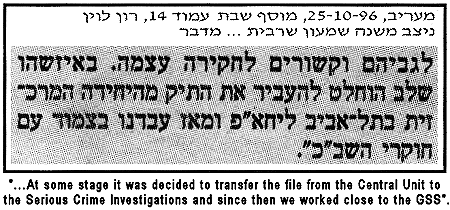
Defense: We have a report
that the Shabak was responsible for the (police) investigation. Do you know why?
Gazit: No idea but the Shabak was the dominant
factor at certain points in the investigation.
Defense: Why did the Shabak receive
responsibility for the investigation?
Gazit: I'm not authorized to tell you...
Defense: How did you feel about the Shabak's
role?
Gazit:
I didn't appreciate it.
It is inconceivable that, judicially, the
organization that is under scrutiny will itself conduct it's own inquiry. The
police hands were tied. It was "Big Brother" who instructed them what to extract
from Amir and they obeyed. As we shall see, the police would be paid handsomely
for its co-operation.
Amir insisted throughout that he traveled to the
rally by public transport - he boarded a bus (no.274) in Herzlya and got off at Arlozorov
at Ibn Gvirol corner, walking the remaining few hundred meters from the square.
According to prison inmates, his brother Hagai has a different version of
events.
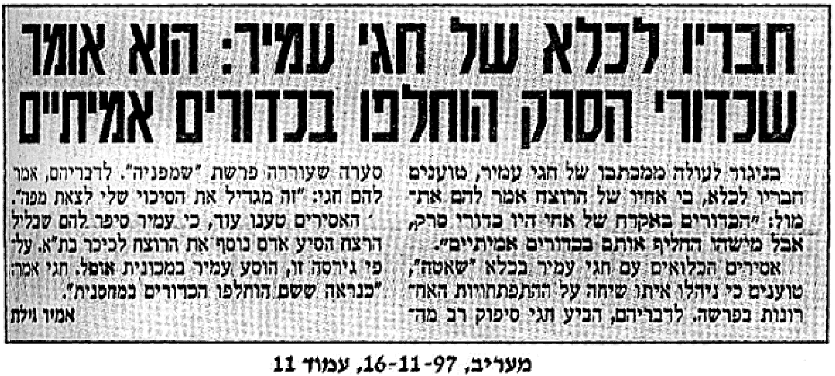
Hagai's prison inmates say that
yesterday the assassin's brother told them: "The bullets in my
brother's gun were blanks but someone changed them to real ones". The Shata
Prison inmates
also said that Hagai was very satisfied with the storm raised by the "Champagne"
affair, saying
that
"this increases my chances to get out of here". The inmates said that [Hagai]
Amir told them
that on the night of the murder another man drove [Yigal] to the Tel Aviv
square. According
to this version, Amir was driven in an Opel car. Hagai said: "It was probably in
there that the
bullets were changed".
IF YOU HAVE ANY
INFO PLEASE
SEND YOUR COMMENTS
Back
 Next
Next