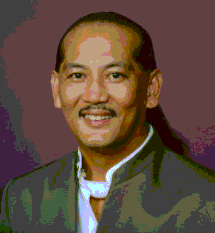
Published July 16, 2003 in the Pacific Daily News
With the passing of Angel Santos, the entire island, and not just the Chamorro community, have lost someone who was never truly appreciated for all he and his activist associates accomplished. Apart from the obvious resurfacing in Chamorro identity and cultural issues, Anghet and organizations such as Nasion Chamoru repositioned, refocused, and gave fresh perspectives, on the one thing which dominates the way our island persists and exists each and everyday, our relationship with the United States of America. Critiquing or slandering the United States in any context is something any and all people on Guam do, but it has been for the most part a private endeavor since World War II. Chamorro chenchule’ for liberation, immigrant attitudes of gratitude for American dreams achieved, non-local control over the news media, all these things and others have factored into limiting public critical conversation about Guam’s status, and still do til this day.
The local response to the Vietnam war, and the formation of organizations such as CHELU and OPI-R helped open up the island by questioning these issues about our colonial status and our military position to the US, and pushed for answers. But it was Anghet and I mangga’chong-ňa gi I Nasion Chamoru, who truly allowed arguments about status, icons and even the very terminology to enter our everyday discussions. The hatred and disapproval they were confronted with when they first began protesting, criticizing and voicing their opinions was a natural response to the extreme position they held. Resisting authority, shouting, jumping fences, these were all things that branded them as tairespetu by other Chamorros, and trouble-makers or “silly activists” by non-Chamorros. These were things almost everyone considered to be contrary to the ideals of Chamorro culture. At one point, yes, this sort of activism, this sort of reaction would be inappropriate. However, with more and more people on Guam becoming aware of the inherently unfair colonial situation of Guam, combined with the fact that most people were not actively engaging or confronting this in any meaningful way, the activism of Anghet was not just justified, but it was necessary.
Anghet and those like him were pioneers. Siha ni’ ma sungon todu I kinasse, I chinatli’e, I inachaki siha, makkat, hunggan, lao ti ma påra. . They endured much hardship, but by doing so became the extreme that allowed less extreme conversations to take place, both publicly and privately. We have never truly appreciated what the existence of activists on Guam, before and after Anghet have contributed. They force us to confront issues, even if we don’t wish to. They occupy our discussions without even knowing it. They slip new words and concepts into our vocabularies. By camping out on that extreme place, in terms of criticizing our colonial status, Anghet allowed so many others to move into the middle of the conversation. Because of his efforts, so many can now critique more clearly and openly our status, they can discuss with less fear of reprisal our colonial history, and our continuing colonial conflicts with our colonial master.
The efforts of Anghet, Dr. Robert Underwood, Ed Benevente, Hope Cristobal, Ron Rivera and so many others did not create an island of indigenous activists (lao siňa ta konsigi gumuife pot enao), but it created a community which is armed with a better knowledge of its history, its colonial relationship to the United States, and can now discuss these issues in a meaningful way, and not be deathly afraid of offending their families or their federal government.
9/11 silenced a lot of conversations, especially about problems with the United States, but we must continue to see the United States as what it truly is, not our friend, not our father, but our colonial and military master. As the United States and Emperor Bush Jr. seek to wreak further havoc around the world, and the American people can do little more than ask “Dude? Where’s my weapons of mass destruction?” we see American imperialism at work again. It was what took Guam, the PI, Puerto Rico and Hawaii more than a 100 years ago, killed off hundreds of cultures, and did kill thousands upon thousands of Filipinos and Native Americans. More recently, it is what killed more than 100 American servicemen in Iraq, not to mention tens of thousands of Iraqis.
It is just one of the legacies of activists such as Anghet that we can no longer deny that we too are victims of American colonialism and imperialism. To honor the memory of Angel Santos we must keep discussing, keep questioning, and at least understand that any real future for Guam, for any people, not just Chamorros, lies not in patronizing and dehumanizing ourselves by accepting our colonial status, but by pushing for equality, parity and partnership with the US. By forcing the US to live up to its own ideals of freedom, democracy and liberty.
Anghet, sainå-hu, ti bei maleffa todu I bidå-mu, ya gi hinasso-ku, ti tulaikayon hao. Maimaigo’ hao på’go, lao tungo’ nai na ti maimaigo’ yu’, yan esta listo yu’ ya bei dalalaki I hemplo-mu, ya bei konsigi’ hafa tinituhun-mu, esta ki put fin mana’libre I manachataotao-ta siha guini, I Chamorro. Ya esta ki mismo