


From the outset we did a preliminary budget of our expected cost for the trip and started saving furiously to achieve this amount. Unfortunately with the constant devaluation of the Rand, our estimates have had to be slightly revised (Rand denominated). We originally budgeted about R30 000 per person, all-inclusive, but subsequently reassessed this figure and we will now have an extra R10 000 per person available if we need it.
From our experience and other peoples advice, the American dollar is the most widely accepted currency throughout Africa. We have however been told to keep clear of large denominations (mainly $100 bills) as counterfeiting of these bills has been rife.
Another useful money strategy is for us to keep the Rands in our Investec bank account and then just withdraw local currency from ATMs in different countries on our way. The advantages to this strategy are that:
a)You only change money once (Rand into local currency) and are therefore only exposed to the ridiculous spreads on forex purchases and sales, once. You also get competitive spreads because you are actually purchasing forex from visa and with our Investec account we only get charged a flat R5 charge (commission)
b)You only draw as much cash as you need. This means that you probably wont be left with too much unspent local currency when you leave the country
There are however distinct disadvantages to this strategy as well:
a)ATMs are not always readily available. From our experience you really only find ATMs in the major cities and towns. However, as long as you plan your cash withdrawals properly, you should be able to get by this way.
b)You still need a small amount of currency for when you get into the country until you get to an ATM
c)As we found on a trip to Mozambique in December 2001, we will be running currency risk on a very volatile currency (the Rand). The Rand had depreciated over 25% in the two months leading up to the December holidays.
We have therefore changed some of our money into dollars (cash and travellers cheques) and will store this in our car safe. The balance we will leave in our Investec bank account, which can either be drawn upon via our credit card or through an ATM.

Louise found out about the various medications we needed:
We contacted the SAA Netcare Travel Clinic in Sandton, Johannesburg, to obtain all our info. They can be contacted on +27-11-807-3132.
Firstly, a yellow fever shot (which lasts for 10 years) is a legal requirement in most countries. (Yellow Fever is a viral infection transmitted by mosquitoes.) A valid Yellow Fever certificate should be produced to immigration officials upon request.
Secondly, Proof of Cholera immunisation may be demanded. International Health Regulations have deemed this outdated, but the circumstances in e.g. Tanzania, makes carrying a cholera certificate advisable. (We have decided on taking the risk and not getting the immunisation.) Nigeria has also been reported to have problems with cholera. Avoid shellfish in areas of risk.
A major problem in most of Africa is the threat of malaria. Malaria is a serious parasitic infection spreading by night biting Anopheles mosquitoes. These mosquitoes are usually most active during dusk and dawn. Prevention of bites is the most effective way of avoiding malaria, but preventative measures need to be taken in addition.
We found that Doxycyclin was the newest and apparently the most effective anti-malarial prophylactic. It also assists in the prevention of most infections (even cholera and ghonnorea). There is a high resistance to Fansidar throughout most of Africa. Amodiaquine has certain fatal side effects (according to the BA website). A high resistance to Nivaquine and Daramal has also recently been developed.
Recommended Vaccinations for Africa Travelling:
�Typhoid: Typhoid is a dangerous bacterial disease that may be fatal. Ingesting contaminated food or drink spreads it. (Kenya has been reported to have a problem)
�Polio: Polio is a viral disease spread by contaminated food or drink. A booster is advisable.
�Ebola: Ebola is at large in East Africa and is fatal.
�Hepatitis A: Hepatitis A is a viral disease spread by food and water. (Two injection system)
�Rabies: Rabies is a uniformly fatal disease ensuing from a bite, lick or scratch of an infected animal. (Three injection system)
�Hepatitis B : Hepatitis B is a disease spread by human fluids. It can be transmitted through sexual contact, by blood transfusion or in medical facilities. A good idea is to carry your own stash of needles, etc. (Three injection system)
�Diphtheria: Diphtheria has recently started to reappear and an adult inoculation is available.
�Meningitis: Meningococcal Meningitis is a disease spread by a droplet infection from naso-pharynx. (Especially a problem in Ethiopia, Rwanda, Burundi and some areas in Namibia. Also the Kenya/ Tanzania belt.)
Other risks: HIV is a serious problem throughout Africa!! So keep clean to keep safe!
Bilharzia is a risk in certain areas.
Certain parasite infections, such as Ringworm or Roundworm.
Brucellosis, transmitted by animal products and unpasteurised milk.
�Diabetics should have all vaccinations well in advance and spread over a period of time. The reason for this is that it influences the sugar levels significantly. The Diabetic Clinic does provide for inoculations. (refer to the diabetic link from the main page)
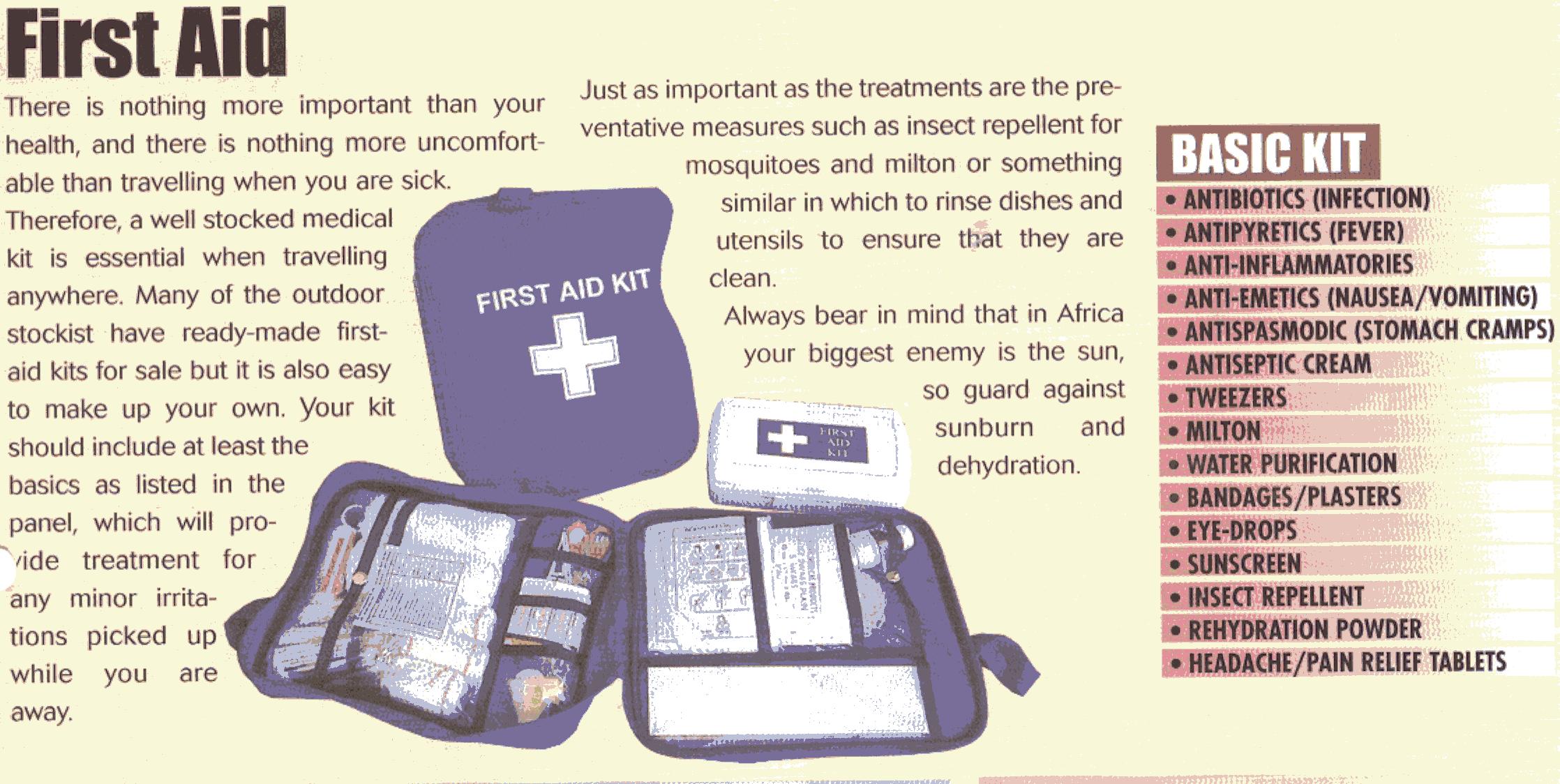
We got the following article from the 4X4 magazine (a South African publication). We will be adding a few extra medical items to the ones listed below, but this is the basic starting point of any medical aid kit.
3) Visas
South Africans only need visas for 3 countries (Mozambique, Ethiopia and Tanzania). We have decided to get them when we get to the various countries as we dont know the dates that we'll be visiting each country yet.
4) Insurance
At this point we still havent managed to find an insurance policy to cover all our needs. We are still looking though
5)Carnet de Passage
When you bring your car into a country, you're required to pay temporary import duties. A Carnet (a document obtainable from the AA) however is equivalent of paying the import duties upfront and it also effectively guarantees that you will in fact take your car out the foreign country and return it to its original point of departure (once you've finished travelling). You need to put up some money or collateral as proof that you will bring the car back to its original departure point, which is refundable when you present the car back after your travels. Everybody we've spoken to recommends the Carnet de Passage as the best way to travel overland. Apart from being the cheapest option it apparently saves on a lot of administration and explaining at the border posts. You can buy various Carnets for entry into different number of countries. Contact your local Automobile Association for further details. (the 10 page costs around R1,450 while the 25 pager costs around R1,690)
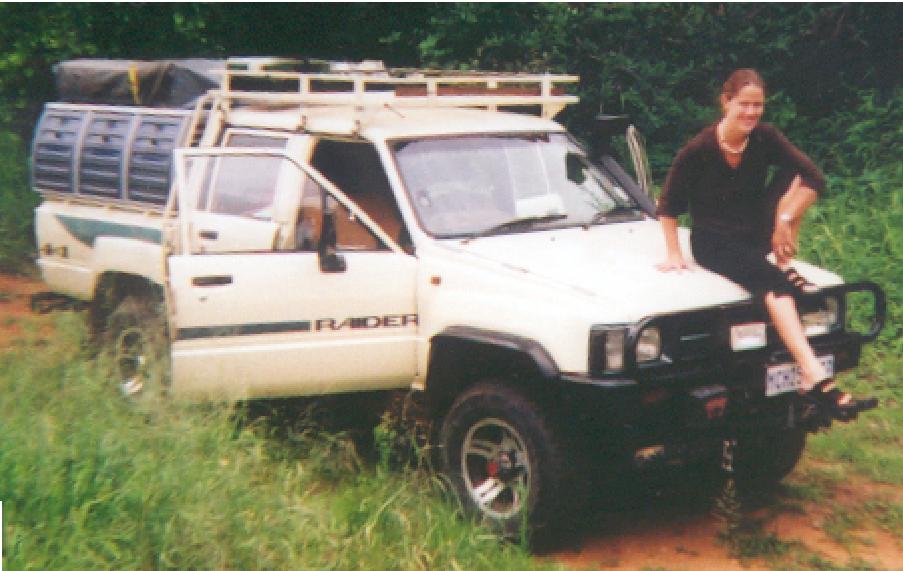
We bought Slapper in March 2001 and took the rest of the year to customise and fix her up. Our philosophy was that she was going to be our house for a whole year and therefore wanted to "kit" her out appropriately. In the end we probably spent too much money on her upgrades etc, but only this year's travels will prove whether this was a valuable investment or not.
Click on the photograph to get more details on what we did to her
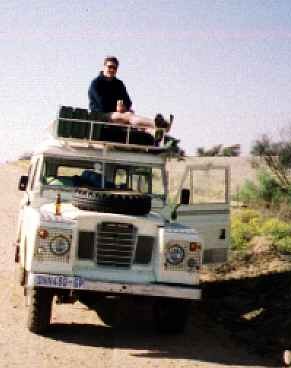
a 1974 Land Rover Series III short wheel base.
My dream car for a tour of Africa since I can remember. With a top speed of 80km/h down a greased mine shaft, I'll need every day of our 9-month tour to keep up with Slapper. But with the TLC required by Landies, Mr Jiggles will go anywhere the wind blows, like me.
Click on pic to see his training.