
The Freedom Files
|
|
The Freedom Files |
|||||
|
|

Winner of the Advocates for Self-Government Lights of Liberty Award!

The Freedom Files
"Laissez-faire, laissez-passer, le monde va de lui-meme."
DIY since 2001…

|
|
|
Howard Stern |
|
Buy New $17.99! |
| |
|
|
|
|
|
George Orwell |
|
Buy New $11.20! |
| |
|
|
|
|
|
Renée Zellweger |
|
Buy New $25.18! |
| |
|
|
|
|
|
Wendy McElroy |
|
Buy New $13.27! |
| |
|
|
 |
| George Carlin |
| Buy New ! |
| |
 |
| Jonathan Wallace |
| Buy New $14.95! |
| |
 |
Hello Freedomphiles! Boy, has my Tittygate essay put me on some shitlists. Everyone and their mother wants to tell me why the FCC has a right to violate the First Amendment daily. So, once and for all, for anyone interested, I am going to take a few minutes to explain the where's and why's of the Supreme Court's justification for such actions, and of course, blow them into fucking smithereens.
Let's start at the beginning...
What we are talking about here is what the Supreme Court considers
indecency. The legal difference
between obscenity and indecency was defined in the 1973 case
Miller v. California, which defined obscenity as "patently
offensive" material, with no "significant scientific, literary, artistic, or
political value." This is otherwise known as the SLAP standard. Now,
indecent material would still be "patently offensive," but would have some
SLAP value. This is the category that Stern fits into. So, "Fuck me"
is out, but "Fuck the FCC" will just get you fined.
Historically, this definition of indecency has been used, according to
Jonathan D. Wallace, co-author of
Sex, Laws, and Cyberspace "to prosecute writers and publishers of
controversial novels (including the works of Balzac, Tolstoy, Zola, and
Joyce), along with early crusaders for women's sexual independence, abortion
rights, and birth control." You know, those
Down With Love girls.
Now, from the beginning, the rationale for censoring the airways has been
the bizarre idea of "spectrum scarcity." The thinking goes that since the
broadcast spectrum is a scarce resource, the government has the right to
appropriate it, dole it out, and regulate content. This is the weakest of
all arguments, as anyone whose been to even the first day of an economics
class knows that all resources are
necessarily scarce, including those to make books and newspapers.
This thinking provides perhaps justification to regulate the use of the
airwaves (I disagree, but that's another Freedom File), but not the
justification to offer lower First Amendment protections to its users. The
argument, in a nutshell, is that since they took the airwaves to facilitate
efficient use, it is now theirs, and they can regulate its content as well.
As Wallace asks, "Why should technical distinctions be the basis for
different treatment under the First Amendment? What would be the rationale,
say, for regulating printed books more strictly than books on parchment or
papyrus?"
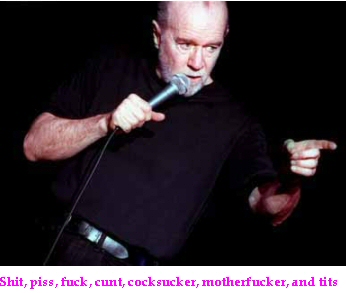 The Supreme Court tried to clear this matter up a bit and gave themselves
some sort of groundwork for the censoring function of the FCC in their
flawed ruling on 1978's Pacifica Foundation
v. FCC. Ironically, this case was over WBAI-FM's playing of George
Carlin's seven dirty words monologue
against FCC censorship.
The Supreme Court tried to clear this matter up a bit and gave themselves
some sort of groundwork for the censoring function of the FCC in their
flawed ruling on 1978's Pacifica Foundation
v. FCC. Ironically, this case was over WBAI-FM's playing of George
Carlin's seven dirty words monologue
against FCC censorship.
Their ruling stated that the most prescient justification for the censoring
ability was that radio was "pervasive," that "the broadcast media have
established a uniquely pervasive presence in the lives of all Americans.
Patently offensive, indecent material presented over the airwaves confronts
the citizen, not only in
public, but also in the privacy of the home, where
the individual's right to be left alone plainly outweighs the First
Amendment rights of an intruder." Never mind that we must first buy, then
turn on, then tune any radio before we can receive these broadcasts,
essentially the same thing as buying, opening, and reading a book. Or
inviting someone into your home who turns out to be offensive to you.
What do you do then? You kick the bastard out. In the case of
radio, you use the opposable thumbs God gave you to turn the fucking dial.
But this justification is not new. It was used by King François I in the
1530s to destroy printers and ban printed books, as the danger of print to
spread ideas quickly was threatening to him - print media was
pervasive.
In his dissent to Pacifica v. FCC,
Justice William Brennan rightly noted its rationale "could justify the
banning from radio of a myriad of literary works, novels, poems and plays by
the likes of Shakespeare, Joyce, Hemingway." Not only those literary works,
but at the time current politically controversial items "such as the Nixon
tapes." Even the Bible was not safe, he argued, as I Samuel 25:22, where
King David says "So and more
also do God unto the enemies of David, if I
leave of all that pertain to him by the morning light any that
pisseth against the wall." [Emphasis
mine]
The Court was not swayed by such arguments, reason being their enemy, and
were not overly concerned because the worst the FCC could do at the time was
put a letter of sanction in Pacifica's file. Of course, this could become
more pertinent when Pacifica tried to renew it's license for WBAI. Since
that time, of course, the penalty has gone from a chiding letter to a
$500,000 fine.
The majority opinion also argued, as many of my would-be detractors have,
that since the "seven dirty words" rule was narrowly defined, broadcasters
could easily find other words to use to make the same point, ignoring the
fact that Carlin's point, which was political speech, could not have been
made without using those seven words!
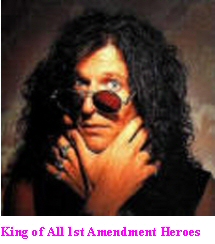
Enter Howard Stern, and the era of double-entendres and innuendo. Using the
Court's definition of indecency and the "seven dirty words" rule, "shock
jock" Stern and scores of imitators spoke frankly about sex without running
afoul of the FCC.
But the FCC showed it's true stripes in response, revealing it wasn't really
the word choice that got them, but the content. It wasn't the words
they wanted to ban, but the thoughts. Even Stern's adherence to
their
newspeak did not protect him, because he was having unapproved
thoughts. The FCC expanded it's indecency regulations in 1986 to
include "patently offensive" language describing sexual or excretory acts or
organs, and as a result, eventually fined Infinity, the show's syndicators,
$2 million.
As a result of these confusing and arbitrary standards, stations don't know
what will be deemed indecent and what will make it by. Could they play the
Nixon tapes, filled with racial slurs and obscene language, or would that
meet the SLAP test? "That is bound to have a chilling effect on programming,
because broadcasters have to anticipate what the FCC will consider indecent,
and even material with a serious point can run afoul of the rules," says
Wallace.
This brings us to today's problem, kicked off by
Tittygate, whereupon broadcasters, fearing these
huge fines and FCC harassment, have gone to great lengths to avoid the wrath
of these amped-up censors. Stern's show has been dropped from profitable
markets, and Emmis Communications and Clear Channel have adopted a much
stricter guideline and zero tolerance policy for their on-air talent because
"federal guidelines on indecency are vague."
Vague enough to present a real threat to other industries, as well. First Amendment attorney Robert Corn-
Revere rightly deduces that "the
pervasiveness doctrine empowers government to exert greater control over a
medium of communication to the extent it is universally available and
influential. By this logic, the printing press should be subject to
intensive regulation, since few media are as pervasive as print. Such
reasoning is antithetical to the First Amendment."
Indeed. And the bitter irony of it all is that the goal of all media is to
reach a larger and larger audience, to become more and more pervasive. So, a
necessary result of success is a weakening of their First Amendment rights.
As Wendy McElroy, president and founder of
iFeminists, said, "Taken to its logical conclusion, the pervasiveness
argument would prohibit anyone standing on a public street from
discussing...controversial matters. The open air might well transmit the
discussion through the open windows of nearby houses, businesses, and
apartments. One might reply, `Let them close the window.'"

Or turn the dial.
So, I reiterate. Fuck the FCC.
Until Next Time, Make Every Day a Good One!
- Rick
If you liked
what you read, please forward this to a friend.
If you've been forwarded this and would like to be on the list, have comments
good or bad, would like more information about Libertarianism, or have
received this in error and would like to be removed from my list of freedom
lovers, e-mail me at:
|
©2004 RS Davis |
Freedom Files Archives • Freedom Lyrics • Freedom Links • Freedom Pictures • Freedom Forum |


