


Eugenia's first contact with a people that deemed the native Eugenian communalist subsistance culture to be 'primitive' uccured sometime in the 1540's. What followed was the usual pattern of false promises, greed, genocide and domination. The visitors brought empty treaties, smallpox laden blankets and square-jawed Jesuits who marched across the land with bible in one hand and sword in the other. Many Eugenians fell victim to the strange deseises that they bought. Many others died defending their land. Some retreated into the jungles, mountans and vast wastelands of Eugenia to take up a guerilla war for land and liberty that would last for over 300 years. These freedom fighters were joined by bands of escaped slaves who were brought over from Africa to build and work the plantations that had been set up by the colonists.
As the stars of various imperial powers rose and fell, the old Spaniards were displaced by other masters but not much changed until the long sought after scource of the gems used in Native Eugenian jewelry was found in the Big Rock Candy Mountains. It was then that the Scramble For Eugenia began in earnest. Many bitter wars were fought amongst the world's imperial powers, and a Free Outer Eugenian Republic was formed by rebel peasants, native insurgents and the various slave revolts in the ensuing chaos. The Free Republic lasted for the better part of a decade until the powers contending for control over Eugenia's resources came to an uneasy compramise. A 100-year monopoly over Eugenia was granted to an international cartel led by the notorious patent medicine conman turned railroad tycoon and beef magnate Augustus Kroc. Kroc then sent his ambitious son-in-law Tiberious at the head of an army of merceneries and the soldiers of the various powers to take possession of his monopoly.
Faced with the ironclads, gattling guns and other supirior arms of an industreal war machine, the machete and musket wielding defenders of the Free Republic were bruttaly crushed. The rich planters who had fled Eugenia returned to their estates as another generation of freedom fighters retreated into the mountains and jungles.
Acting as an agent of Kroc Industrial, Tiberius Kroc (who had taken his father-in-law's name) employed slaves and indentured laborers to mine Eugenia's gems.
As slavery fell out of favor in the world and early trade union movements began to win rights for waged labor, Kroc Industrial saw Eugenia as a lawless haven for the employment of slaves and waged semi-slaves to produce cheap goods for the world market. The discovery of oil and heavy metal deposits further spurred KI to develop Eugenia. Tiberius Kroc (who had become the head of KI after the death of his father-in-law) negotiated a 100 year extension on KI's monopoly and moved his corporate headquarters to a fortified base on Vanderbilt Island. He imported masses of impoverished workers to fuel the industrial machine of his corporate feifdom.With them was bought the germ of revolutionary syndicalism, the seed of Eugenian liberation.
Revolution and Liberation
The Federation of Free Outer Eugenia was declared nine decades ago after the workers of Port Bakunin (then known as New Krocsport) aided by a group of their Shiree comrades expelled the cartel of transnational corporations that had been the unchecked exploiters and oppressors of the people of Outer Eugenia.
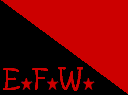
The revolution continued for the next fifty years until the whole of Outer Eugenia had thrown off the yoke of corporate imperialism, though the old regime had been largly contained in a diminishing sphere of control around Fort Vanderbilt (later renamed Fort Vanzetti) for forty-two years. The revolution was fueled by a fusion of an underground syndicalist labor union (the Eugenian Federation of Workers) that had formed during the years of industrealization and the native uprisings that had been raging since the early years of colonization. The traditional concensus-based collectivism of the Native Eugenians and the anarchist syndicalism of the EFW formed the foundation of the















The Eugenian Social Revolution then spread across the region giving rise to the Anarchist Federation of
The University at Port Bakunin
The University was founded by a collective of artists, peots, engineers and philosophers shortly after the revolution to advance the propogation of the arts and sciences amongst the workers of the Federation. It is for the most part the University that makes Port Bakunin the cultural and intelectual center of Free Outer Eugenia. although there are many other great educational collectives in the Federation, most Outer Eugenians spend at least a year or two as a part of the University at Port Bakunin.
Entering the International Arena
Aside from aiding those oppressed under Dictatorship of Great Ponte Preta and participating in other international revolutionary struggles, the Federated Communes of Free Outer Eugenia had not really entered the international political scene until all of Outer Eugenia had been liberated and united under the Federation thirty years ago.
There had been a heated debate as to whether or not the Federation should apply for membership in the bourgeois United Nations. There were those who held that by joining this organization, the people of the Federation would be subjected to the influence of the very tyrants whom they had just overthrown. Others though pointed out that UN membership could be used as a powerful tool for the Federation to exert it's own sway over the capitalist/statist tyrants and thus to further the international emancipation of labor.
To solve this dilemma, an association was formed by those individuals and communities who wished to join the UN, and this association presented itself to the Applications Committee with its petition for Free Outer Eugenian membership.
The Federated Communes joined the CACE under a similar arrangement shortly after the erection of the CACE headquarters in Celdonia. Though most of the member-nations are state-socialist, most are relatively free and democratic. There are some notable exceptions to this though, and this has lead to some conflicts. The people of Free Outer Eugenia have never failed to take up the cause of the opressed workers, even when the opressors wrap themselves in the red banner. The most notable of these conflicts have been with the coordinator class dictatorship of Seocc.