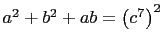
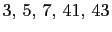
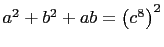
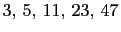
![\includegraphics[width=2.5in]{../../../texdocs/ip4}](img784.gif)
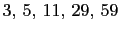
It's well known that if  is a a Pythagorean triple, that
is, if
is a solution in positive integers to the 90 degree
triangle equation
is a a Pythagorean triple, that
is, if
is a solution in positive integers to the 90 degree
triangle equation
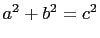 , then 3 and 4 each divides
  or
or
 , and 5 divides
  or
or  where, of course,
  is the
smallest such solution.
is the
smallest such solution.
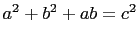
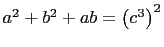
A 120 degree triple,
, is a solution in positive integers
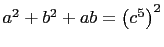
to the 120 degree triangle equation

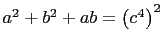
So, naturally, one wonders if a similar relationship exists between the positive integer solutions of 120 degree triangles and the smallest such solution,
 ? It does, almost. To find such a relationship
it's necessary to include an
? It does, almost. To find such a relationship
it's necessary to include an  term.
term.
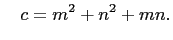
All primitive solutions to a 120 degree triple
, are given
by the parametric equations:
 and
and  are relatively prime, positive integers,
  ,
and
,
and
 . See (8) for a proof.
If
and  are considered the same solution, then
the first 6 primitive solutions in order of smallest value for c
are,
are considered the same solution, then
the first 6 primitive solutions in order of smallest value for c
are,
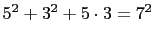
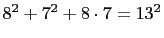
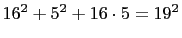

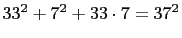

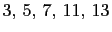
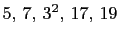
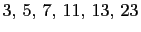
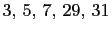
Notice that, in each case, 3 and 5, each, divides one of
, or
, and 7 divides one of
,
, or
.
is any 120 degree triple then 3 and 5
divides  , and 7 divides
  .
.
 and
and  are integers, and
  is a prime, then
 divides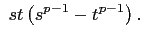
From (37),
 |
 |
|
 |
||
 |
 |
 |
|
 |
,
and 7 divides
. And since 3, 5, and 7 are primes then 3
and 5 each divides one of
, or
, and 7 divides one of
 , or
.
, or
.

A 60 degree triple,  , is a solution in positive integers
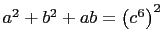
to the 60 degree triangle equation
, is a solution in positive integers
to the 60 degree triangle equation

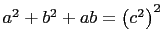
Note that

Hence, if
is a 120 degree triple then  and
and
 are 60 degree triples.
Here is a ``neat'' way to construct these three triangles.
![\includegraphics[width=4.0in]{../../../texdocs/ip2}](img811.gif)
On line  layout line segments
  and
and  having lengths
and
respectively, where
and
are the side lengths of a
120 degree triangle. On and below
construct equilateral
triangle
having lengths
and
respectively, where
and
are the side lengths of a
120 degree triangle. On and below
construct equilateral
triangle  with sides of length
. On and above
construct
equilateral triangle
with sides of length
. On and above
construct
equilateral triangle  with sides of length
. Hence
with sides of length
. Hence
 and
and
 are each 60 degrees. So point
  lies on line
segment
lies on line
segment  and
and
 is 120 degrees. Draw line segment
 . Thus, the construction shows the 120 degree triangle
  and
its two associated 60 degree triangles
and
its two associated 60 degree triangles  and
and  .
.
Let
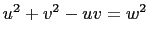 . If
. If  , and
, and  are positive integers,
then
are positive integers,
then  is a 60 degree triple. If, additionally,
,
and
are pairwise relatively prime, then
is a primitive
60 degree triple. The first seven such triples in order of the
smallest value for
are,
is a 60 degree triple. If, additionally,
,
and
are pairwise relatively prime, then
is a primitive
60 degree triple. The first seven such triples in order of the
smallest value for
are,
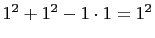
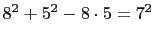
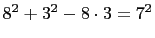
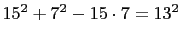
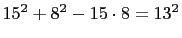
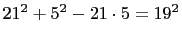

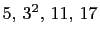
Notice that, in each case, 3 and 5, each, divides one of
, or
 , and 7 divides one of
,
, or
.
, and 7 divides one of
,
, or
.
is any 60 degree triple then 3 and 5
divides  , and 7 divides
  .
.
 . So let
where
is a primitive triple,
. So let
where
is a primitive triple,  . Without loss of generality, let
  be greater than
  ,
then
,
then

Hence
 is a 120 degree triple. So, from claim (8),
 and
and
The drawing below shows two 60 degree triangles
and
along with their associated 120 degree triangle
.
![\includegraphics[width=4.3in]{../../../texdocs/ip3}](img841.gif)
and
be non-zero integers, and let  and
and  be positive integers such that
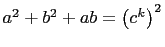 where
is a divisor of
where
is a divisor of  and
and
 and
are pairwise relatively prime.
and
are pairwise relatively prime.
 is a prime then
divides one of
and
is a prime then
divides one of
and

 is a prime then
  divides one of
 and
and 
 ,
,  a non-negative integer, then
  divides one of
and
divides one of
and
To find relative prime non-zero integer solutions to
, set

where
 and
and
And where
and
are positive integers,
, and  is not
a multiple of
is not
a multiple of  Then
Then
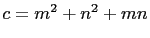 .
.
and
have the same sign then
 is a 120 degree triple.
and
have opposite sign then
is a 60 degree triple.
is a 120 degree triple.
and
have opposite sign then
is a 60 degree triple.
Note that if integers
and
have the same sign then  and
have the same divisors. And if
and
have opposite
parity then
and
and
have the same divisors. And if
and
have opposite
parity then
and  have the same divisors. So to
change table (6) to a table of divisors of 60 degree
triples all that's necessary is to change
to
have the same divisors. So to
change table (6) to a table of divisors of 60 degree
triples all that's necessary is to change
to 
 and
and