The information obtained from the Internet at the front desk indicated Mitch was stalled southeast of the Yucatan Peninsula. We decided to head to the east coast and beach despite the danger, albeit reduced, of Mitch's possible impact.
We got a late start on the day, Curt and Eric checked out of the hotel and packed the car while Missy walked to the nearby Hardee's to pick up some hash browns and fries for a "tide us over" breakfast. (At least we also had some corn flakes to reduce the fried food factor.) It's unfortunate that, in our travels to other countries, the only fast food restaurants we ever see are American based. That means the fare at them is heavy with meats, grease, and other "foods" high in fats. We frequently seek to trade time spent eating for time spent touring (especially during daylight hours), but that often leaves us with few choices for meals. For example, we can have foods we bought at a grocery store–not warm filling meals–or foods bought at a fast food restaurant; i.e., greasy, unhealthy food. When touring in the US we can at least get healthy, vegetarian fast food at Taco Bell's, but in Mexico a Taco Bell would probably be considered sacrilegious.
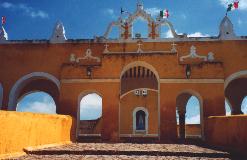
About one hour into our drive to the east coast, we stopped in Izamal. A center of commerce and trade during the Spanish colonial period, Izamal slipped into obscurity when Mérida took over as Yucatan's chief city. Izamal's nickname is Ciudad Amarillo (Yellow City). Nearly all its buildings are yellow, constructed with materials taken from the nearby Kinich Cakmó Pyramid and other Maya structures. (Reminiscent of the way many old European churches were constructed from ancient Roman buildings.)
We parked in front of the large, yellow, 16th
century Franciscan Monastery at the city's center,
 tipping a uniformed
police/tour industry person for giving us information, a map, and directions.
The monastery was built on top of a Maya pyramid, the stairs of which remain.
Inside the monastery, a humpback dwarf (there are lots of them about…what
keeps that gene pool going?) followed us around, seeking to be our guide.
Curt tipped him and sent him on his way. A few years ago, the pope had
made a visit to this monastery and gave a crown offering to the statue
of Our Lady of Izamal, a crown she wears to this day.
tipping a uniformed
police/tour industry person for giving us information, a map, and directions.
The monastery was built on top of a Maya pyramid, the stairs of which remain.
Inside the monastery, a humpback dwarf (there are lots of them about…what
keeps that gene pool going?) followed us around, seeking to be our guide.
Curt tipped him and sent him on his way. A few years ago, the pope had
made a visit to this monastery and gave a crown offering to the statue
of Our Lady of Izamal, a crown she wears to this day.
There is a wonderful view from the monastery of the town and the Kinich Cakmó Pyramid. Before heading there, the other site to see in Izamal, we hit the monastery's bathroom. These bathrooms were in very good condition. It's likely they were built or refurbished prior to the pope's visit (one wouldn't want his Holiness to catch a disease while relieving himself on one's premises). The tourbooks on Mexico recommend using bathrooms in hotels or restaurants as public bathrooms (e.g., at gas stations) aren't up to US standards. This was probably one of the most "public" bathrooms we used (other than those in the airport and when we were swimming in the Caribbean Sea) and it was fine; though its toilets had no toilet seats. That, however, was common even in clean bathrooms (though we always had toilet seats in our hotel rooms). We don't know if they were missing to reduce the amount of cleaning, to reduce spread of diseases (what can one really get from a toilet seat?), or if they had been stolen.
The short drive from the monastery to the pyramid took longer than expected. We first got behind a tour group which was making its way to the pyramid in a line of horse drawn carriages. Then we missed a turnoff and had to double back. Missy and Eric preferred to wait in the car as Curt climbed the rather crumbling pyramid. It was a fun if rather rushed climb though the view of the monastery from the pyramid was not as scenic as the other way round.
Continuing our drive, we reached Valladolid about an hour later. This is the small town we had intended to visit the previous week but merely drove through due to heavy rains. We had a late lunch at a hotel restaurant in the town square. The weather, which had turned from sunshine to gray as we approached Valladolid, took a turn for the wetter. Rain poured down as we ate. While watching the TV at the front desk for the latest news about Hurricane Mitch (TVs everywhere were on and it seemed every channel was talking about Mitch) Curt noticed the rooms at the hotel were $30 a night. It would have been wise to think about spending the night there.
After lunch, with the sky again bluing up, we visited the Dzitnup Cenote, a few miles out of town. There is an admission to enter this cenote and the parking lot for it is surrounded by small tourist shops and children (5-10 years old) hawking wares or seeking payment to "watch your car." (From who? The other kids?) Nervous about leaving all our possessions in the car while we were in the cenote, we decided to take turns visiting it. Missy would car sit first while Eric and Curt went to the cenote.
The reason this cenote stands on its own as a tourist
attraction and why there is an admission to see it is that it is underground
in a spacious cavern.
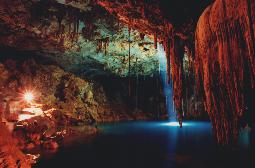 A hole in the cavern roof, forty feet above the cenote
water level, allows shafts of light to enter and gives the place an underground
majesty. Plus, one is allowed to swim in its cool, crystal clear water.
Eric and Curt descended the narrow, slippery passageway into the main cavern
hall. A handful of German tourists were toweling off after their swim.
After exploring the cave a little (there is a short stairway up that leads
to a quick dead-end), Eric led Curt into the water. Still a little tentative
since his last swim ended uncomfortably and his snorkel problem (the small
stone in it) hadn't yet been detected and fixed, Eric didn't want to swim
out too far. As Curt was entering the water, Missy appeared. Having talked
with the children in the parking lot (though they knew little more English
than Missy knew Spanish), she felt comfortable leaving them watch the car.
A hole in the cavern roof, forty feet above the cenote
water level, allows shafts of light to enter and gives the place an underground
majesty. Plus, one is allowed to swim in its cool, crystal clear water.
Eric and Curt descended the narrow, slippery passageway into the main cavern
hall. A handful of German tourists were toweling off after their swim.
After exploring the cave a little (there is a short stairway up that leads
to a quick dead-end), Eric led Curt into the water. Still a little tentative
since his last swim ended uncomfortably and his snorkel problem (the small
stone in it) hadn't yet been detected and fixed, Eric didn't want to swim
out too far. As Curt was entering the water, Missy appeared. Having talked
with the children in the parking lot (though they knew little more English
than Missy knew Spanish), she felt comfortable leaving them watch the car.
We took turns swimming and filming each other. There are fish in the cenote, though not schools of them, but the interesting part of the swim is going where the shafts of sunlight and human-supplied artificial light doesn't shine. That water is pitch black and intimidating just a few feet below the surface.
As we were toweling off,
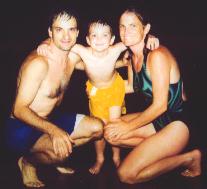 a small group of Americans arrived.
They hadn't thoroughly planned for this stop as they didn't bring along
bathing suits. Most of them went in anyway including a woman who wasn't
wearing a bra. She was a little embarrassed coming out of the water with
her light, white cotton shirt clinging to and revealing her bosoms. Curt
pretended not to notice (to lessen her embarrassment) as did the Mexican
tour guide who had come down during our visit (though Curt saw him noticing).
a small group of Americans arrived.
They hadn't thoroughly planned for this stop as they didn't bring along
bathing suits. Most of them went in anyway including a woman who wasn't
wearing a bra. She was a little embarrassed coming out of the water with
her light, white cotton shirt clinging to and revealing her bosoms. Curt
pretended not to notice (to lessen her embarrassment) as did the Mexican
tour guide who had come down during our visit (though Curt saw him noticing).
We had fun pulling ourselves back up the passageway to the earth's surface (a rope is provided). Missy paid the kids who watched the car with a half empty box of corn flakes (which they had requested). We also gave away three small toys we brought for occaisions like this. The three girls who got the spinning propellers were gleeful.
It was now about 5:00 and we continued our drive to the coast without a second thought. That was a mistake. We had already spent a couple of hours in the car and it would soon be dark. Tour books advise against night driving on the peninsula as there is little traffic (which means a broken down car will sit until the next day), the roads are not lit (they may have potholes and do have speed bumps), and people may walk or sleep (for its coolness) on the roads. We successfully made the final two hour segment of our drive to the small coastal town of Puerto Moreles, arriving just after 7:00. (Besides card games, one of the things we did to pass the time was watch lightning bugs 'crash and burn' on our windshield.)
All hotels and restaurants in Puerto Moreles, and indeed up and down the east coast, were closed due to Hurricane Mitch. The coast was under a double red alert and the tourist towns were evacuated–except for the biggest of the big money towns: Cancún. As we left Puerto Moreles and headed north towards Cancún, every building we saw had its windows boarded and/or taped up. Thirty minutes later we got a room in a Hotel Calinda in Cancún. We were too tired to look for a less expensive hotel (nightly room rate was advertised at $63 for a single, $70 for a double). As this Calinda was not on the beach but by Nichupte Lagoon and the town of Cancún, its prices were half that of its sister hotel (where we stayed our first three nights). The hotel was nearly empty as tourists fled before Mitch would arrive. (We assume this caused a rate reduction as we were only charged $54 for our room.)
Though we were tired we were even more hungry. We headed to the large shopping mall a couple of blocks from our hotel and dined there in an Italian restaurant (gnocchi and Mexican pasta). Even inside the mall, the large windows of the stores were taped or boarded. The mall had a supermarket/department combination store where we did a little shopping. One woman there was partially peeling onions to ensure she picked good ones, a family of three was buying a stack of grapes, picking off any that seemed damaged so they wouldn't have to pay for them (those could be reasons for having security personnel in a store).
The TV in our hotel got HBO. Curt and Eric stayed up late
watching Men In Black. Missy read a little and turned in earlier.
| PREVIOUS DAY | NEXT DAY |
| Back to Curt, Missy, and Eric Homepage | Back to Start of Mexico Diary | Back to All Diaries |
© 1999 [email protected]
