The front desk was making up-to-date information available on Hurricane Mitch (pulling it from the Internet). Mitch was now a class five hurricane (the most severe) packing sustained winds of 180 mph with gusts of 210 mph. It was expected to hit land at Chetumal this evening and then work its way north up the coast to Cancún. The hotel was getting new Customers who were leaving the east coast ahead of Mitch. The Mexican weather forecasters are dependent upon US weather tracking satellites and software, and the latter is evidently poor when the weather system is extremely slow moving–as was the case with Mitch. We'd have to make our plans on a day to day basis.
We drove to the northern part of Mérida to the Paseo Montejo, the so-called Mexican version of the Champs-Élysées. Paseo Montejo is a broad, attractive avenue (three lanes each way with a line of trees separating the traffic in each direction), but it had little to remind us of the Champs-Élysées. The buildings along Paseo Montejo were spaced and mostly luxury hotels and there was almost no pedestrian traffic. The Champs-Élysées is alive with people. It's in the center of Paris, bordered on all sides by famous Paris landmarks and museums, and the packed in buildings include stores and restaurants to cater to the large number of people (French and foreign) found there nearly any time of any day. Perhaps the wealthy Mexicans who lived here during the 19th century–their wealth gained through henequen plantations–imagined themselves as social peers to the European elite so they claimed they lived on Mexico's version of the world's most famous street.
We cashed some traveler's checks at an American Express Office getting our best rate yet ($10NPs to $1USD). One of the tips tour books give on saving money is to cash traveler's checks at banks. If a bank is not readily available, use a money changer. Only as a last resort use a hotel as they give the worst rates (next to airports). The hierarchy they cite is generally accurate, however the savings (or expense) on money conversions is rather insignificant. As noted, the 10:1 exchange we got at the AMEX office was the best we got on our vacation. The money changers and banks (the one time we used a bank it wasn't as good as some of the money changers) had rates of 9.8:1 to 9.95:1. The one hotel in which we inquired about the rate was 9.65:1. The difference in best to worst exchange rates translates to a difference of $3.50 for every $100 converted. Not a big deal. (Compare that to the $100+ extra expense you incur for every night you sleep, shower, and shit in an expensive hotel as opposed to a locally owned and operated one.)
The only restaurants we found on this "Nothing like the Champs d'Elysees" avenue were hotel restaurants. The first restaurant we inquired at suggested a breakfast that included eggs, ham, and sausage (this was after the waitress read our "we are vegetarians" card), the second (and chosen one) could only offer hash browns and a fruit plate. The food was expensive and not very tasty.
Our main reason for coming to Paseo Montejo was to visit
the Museo de Anthopologia E Historia (Museum of Anthropology and History).
We saw its collection of misshapen (by design) ancient Maya skulls and
other skulls containing filed, bejeweled teeth. The museum also contained
gold and jade objects retrieved from the Sacred Cenote at Chichén
Itzá and the ball hoop that was missing from Uxmal. In a room displaying
how the Maya dealt with death,
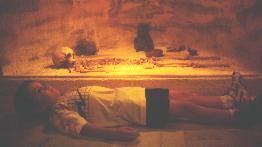 Eric posed for a picture laying on the floor
near the skeleton of a small person in a burial hole. The museum guard
was quite amused, laughing and calling to a friend describing what he'd
seen.
Eric posed for a picture laying on the floor
near the skeleton of a small person in a burial hole. The museum guard
was quite amused, laughing and calling to a friend describing what he'd
seen.
A dozen miles north of Mérida is Dzilbilchaltún. This former Maya center is one of the largest of Mexico's archeological discoveries. More than 8,000 structures, mostly mounds of ruble or the remains of low platforms, have been discovered so far. We headed north towards Dzilbilchaltún passing by the large, elaborate sculpture grouping, Monumento a la Patria (Monument to Patriotism). We didn't stop to inspect the sculptures, we just circled the roundabout on which they sit one and a half times.
The facilities at Dzilbilchaltún are new and top-notch, though they don't yet have a restaurant located there as there are few tourists. The reason there aren't many tourists is there aren't attractive or impressive ruins to see. There is heavy reconstruction going on–we saw a Maya pyramid being formed from a mound of rubble–and there are ruins on which to build. It would be interesting to see what Dzilbilchaltún looks like in ten years. The area houses a beautiful museum of artifacts and describes the lives of the Indians from ancient times through the Spanish invasion, the caste wars, up through today. It was worthy of more time than we allotted it.
We pushed on to the main reason for our visit, a chance
to swim in the sacred cenote. This pool of water had been used by the ancient
Maya to offer human sacrifices to the gods. The water was somewhat murky
and had water plants growing on it. Missy chose not to swim in it but Curt
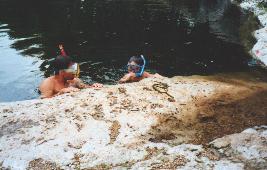 and Eric slid in (its steep sides precluded walking in). We were instantly
surrounded by small fish. The water below us disappeared into blackness
(no one knows how deep the water is, divers found it goes down at least
140 feet). As we paddled around the cenote, Eric–perhaps struck by the
religious and sacred nature of this place–peed in it. At one point, Eric
took on some water (we later found a small stone lodged in his snorkel,
causing water to leak in). He grabbed onto Curt's back to lift himself
out of the water. Curt, thinking Eric was playing and always a little uncomfortable
in deep water (especially when not wearing his fins), shook him off. Eric
was struggling. Missy shouted for Eric to swim to shore and he responded.
Curt, hearing Missy's yell, gave Eric a push toward shore (as a barely
competent swimmer, that was about the best he could do). Missy pulled Eric
from the water and he chose not to reenter it. (Was this Chac's punishment
for Eric's unholy urination?)
and Eric slid in (its steep sides precluded walking in). We were instantly
surrounded by small fish. The water below us disappeared into blackness
(no one knows how deep the water is, divers found it goes down at least
140 feet). As we paddled around the cenote, Eric–perhaps struck by the
religious and sacred nature of this place–peed in it. At one point, Eric
took on some water (we later found a small stone lodged in his snorkel,
causing water to leak in). He grabbed onto Curt's back to lift himself
out of the water. Curt, thinking Eric was playing and always a little uncomfortable
in deep water (especially when not wearing his fins), shook him off. Eric
was struggling. Missy shouted for Eric to swim to shore and he responded.
Curt, hearing Missy's yell, gave Eric a push toward shore (as a barely
competent swimmer, that was about the best he could do). Missy pulled Eric
from the water and he chose not to reenter it. (Was this Chac's punishment
for Eric's unholy urination?)
On the drive back into town, we noticed the cola wars. We couldn't drive for even one minute without seeing a sign (on a billboard or small store) advertising either Coca Cola or Pepsi. The more we looked for them the more we saw. (We'd sometimes see ten signs in less than a minute.) It seems that every small store was courted to sell one of these colas. The cola company would sweeten the deal by providing free paint jobs on the store's exterior–prominently painting the name of their cola. The store owner gets regular new (and colorful) paint jobs (none of the cola signs seemed weathered whereas nearly all surrounding walls looked drab and old) while the cola company gets another advertising notch in its belt at low cost. (These "wars" seem rather useless for the US companies involved. When was the last time you were moved to buy a particular cola because of a sign you saw? The signs wouldn't bring new customers to the stores as they were neighborhood stores for walkup customers and, if it matters to them, the locals know what type of cola their neighborhood stores sell. Perhaps it's a mind share issue. Plant the seeds often enough so that some people will choose your product without thinking about it.)
Back in Mérida we ate lunch (Missy settled for
stuffed peppers as they were out of zucchini) and then went shopping and
sightseeing (all in walking distance from our hotel). Downtown Mérida
was hopping on this weekday afternoon (as it usually seems to be). The
narrow sidewalks were packed with people. The roomier pedestrian mall areas
had more elbow room.
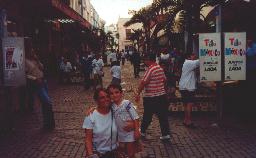 The cars crowding the streets
were directed by policemen overriding the traffic lights. (Hint:
Time the lights and reduce the number of traffic cops you need then find
productive jobs for those people). Fully loaded buses contributed their
share of noise and stink. The aliveness was invigorating. Curt felt like
a "big man", more accurately a "tall man". The Mexicans, mostly of combined
European and (short in stature) Indian descent, are generally smaller than
we are. We often towered over the crowd on a sidewalk–a different experience
for us.
The cars crowding the streets
were directed by policemen overriding the traffic lights. (Hint:
Time the lights and reduce the number of traffic cops you need then find
productive jobs for those people). Fully loaded buses contributed their
share of noise and stink. The aliveness was invigorating. Curt felt like
a "big man", more accurately a "tall man". The Mexicans, mostly of combined
European and (short in stature) Indian descent, are generally smaller than
we are. We often towered over the crowd on a sidewalk–a different experience
for us.
We browsed and shopped at department stores (including a Sears), markets, specialty stores, and bazaars. Shopping doesn't generally interest Eric but when we went to a toy store and he got a large, plastic Batman and batplane (for $1) he was reinvigorated. We also went back to the hammock store and Eric's girlfriends recognized him at once and fussed and cooed over him. He loved it!
We interrupted our shopping and had a tasty dinner at
a hotel restaurant (the one we ate in our first night in Mérida)
then got in some grocery shopping before returning to our hotel for the
night.
| PREVIOUS DAY | NEXT DAY |
| Back to Curt, Missy, and Eric Homepage | Back to Start of Mexico Diary | Back to All Diaries |
© 1999 [email protected]
