We got a late start to the day, or so we thought. After a filling and delicious breakfast of our favorite Mexican staple–beans and rice–served up by the hotel's restaurant ($5 for breakfast for three), we checked out of the hotel, loaded up the car, and headed a mile down the street to Chichén Itzá arriving around 9:30 (the place opened at 8:00). Chichén Itzá ("mouth of the well of the Itzas") is worth a full day of exploring so an early start is important; especially since you can see a lot before the day heats up. (In Egypt seven years ago, we'd start our days touring tombs, temples, and pyramids at 5:00 AM; sites open that early to let people finish touring before they faint.) This day the sky was overcast and that would keep the sun from baking us (especially important now that the sea was no longer readily available to us for a dip).
Sundays are free days at many Mexican tourist sites. This gives the low income locals a chance to see what tourists regularly pay to see. Chichén Itzá was free except we paid $3USD to bring in a video camera. All the Maya sites we visited had a $2 or $3 charge for use of a video camera–though at some of the smaller sites the fee was waived if you already paid it that day at a nearby site.
Chichén Itzá is the most visited ancient Maya city. It is a two and a half hour bus ride from Cancún and several tour buses make that trip daily. Even though there are closer and still impressive ruins, Chichén Itzá is one of only two Maya sites to which tour buses from Cancún will run (the other being Tulum, tours to which are combined with a trip to the Xel-Há waterpark). The reason people will spend five hours in a bus during their Cancún vacation to see a Maya site is: Chichén Itzá is fabulous! Nearly each of its landmark buildings is worth examining. (Many buildings at other sites, labeled on a map with an impressive sounding name, turn out to be little more than heaps of rubble).
Puzzlingly, the place was rather empty when we arrived.
Our first mission was to climb Kulkulcán, the large, 75' tall pyramid
that welcomes you to Chichén Itzá. (The pyramid is also called,
El Castillo. "The Castle" is the name applied to the big pyramid on most
Maya sites. The archeologists weren't very original.) Eric scaled the stairs
first with Missy and Curt hanging back to seeing if it was safe to follow
(they were fumbling with cameras trying to capture Eric's ascent on film).
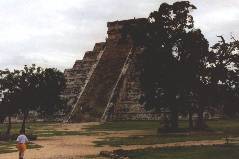
Eric, in yellow shorts, approaches El Castillo. |
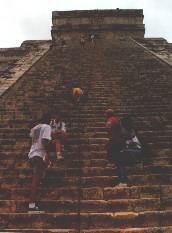
Ascending the pyramid with curious onlookers. |
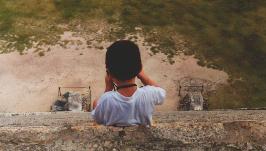
Capturing on film from whence he came.
Ninety-one stairs later, we stood atop the pyramid. The 91 stairs on each of the four sides of the pyramid add up to 364. Counting the platform on which the crowning pyramid sits, the total number of steps is 365–a special number for the calendar conscious Maya. The pyramid is also oriented so that on the spring and fall equinoxes, the shadows cast by the terraces on the north staircase form the body of a serpent whose actual sculpted head rests at the base of the stairs. Thousands of people visit Chichén Itzá on those days to see the serpent.
The view from the top of the pyramid, especially after
the somewhat demanding climb, is exhilarating!
Descending the pyramid is more
challenging. We saw people walking down its stairs as if they were no different
from stairs in their house. That's a little risky as one slip could have
life damaging (or ending) consequences. (Boy, did they look cool doing
it so nonchalantly!) There was a chain hanging down the center of the each
of the two stairways one is allowed to climb (the other two are not in
sound enough condition to climb).
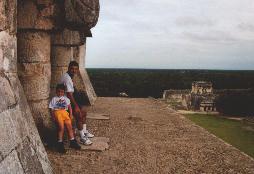 The steps are so steep they
are lost from view when one looks out over this ancient city. There is
a sense you are suspended in the air with your feet planted on rock. Because
of the many trees on the site, only a few of the other buildings in Chichén
Itzá are easily visible from atop the pyramid. We would visit them
all up close and personal. The temple on the pyramid is in excellent condition.
One never knows how much of a ruin is as it was found or is as has been
restored. The carvings around the doors are clearly visible, as is some
graffiti applied by later day Blipniks.
The steps are so steep they
are lost from view when one looks out over this ancient city. There is
a sense you are suspended in the air with your feet planted on rock. Because
of the many trees on the site, only a few of the other buildings in Chichén
Itzá are easily visible from atop the pyramid. We would visit them
all up close and personal. The temple on the pyramid is in excellent condition.
One never knows how much of a ruin is as it was found or is as has been
restored. The carvings around the doors are clearly visible, as is some
graffiti applied by later day Blipniks.
 Unfortunately, as with the rope in Cobá,
the chain has little slack so using it requires scrunching down. Also,
the center of the stairway where the chain lies has been the most heavily
used portion of the stairway and hence it is worn smooth and slippery.
It is also chipped by the chain rubbing against it. If not for the chain,
the center of the stairway would easily be the most dangerous place by
which to climb up or down the pyramid's steps. We went down the pyramid
about an arm's length away from the chain in a place where the stairs edge's
were not yet rounded. We'd occasionally hold the chain and always be aware
of where it was in case a grab of it was needed to break a fall. Coming
from the US ("lawsuit capital of the world"), it's hard to believe the
place is so unsupervised and personal responsibility is left up to the
individual (what a strange concept).
Unfortunately, as with the rope in Cobá,
the chain has little slack so using it requires scrunching down. Also,
the center of the stairway where the chain lies has been the most heavily
used portion of the stairway and hence it is worn smooth and slippery.
It is also chipped by the chain rubbing against it. If not for the chain,
the center of the stairway would easily be the most dangerous place by
which to climb up or down the pyramid's steps. We went down the pyramid
about an arm's length away from the chain in a place where the stairs edge's
were not yet rounded. We'd occasionally hold the chain and always be aware
of where it was in case a grab of it was needed to break a fall. Coming
from the US ("lawsuit capital of the world"), it's hard to believe the
place is so unsupervised and personal responsibility is left up to the
individual (what a strange concept).
Near Kulkulcán is the Temple of the Jaguars whose carvings of snakes, jaguars, and Maya warriors suggest a testosterone driven populace. This temple is at the southeastern corner of the largest pre-Hispanic ballcourt yet discovered. The ballcourt, one of as many as nine in Chichén Itzá, measures 135 by 65 meters and it's bordered by 8 meter high walls. Its acoustics are such that two people standing at its opposite ends can carry on a conversation with each other in normal voices. As no one knows the rules of pok-a-tok, the game that was played on these ballcourts, one can only wonder why the courts come in such different lengths; especially since the "hoops" are in the middle of the court. It would seem the action on this particular court would almost exclusively occur in the middle portion of the field. Why make the field so long? (Imagine a basketball court that is five times wider than it is long. What would be the point of all that dead space away from the baskets?)
A few steps east of the ballcourt is the Temple of the Skulls (Tzompantli). This temple is decorated with carvings of rows of human skulls and eagles ripping out human hearts. Adjacent platforms have similar macabre carvings: jaguars, eagles, and serpents grasping human hearts. Praise be to gods! Good clean fun.
A five minute walk north from these platforms and one arrives at the Sacred Cenote. Human sacrifices occurred here as well. The cenote is 60 feet in diameter and the water is 60 feet below the cenote rim and 100 feet deep. It's hard to imagine anyone surviving being bound and tossed into the well. As we walked along the cenote's edge, we spotted metal hooks protruding from a rock and we deduced that these were used 95 years ago to support the dredge that first brought up human bones and sacred objects that had been cast into the water. The actual dredge that was used is on display just outside the bathrooms of the Chichén Itzá visitor center and photos of it in use confirmed our earlier assumption about the hooks we had seen.
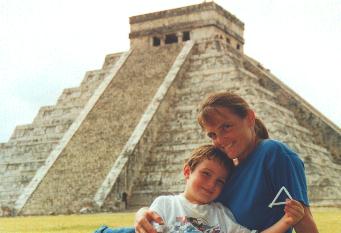
Walking back towards El Castillo, we stopped and took a family photo (using our camera's timer function). It turned out to be the picture we would send with our end of year letter.
Just east of El Castillo is the Temple of the Warriors guarded by a reclining Chac figure. This temple was cordoned off so we could not climb it. Next to it is the impressive Group of a Thousand Columns. Wandering around them we spied an empty beer bottle and beneath that, scraps of toilet paper and a human poop. This one wasn't from Curt and it didn't look ancient, though it might have been Maya.
By this time, Missy was starting to lose interest in visiting the ruins. (Old rocks are more of a guy thing; unless the rocks are gems). Eric and Curt made a quick exploration of The Market and steam house while Missy sat playing a Gameboy we bring with us in case either she or Eric are bored.
The great El Castillo pyramid is actually built over a smaller, older pyramid. We figured we'd go inside El Castillo to climb the inner pyramid before heading to the restaurant to feed and cool off. A door has been cut into the outer pyramid allowing entrance to and climbing of the interior pyramid, but that door doesn't open until 11:00. We were standing outside the entrance to the pyramid's interior at 11:30 but the gate was still locked. The sign posted beside the gate repeated the opening hour along with advisements not to enter the pyramid if you are outside the ages of 10 to 60, have heart problems, fear heights, are claustrophobic, or are not in good health. Disappointed that the interior may not be open on Sundays we headed to the restaurant near the ticket booth. We asked the ticket taker why the pyramid wasn't open and he indicated that it would open at 11:00, ten minutes from now. D'oh! Daylight savings time had arrived and, for a change, was being honored in the Yucatan. (This was reminiscent of a time in Nice, France; when Curt got into an argument with a museum guard about a museum that was closed for lunch even though its closing hour was 30 minutes away. The guard never did point out the clocks had just been moved up.)
At the restaurant we snacked on popcorn and liquados then dined on beans and tortilla chips. Returning to El Castillo, we saw a line had formed to enter it. A guide lets fifteen people in at a time. As the passageway inside is only one person wide, the fifteen people all file up steep rock steps to the top of the original pyramid, check out the statues on exhibit there, then file back down. The fifteenth person of a group was the one right in front of us so we had to wait an extra ten minutes for that group to return. That was fortuitous because it let us see people's reaction to the experience up close. Most people exiting the pyramid were sweating and fanning themselves; seemingly relieved to be exiting a dark, damp, cramped, hot, smelly (from body odor) place rather than being excited and inspired by the challenging trek through the ancient, mysterious, historic rock passageway.
A second benefit of being the first in a group entering the pyramid was being able to appreciate the view of the climb up the interior (following behind someone up steep steps you mostly see their butt; and if it's not a shapely one the view is especially disappointing). Eric led our troop to the top, which seemed about halfway up the exterior pyramid. The small room at the top, formerly a temple, could not be entered but its contents–a statue of Chac Mool and a jaguar throne with eyes of green jade–were plainly visible (especially to those of us who got there first). As the rest of the troop piled up, the platform reached its capacity. The small fan trying to move air was only succeeding for one person: Missy, who had grabbed the spot in front of it as the second person to arrive. After a few minutes, we turned and headed down (this time about the middle of the group). Exiting into the bright light it was obvious that the others waiting in line were generally studying the faces and composure of those leaving the pyramid (as we had done with the group before us). When Eric exited fairly skipping out and exuberant (by far the youngest person we saw exploring Chichén Itzá, let alone climbing its pyramid), there was a mixture of gasping and laughter from those in line. Some were probably relieved that maybe this adventure wouldn't be so stressful for them if a child could do it. Curt followed Eric also smiling; in part out of joy of the experience and in part over the reaction Eric had drawn.
Finished with Chichén Itza's northern ruins, we headed for its southern and less developed ruins. The first building we saw was the Tomb of the High Priest. This small pyramid was not available for climbing so we continued on–not wanting to push Missy and Eric's interest levels. The next building we reached was the beautiful Observatory, El Caracol ("The Snail" or "Winding Stair"). This domed 10th century observatory with an interior, winding stairway (too broke to allow tourists to ascend) is unique in ancient Maya sites (Chichén Itzá architecture was heavily influenced by the Toltecs). Eric was taking a photo of the Observatory when an American woman stopped to watch him, saying, "How cute!" Eric had become a bit of a camera bug as our vacation wore on and was generally responsible for taking photos with our autofocus camera (choosing the subject matter and composing the picture with some input from mom and dad).
We climbed the steps to the Observatory and entered its dome. The winding steps within the dome below a height of about ten feet were gone. From El Caracol, there is a good view of the other buildings in the southern section of Chichén Itzá. Missy and Eric decided they were done exploring Maya ruins for the day so Curt pushed on alone to check out Casa de las Monjas (the Nunnery), so named because it is reminiscent of a convent, and La Iglesia (The Church). Both of these buildings are in excellent condition and have extensive, exquisite carvings along their walls.
Heading towards Chichén Itza's exit we had been entertaining the notion of climbing the pyramid once more; even more challenging now that we were tired. (Curt was carrying Eric to save his legs). Unfortunately it started to rain and we didn't think climbing in the rain or on wet steps was a good idea. We left the ruins and walked into the myriad of Maya souvenir stalls just outside. We bought a couple of T-shirts then had to run the gauntlet of over-friendly sales people to our car (they try to get your attention with calls of "one dollar"). Happy our luggage was still in the car (outside of Mexico City, this is a safe country), we started on our one and a half hour drive towards our next destination; Mérida.
The rain started in earnest on our drive to Mérida. We later learned that the weather system responsible for the rain was keeping newly formed Hurricane Mitch in place just south of the Yucatan Peninsula. Arriving in Mérida we sought to gas up. Pulling into the Pemex station, we were greeted by several gas station attendants each waving frantically at us. As their waves did not appear to be signaling the same thing, we kind of drifted back and forth leaning towards different gas pumps. When we finally stopped by one, it occurred to us that all that waving were attempts by individual attendants to get some business to the particular pump for which they are responsible (to garner the tip associated with dispensing gas). Here's a case of wasted labor. Instead of six or seven full-time employees each manning one pump, they could use zero people and credit card pumps (or, if the infrastructure is not present to support a credit card using society, one person in a small booth the way Hess stations did for years in the US). The attendants may put in long days but they are remarkably unnecessary and unproductive days. Guide and taxi drivers, since there are more than enough of both, are other examples of occupations that may involve long hours on the job but that provide little value.
We got a room at a center city hotel we saw recommended in a Mérida diary posted on the Internet. (See http://dyred.sureste.com/dolores/index.html). This hotel, converted from a large Spanish colonial residence, has charm and beauty for $27 a night. We got a room that fronted the courtyard.
As we checked in, Eric played paper airplanes with a Mexican girl of about the same age.
We asked at the desk for directions to a nearby laundromat and vegetarian restaurants. As we walked to each identified place, we found it closed. The heavy rains, still intermittently falling, had left large puddles on most streets and the passing cars were kicking water up onto the narrow sidewalks. We were getting wet from above and below. The western half of the Yucatan Peninsula has a different weather pattern than the eastern half. In the west, rain is more long-lived. We had planned to experience Sunday in Mérida, a day in which the locals get dressed up and head for the city center squares (streets are closed off around these 1 block square parks) to participate in a weekly festival. The weather washed that out for us (we walked past a couple of parks and saw a lot of activity, but we chose to not to participate in it because of the rain.)
We dined in a hotel restaurant across the street from a park. The food was fabulous! In addition to beans, rice, guacamole, and tortillas, we had a soy burger with mole sauce (a Mexican sauce of chocolate, chili, sesame seed, and spices). There was enough food for four people and the price was under $10.
Heading back towards our hotel, we shopped in a hammock/jewelery/clothing specialty store. A couple of attractive Mexican female clerks in their mid-20's engaged in flirting with Eric. By the time we left, Eric was exchanging hugs and kisses with them. Let's see if he can keep that up until he's in his 20's.
We dropped off our souvenirs and cameras in our room then
headed back out to the nearby supermarket, following that up with a dip
in the hotel's pool. Our room did not have a television and that was fine.
We chatted, played, read, then slept.
| PREVIOUS DAY | NEXT DAY |
| Back to Curt, Missy, and Eric Homepage | Back to Start of Mexico Diary | Back to All Diaries |
© 1999 [email protected]
