After a breakfast of PBBBs and corn flakes and a little grocery shopping, we drove off to Cobá under overcast skies. The nearly one hour (26 miles) drive from Tulum to Cobá is through the jungle on a narrow two lane, unnamed, unnumbered road which has speed bumps whenever it passes through a "village" (a collection of a dozen or so thatched roof dwellings). Children would stand at the speed bumps and ask for money when cars slowed down. This sad sight is one most tourists to Cancún do not see. If you live in third world conditions, but don't know them as "third world," you may not consider yourself poor. Wealth is a relative term. If you live about the same as those around you, you are neither rich nor poor. You may even be "upper middle class" for your locale. (Until recent times, no one, not even the wealthiest king, owned a car, TV, stereo, computer, or refrigerator, or had a house with indoor plumbing, heating, and air conditioning). But it is hard to believe that you wouldn't think of yourself as abysmally poor when you are living next to the wealthiest country in the world and see cars and trucks pass through your village and never stop there. The unschooled families living in these villages continue to eke out a subsistence living, consciously or unconsciously keeping their lifestyles alive while making it difficult for their children to do anything different.
At the Cobá ruins hangs a handwritten poster: "If children ask you for money, do not give them any. Tell them it is important for them to go to school."
Cobá (in Maya, "water stirred by the wind") was
a large, ancient Maya city but now lies largely overgrown by jungle. The
first building one sees in Cobá is a ball court.
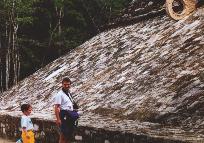 The playing field
itself is in good condition but the onlooker structure is in need of repairs.
Next to the ball court is an awe-inspiring large pyramid; the Temple of
the Church. Even for modern eyes accustomed to high-rises and skyscrapers,
the massiveness of the structure as well as its age is staggering. The
steps of the pyramid have not been restored so visitors are not allowed
to climb it. There is a passageway beneath the pyramid that one enters
by walking under a tree. We went through this and over the lower part of
the pyramid and adjacent structures before heading towards the even bigger
pyramid, Nohoch Mul ("large hill"), a mile and a half walk through the
jungle.
The playing field
itself is in good condition but the onlooker structure is in need of repairs.
Next to the ball court is an awe-inspiring large pyramid; the Temple of
the Church. Even for modern eyes accustomed to high-rises and skyscrapers,
the massiveness of the structure as well as its age is staggering. The
steps of the pyramid have not been restored so visitors are not allowed
to climb it. There is a passageway beneath the pyramid that one enters
by walking under a tree. We went through this and over the lower part of
the pyramid and adjacent structures before heading towards the even bigger
pyramid, Nohoch Mul ("large hill"), a mile and a half walk through the
jungle.
Curt carried Eric most of the way and when they reached the pyramid and nearby ruins, Curt had a biodegradable deposit he wished to make. Squatting atop a small ruin he pinched one off leaving it roll down the hillside away from the historic site–he wanted to defecate not desecrate.
We all climbed Nohoch Mul, though not the most beautiful,
at 138 feet it is the tallest structure of its kind in the northern Yucatan.
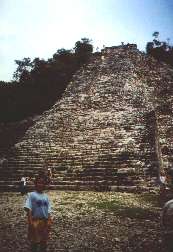 The climb is challenging, not so much that it is more than 100 steep, stone
steps, but because of the height and openness of the climb. There seems
nothing to grab onto, nothing to obscure the fact that you are high up
(the tops of trees can be seen in your peripheral vision), and you are
aware that it is a long, rocky way down below you–painful if not deadly
if you fall. As he climbed, Eric kept repeating, "Don't look down, don't
look down." There is a rope that hangs down the center of the pyramid steps,
however as it is attached to the steps with little slack, you have to be
uncomfortably scrunched down to make full use of it. The more uncomfortable
you are climbing, the more likely you will be to need the rope.
The climb is challenging, not so much that it is more than 100 steep, stone
steps, but because of the height and openness of the climb. There seems
nothing to grab onto, nothing to obscure the fact that you are high up
(the tops of trees can be seen in your peripheral vision), and you are
aware that it is a long, rocky way down below you–painful if not deadly
if you fall. As he climbed, Eric kept repeating, "Don't look down, don't
look down." There is a rope that hangs down the center of the pyramid steps,
however as it is attached to the steps with little slack, you have to be
uncomfortably scrunched down to make full use of it. The more uncomfortable
you are climbing, the more likely you will be to need the rope.
At the top of the pyramid is a small temple. Though it is empty, there are carvings around its door and on its walls. The best part of being on top of the pyramid is the view. Out the back one sees nothing but tree tops. Out the front, one sees trees as well but also other pyramids poking through the jungle. On the horizon is one of the five large lagoons in the area. The presence of this water enabled 50,000 people to live at Cobá in ancient times. The other interesting view from the top is the one down. Looking over the steep steps of the pyramid, it seems one climbed the 138 feet at about a 50° angle. You wonder how you made it up and how you will make it down.
Returning without problems to the ground (sometimes holding onto the rope as we descended), we hiked back through the jungle to our car. Our next scheduled stop was Valladolid but as we arrived there the intermittent rains we experienced during the hour drive turned into a downpour. We navigated through flooded streets and headed out of town, continuing on our way for 26 more miles to Piste, a small town just outside the major tourist site of Chichén Itzá. We got a room in the nice Pyramide Inn ($40 a night) then dined near the pool in the attached restaurant. After eating, we went for a swim. We were the only people in the pool, but there were a lot of water beetles and a few walking sticks enjoying the water with us. Actually, Missy didn't enjoy swimming with these creatures as much as she liked swimming with fish.
After the swim, we played in the room then did some browsing
and shopping in town picking up a couple replicas of the stone sacrificial
knives used by the ancient Maya to cut out the hearts of living people.
We had beans and rice at the hotel restaurant before heading a mile down
the rode to Chichén Itzá for the evening light show.
 Visiting
the ruins at night gave us a sense of their layout before our visit there
the next day. Near the ticket booth is a large model of the site as it
was believed to look 800 years ago. That also provided an important perspective
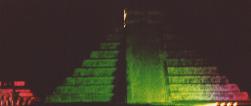
for our visit. The beautiful El Castillo pyramid looked mysterious at night
when bathed in blue and red lights. The other ruins lit for the show were
not nearly as impressive. Sitting near the pyramid does not provide a vantage
point from which one could begin to appreciate any other structure. The
story told along with the light show was interesting–though it offered
little more than our pre-vacation research revealed. Back in our room,
we read the Maya history report Curt had written a month earlier and flipped
through some photo books we had bought at the Chichén Itzá
gift shop before turning in for the night.
Visiting
the ruins at night gave us a sense of their layout before our visit there
the next day. Near the ticket booth is a large model of the site as it
was believed to look 800 years ago. That also provided an important perspective
for our visit. The beautiful El Castillo pyramid looked mysterious at night
when bathed in blue and red lights. The other ruins lit for the show were
not nearly as impressive. Sitting near the pyramid does not provide a vantage
point from which one could begin to appreciate any other structure. The
story told along with the light show was interesting–though it offered
little more than our pre-vacation research revealed. Back in our room,
we read the Maya history report Curt had written a month earlier and flipped
through some photo books we had bought at the Chichén Itzá
gift shop before turning in for the night.
| PREVIOUS DAY | NEXT DAY |
| Back to Curt, Missy, and Eric Homepage | Back to Start of Mexico Diary | Back to All Diaries |
© 1999 [email protected]
