The Pythagorean Theorem was one of the earliest theorems known to ancient
civilizations. This famous theorem is named for the Greek mathematician
and philosopher, Pythagoras. Pythagoras founded the Pythagorean School of
Mathematics in Cortona, a Greek seaport in Southern Italy. He is credited
with many contributions to mathematics although some of them may have actually
been the work of his students.
The Pythagorean Theorem is Pythagoras' most famous mathematical contribution.
According to legend, Pythagoras was so happy when he discovered the theorem
that he offered a sacrifice of oxen. The later discovery that the square
root of 2 is irrational and therefore, cannot be expressed as a ratio of
two integers, greatly troubled Pythagoras and his followers. They were devout
in their belief that any two lengths were integral multiples of some unit
length. Many attempts were made to suppress the knowledge that the square
root of 2 is irrational. It is even said that the man who divulged the secret
was drowned at sea.
The Pythagorean Theorem is a statement about triangles containing a right
angle. The Pythagorean Theorem states that:
"The area of the square built upon the hypotenuse of a right
triangle is equal to the sum of the areas of the squares upon the remaining
sides."
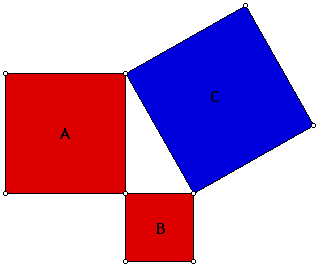
Figure 1
According to the Pythagorean Theorem, the sum of the areas of the two
red squares, squares A and B, is equal to the area of the blue square, square
C.
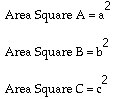
Thus, the Pythagorean Theorem stated algebraically is:

for a right triangle with sides of lengths a, b, and c, where c is the
length of the hypotenuse.