

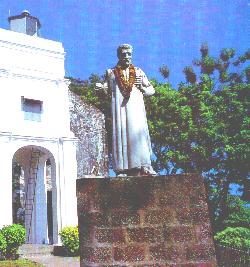
 |
(taken from the booklet
Church of St Francis Xavier, Malacca, Laying of Foundation Stone, 150th Anniversary 1849-1999) |
In 1528, Don Francisco de Yesu was a brilliant young man pursuing a scholastic career, rich with promise, at the famed University of Paris. In 1540, Francis Xavier was a member of the Company of Jesus setting out on a missionary quest from Lisbon. In 1542, Xavier was walking barefooted, his lips parched, his whole frame racked with pain, in an obsure village in India.
Thus within the short space of scarcely 15 years, St Francis Xavier or Santo Padre as he was known began the mission which brought Christianity to the East.
Before he had actually arrived in Malacca for the first time his "fame" among the poor in India had preceded him and a large crowd of people and local dignitaries were at the waterfront to receive him. He must have been naturally surpriesed at the nature of the welcome and it is reasonable to assume that later he discovered that it was the sailors trading in the region of the Spice Islands who had informed the people of Malacca about the holy father from Europe.
It was late September 1545 and though many notable people offered him hospitality, he chose a little house near the hospital and later moved to the hospital itself so that he could be of immediate service to the sick night and day.
There is a strange story related by Fr Paul Gomez who was a witness to the reception which Francis Xavier received. He says, "There were some mothers with their babies. He called the babies by their names, inquiring from them about their fathers. I and many others believed this a miracle. How could he know the names of children he had never seen?" He remained in Malacca during October, November and December 1545, serving the sick and teaching the children daily. On Sundays, he preached at the church on the hill and he was so overwhelmed by the great number of people seeking ministrations that he himself bore testimony to the fact saying, "It is impossible to satisfy all who come."
Although he was working round the clock, he still found time to translate all the simple prayers and instructions into Malay. He found that there was a confusion of languages in the islands of the East but discovered that all could understand a little Malay.
During his short first visit to Malacca, he wrought a number of miracles, the more conspicious being the cure of Antonio, son of John Fernandez de Igler, the calling to life from the grave of a girl buried three days and another calling to life of a boy, Francis de Chaves who later became a Franciscan and died a missionary in China.
With the end of the monsoon months, Francis left Malacca on New Year's day, 1546 and set sail for Amboina, Ternate and the Isles of the Moors. He was strongly advised against going to the latter place where inhabitants were said to be cannibals and where two priests had already been killed. However, Francis survived the danger and the "appalling conditions" and in July, 1547 was back in Malacca once more.
Two events marked his second stay in the town. The first, still recorded on the stain glass windows of the present Church of St Francis Xavier, refers to a nocturnal attack by the Achinese.
Let us hear the late Fr Jules Francois relate the story : "On his advice a snall fleet set off in pursuit of the enemy and found them on a Sunday morning in the Perlis river. They killed 4000 of the enemy, sank several of their ships and captured the remainder with 300 cannons and nearly 1000 muskets. The Portuguese losses were but five men. That morning as Francis was preaching in the cathedral, he was suddenly wrapped into a profound esctasy until his voice burst forth commanding the people 'to prostrate before the altars, to give thanks to God."
The other event was the coming of a Japanese, named Yagiro, who having heard of the Santo Padre from a Portuguese friend, wished to meet the great man and to be baptized by him. After having heard the request of Yagiro, the saint taught him the truths of religion. The Japanese catechumen was very attentive and Xavier was very impressed, resolving thereby to go eventually to Japan, to convert the people, the nobles and the king himself. In March 1549, Xavier left on a short visit to Goa to arrange certain matters in connection with his fellow missionaries in India. On that visit, John de Castro, reputed to be one of the best viceroys India ever had, died (after approving the Santo Padre's request for a journey to Japan) and Francis had the consolation of assisting him in his last moments.
The saint was back in Malacca by May 1549 and once again his reception was a "delirious triumph with the whole town turning out to greet him" at the jetty.
He was anxious to start on his journey to Japan and although he tried hard to get a Portuguese ship to take him there, none was available. The captain of Malacca at that time was Don Pedro da Silva de Gama, one of the six sons of the celebrated voyager Vasco. He was most generous to Francis and gave him the means of supporting himself during the first stages of the Japanese mission, as well as the means to build a chapel there and gifts to be presented to the king of Japan. In the end, out of desperation, Francis and his companions accepted passages in a Chinese junk to Japan.
He spent two and a half years, preaching in the land of Yagiro and at the end of his initial mission became convinced that he could bring about a conversion of Japan if the learned men of China were won over to the faith. So, leaving his companions to continue the work in Japan, Francis started back on the long journey to Goa to organise a missionary expedition to China.
He called again at Malacca on this journey but his visit lasted only three days, long enough to persuade the captain of a ship bound for India to delay sailing date so that Francis could be on it. When he eventually reached Goa he was faced with a host of problems but in the end he managed to conclude preparation for his trip to China and was on his way back to Malacca again.
This market his fifth visit to Malacca, one that was to be filled with troubled forebodings of disaster.
The new governor of Malacca, Don Alvaro de Alaide (another of Vasco de Gama's sons), wanted his son to be taken as the ambassador as opposed to Xavier's desire to take a reliable merchant named Pereira. Neither the letters signed by the viceroy nor even the threat of excommunication could bring the obstinate governor to reason. In the end, Francis used his powers as Apostolic Nuncio (given by the pope) to excommunicate him and refused to see him before his departure, saying that he would next meet him at the tribunal of God.
For Francis now it was a mad gamble. No longer would it be possible to hope for a legal entry into China (without the ambassador) since the governor had refused permission for Pereira to leave Malacca. Eventually, Francis reached the island of Sancian, south of the delta of the Canton river. He tried in vain to get someone to smuggle him into the Chinese city.
At last a merchant was found who promised him the needful ship but the wily fellow, after receiving the 200 cruzados of pepper agreed to, disappeared. Suddenly Xavier became ill with fever and with no proper care available on the desolate isle, was to die like Moses, in sight of the land of promise at the age of 46. Only his faithful servant Antonio was with him to the end. Antionio sought the assistance of the crew of the Santa Cruz, anchored just off Sancian at that time, and placing the body in a rough coffin filled with lime, buried the saint on Sancian.
After Xavier's death, the Santa Cruz remained in Sancian for two and a half months. Before it sailed for Malacca, Captain Jorje Alvaro despatched a Portuguese to open the grave and see the state of the body so that if it could be moved he would take it back with him. It was found that the body was still in a perfect condition and immediately arrangements were made to transport the body to Malacca.
It was late at night on March 22nd, 1553, that the Santa Cruz reached Malacca harbour and the corpse was taken to a house situated at the sopt where the clock tower stands today. The local clergy examined the body and they found, to their surprise, that it had been preserved incorrupt. The following day a great procession was organised and with candles in their hands, the people of Malacca accompanied the body to the chapel of Our Lady of the Mount, on top of the hill where St Paul's church stands today. The body was buried there in the middle of the choir, enveloped with a shroud, as it was the custom of those days. It is recorded that a plague that had been causing many deaths a day at that time, came to an abrupt end on that very day of the funeral.
An opportunity of sending the body of St Francis Xavier to Goa arose with the arrival from Japan of a Jesuit Brother, Peter de Alcacova, going to Goa to secure new missionaries for the already flourishing missions of Japan.
On December 11th, 1553, once more the body of St Francis Xavier was afloat on the sea. It was carried to the ship on a decorated sampan. All Malacca escorted the Santo Padre, bidding an eternal farewell to the apostle, to whom, during his life, most of them had scarcely listened. The coffin was placed in a cabin with silk hangings all round, in the midst of lighted candles and burning perfumes. The boat when passing between Penang island and the shore, went on a sandbank but was sent back to the deep waters by a strong wind that arose providentially. The boat called at Ceylon and Cochin and arrived at Goa on the evening on March 15th, 1554.
The next day the whole population accompanied the saint to the cathedral.
The coffin was opened. After sixteen months the body was still fresh. During
the next three days and three nights the people were allowed to see again
the holy man whom God had sent them. Thousands of men and women kissed
his feet and many miracles were wrought through the intercession of the
great saint whom death itself seemed to have respected.