 |
|
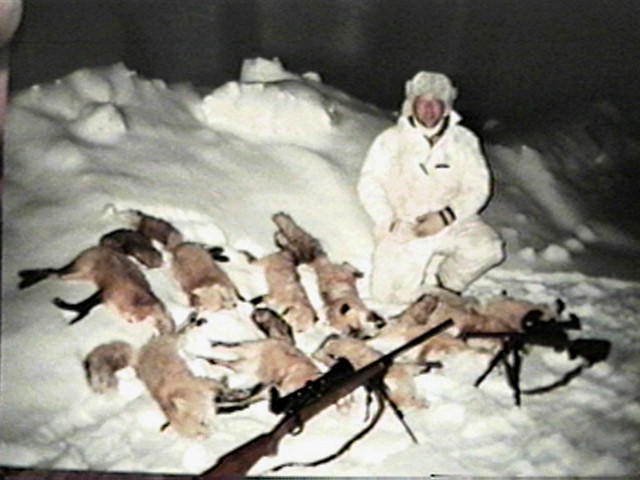
| Here I am with ten foxes Paul Stine and I shot in November of 1996. Seldom do things come together this well! |
| The Setup: The setup for the hunt is probably the most important part of the entire hunt. In order to be successful, you have be able to envision where the fox might be hiding, where he's likely to respond from bases on the terrain, wind direction and other environmental factors such as homes, roads and human activity. The first part, however is how do you get into a setup? Foxes have super hearing and can hear you coming from a mile away if you aren't quiet. I've discovered that you don't have to get very far away from your truck to make a call but you do have to be quiet. Slamming doors, banging gun cases and especially talking will jinx your stand before you start. If you don't pay attention to those few basics from the get-go, you may as well stay home and watch TV because you sure won't be calling very many foxes. The wind is likely the most important factor in how you set up. My favorite way to set up is to call across wind. So, picturing a baseball diamond, picture the foxes being on second base. The wind is blowing from right to left from first base to third. You are going to be calling to those foxes on second so you leave your truck at home base, sneak into the pitcher's mound and start calling. Because foxes trust their nose so well, what we generally expect is for the fox to run out of the cover at second base and because the wind is blowing from first to third, they will start swinging toward third base so they can use the wind to use their nose to confirm what their ears have just told them. Sometimes foxes will come in straight to the call. Eight of ten times, however, they are going to swing down wind. They almost never respond from upwind. (Almost never does not mean that you won't get burned by this though from time to time because there could have been an aggressive fox on first base that will burn in as soon as you start calling.) So, what does this wind scenario tell you? It hopefully tells you that your attention should be particularly focused on the area between second and third base. And, if you are hunting with a partner, guess where he should be. That's right. Sitting on third base. A setup like this will likely put that fox right into the lap of the shooter sitting on third base. Try it, it works great! How Loud to Call?: I've heard some folks talk of calling softly to start with and then increasing the volume as you go if nothing comes in right away. I'm sure that works. I don't do it that way though. I start off loud and stay loud unless I'm trying to coax a fox in that I have seen and I know to be hanging up up there. I figure that when an owl first catches a rabbit, it's unlikely that the rabbit starts screaming softly at first. More likely, that is the loudest, most frantic screaming of the entire scene and the screaming will probably get softer as the rabbit looses strength and begins to die. So, I sit down and blow loud! Do I scare away foxes when I do this? Maybe. I can't say that I have ever knowingly scared one way though. On the other hand, I've had foxes respond within mere seconds from when I started which would seem to tell me that they were very close and they liked the loud, frantic sounds I was making. You've got the fox coming. Now what????: This is the moment of truth. What you do next will mean the difference between killing that fox and watching him run over the next hill. Foxes are shy little critters and they won't tolerate a lot of mistakes. First off, keep in mind that if you are using a hand call, they are zeroed in on your location. And, if you can see them, they can see you! Any excess movement at this point will be the death of your stand and not of the fox. It's important not to move unless you are ready to shoot the fox. If he's way out there and coming hard, just sit back and let him come! Only raise your rifle when he is in range, you are sure of the shot and if possible, when he can't see you. Wait till he is out of sight of you or behind some brush. If this isn't possible, wait till you have a good shot and then slowly but steadily, raise your rifle. Chances are good he'll stop when he sees you. At this point, you have a couple of seconds to get the cross hairs on him and squeeze that trigger. The biggest rookie mistake I've seen is that once a fox is spotted the shot is attempted. Usually too far and too soon. If they are coming, let them come. Sometimes the fox is so intent on coming that he ignores your movement or he isn't interested in stopping. I like to wait till they are good and close and then give them a sharp whistle or just say "hey!". Chances are good they will stop. Now it's up to you! BOOM! |
| Email me at: [email protected] |