Noteworthy Items: Noteworthy Items:

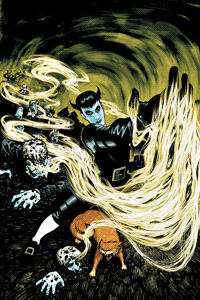
The very first page, where the Horigal says "Ye broke the Law!" and "Ye shall be judged!" to me went a step beyond confirming what we'd all already noticed - that the Submissionaries represented authoritarian organized religion. It and subsequent pronouncements from the Horigal immediately evoked for me the Old Testament as opposed to the New testament. The clincher is when the Horigal rants "Ye have no advocate! There is no redemption!" since redemption is exactly what Jesus brought to humanity (or at least that part of it lucky enough to hear his message) according to Christian doctrine. The missing advocate would be a Jesus figure.
However, right after that statement from the Horigal (stand-in for the vindictive an wrathful god of the Old Testament?), Klarion is in fact saved by Ebeneezer Badde, so maybe we do have our Jesus figure. But, if so, what a comment on Christianity: Badde sells Klarion to unknown forces who have a literal, physical cage all prepared for him. So the "redemption" offered by the New Testament merely leads to a differnt kind of bondage. That Klarion is sold into this bondage by his Badde saviour is a very fair comment on the entire nature of Christian doctrine: the very word "redemption" itself has implications of the buying and selling of slaves - something glossed over all too often (check out William Empson's 'Milton's God' for more on this idea).
In another twist, Ebeneezer (like his Dickensian namesake?) has a last-minute change of heart and tries to save Klarion again, this time from his (Badde's) own betrayal. It looks like he was killed by Leviathan, but I hope Badde survives; good character.
Bur there's another way of looking at Badde, one which appears to conrtradict everything I stated above: his general attitude and several of his specific lines mark him as a man who has lost faith in anything beyond the immediate material world he can perceive thorugh his senses and in any goal beyond crass gratification of his physical needs/desires. I'm thinking of his bounty of porno books and booze
for delivering Klarion, lines like "why bother with gods and heroes at all?" and of course his statement about the absent, i.e. non-existent, god Croatoan.
But Klarion, right before that statement of Badde's, shows that he has the opposite view: ""I've always felt that ... well, he [Klarion's real father] was still alive somewhere. Perhaps he reached Blue Rafters and dwells there where I will find him." In other words, 'Our Father, Who art in Heaven, ...'. The fact that Badde's response to this speech of Klarion's is "You're all alone." (i.e. there is no father, no Father, no Croatoan, no God) reinforces what I said in the paragraph above.
Ebeneezer Badde: “You have the look of Limbo Town - The Sheeda face.” The Witch people are descendents of the Sheeda in some way.
Name Ebeneezer(Ebenezer) comes from Hebrew meaning the helping rock(?).
Ebeneezer Badde is a reference to the song by the Shamen, Ebeneezer Goode(thanks Newsarama poster AndrewHickey)
Klarion's father's name is Mordeci and he apparently disappered years ago. Klarion believes him alive in “Blue Rafters.”
Badde: “Maybe there was a god here once but he’s long, long gone. He escaped and left us on here alone. Only his dreadful chains remain.” Reference to Loki who was chained up underground with poison dripping on him(the toxic waste around the treasure as seen in Guardian #2). If so that would mean the beginning stages of Ragnarok. Then again, you can always count on other religions/mythologies to have gods or deities chained under earth in some torture.
The location of the treasure in Guardian #2 is the House of Croatoan where Witch-Men came to be initiated. Here Klarion retrieves the dice where dozens of dead subway pirates sit.
King Rat was a villain in the British pantomine Dick Whittington.
Plot synopsis
Dick Whittington, a poor boy from Gloucestershire, goes to London to seek his fortune, but he can't find a job. Dejected, he turns round to go home. On the way he meets a cat, which he calls Tommy, and before he's gone very far, he hears the church bells of London calling him back - they seem to be saying "Turn again Whittington, Lord Mayor of London!"
He returns to London and meets Alice Fitzwarren, the daughter of a rich merchant, who gets him a job working in her father's shop. Tommy the cat (Primus!) makes friends with Sarah the cook (and the pantomime dame), by catching rats and mice in the kitchen.
The villain of the story is King Rat. One night, he organizes a burglary at the Fitzwarrens' house, when he locks Tommy in the kitchen and steals a valuable necklace belonging to Alice. The next day the theft is discovered, and Dick is blamed. He's sacked from his job and runs away to sea, with his cat. Alice and Sarah follow him, because Alice doesn't believe that he has stolen the necklace. King Rat is on the same ship, going to sell the necklace overseas and check on his rat kingdom in Japan (of course you can substitute any country you like here).
The rats are a very serious problem in Japan, and there are no cats there. Tommy immediately starts catching rats, and finally catches King Rat. The necklace is recovered, and the emperor (or in our story, the children that make up Leviathan) is so delighted to get rid of the rats that he gives half of his fortune to Dick.
Dick, Tommy, Alice and Sarah return to London, and Alice tells her father the whole story. Dick and Alice get married, and Dick later becomes Lord Mayor of London.
Charles Robert Maturin’s Melmoth the Wanderer
(1820)/Gothic literature
The publication of Charles' Maturin's Melmoth the Wanderer in 1820 is the last of what some critics have called the Classic Gothic novel and for others marks the end of the true Gothic novel. His forte is showing character under extreme conditions, both psychologically and physically; Melmoth has sold his soul to the devil to live another one hundred fifty years, with an out, if he can only find someone else to take his place. |