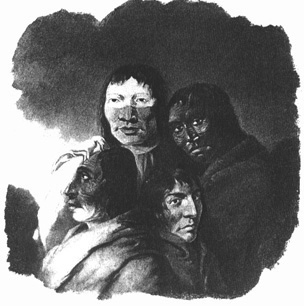
The Chinook Indians, relatives to the Clatsop tribe, lived in the Northwest along the banks of the Columbia River and the coast of the Pacific Ocean. The Chinooks were superb canoe builders and navigators, masterful traders, skillful fishermen. They lived in large wooden plank houses and slept on reed mats over raised boards
HOW THE CHINOOK PEOPLE CAME TO BE
"Long,long ago, when old Man South Wind was traveling North, he met an Old
Woman, who was a giant.
"Will you give me some food?" asked South Wind. "I am very hungry."
"I have no food," answered the giantess, "but here is a net. You can catch
some fish for yourself if you wish."
So Old Man south Wind dragged the net down to the ocean and with it caught
a little whale. Taking out his knife, he was about to cut the whale and take out
the blubber.
But the old giantess cried out, "Do not cut it with a knife, and do not cut it
crossways. Take a sharp knife and split it down the back."
But South Wind did not take to heart what the old woman was saying. he cut
the fish crossways and began to take off some blubber. He was startled to see
the fish change into a huge bird. It was so big that when it flew into the air, it
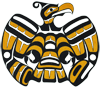
hid the sun, and the noise of its wings shook the earth. It was Thunderbird.
Thunderbird flew to the north and lit on the top of Saddleback Mountain, near
the mouth of the Columbia River. There it laid a nest full of eggs. The old
giantess followed the bird until she found its nest. She broke one egg, but it was
not good. So she threw it down the mountainside. Before the egg reached the
valley, it became an Indian.
The old giantess broke some other eggs and then threw them down the
mountainside. They too became Indians. Each of Thunderbird's eggs became
an Indian.
When Thunderbird came back and found its eggs gone. it went to South Wind.
Together they tried to find the old giantess, to get revenge on her. but they
never found her, although they traveled north together every year.
That is how the Chinook were created. And that is why Indians never cut the
first salmon across the back. They know that if they should cut the fish the
wrong way, the salmon would cease to run. Always even to this day, they slit
the first salmon down the back, lengthwise....
 CHINOOK PEOPLE