| COMPONENTS OF THE HIVE |
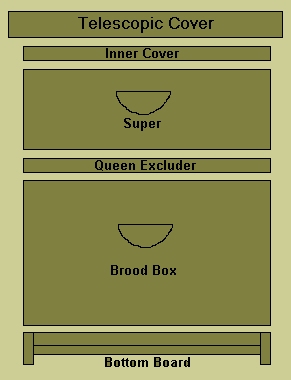
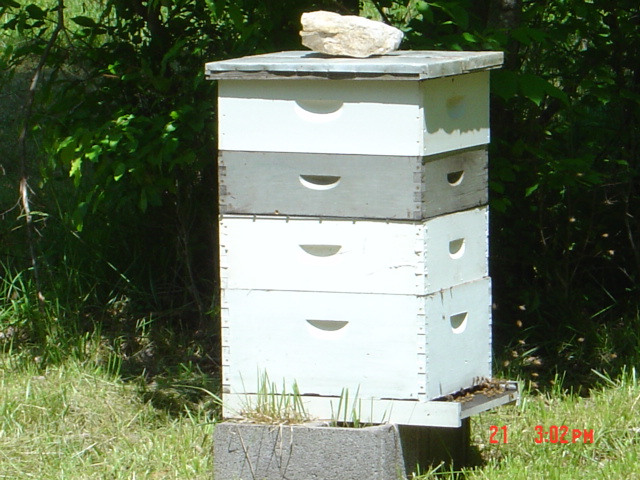
| Components of the Hive. There are several items that make up what we call a (Langstroth) hive. a) Hive Stand (optional) - This is the item that the whole hive sits on. The base. Some people don't use these, they use cinder blocks, a wood stand, or pallet. I use cinder blocks for my base with the bottom board sitting on these, which works very well. See photo. b) Bottom board - This item sits on top of the hive stand, if used. Otherwise, it sits on some kind of stand. One side of the bottom board is shallow and the other is deeper. This permits reversing depending on the season. Most people use the deep side up and never reverse and if the entrance needs reducing, it is done with an entrance reducer. See photo. c) Hive body - This is a hollow box with no top or bottom which hold the frames w/ foundation. This item sits on top of the bottom board. The standard Langstroth hive will hold 10 standard frames. This area in the hive body is called the brood nest. This is where the swarm raises more young bees. This is the heart of the hive. d) Frames with Wax Foundation - These are removable racks in which the foundation is held for the bees to draw comb. There are several types on the market: plastic one piece frames that are ready to install, wood frames with plastic foundation, wood frames with wax foundation. There are some plastic aIready drawn comb frames on the market made by John Seets called (Permacomb). These may be a good choice for honey production, because the bees don't have to draw the comb. They just fill em up and cap em. I prefer the wood frames with either wax or plastic foundation. I will be trying some of the permacomb frames this year 2004. I will let you know my opinion on these. e) Inner Cover - This item goes on top the hive body. The inner cover is just that, an cover. It covers the frames in the hive body. The inner cover has an elongated hole in the center of the hive, about 1" x 3" with a 3/4" slot cut in the outside band of the cover. The holes in the inner cover are for ventelation and an upper entrance for the bees. The inner cover also provides an insulation barier between the frames and the top cover. f) Top Cover - This cover goes on top of and down over the inner cover to protect the hive from weather. g) Supers - Supers are shallow versions of the hive body used for the collection of honey during a honey flow. Supers also have frames with foundation or drawn comb, usually 9 or 10 frames. There are several size supers: Deep, Medium, or Shallow. A Deep super is 9 5/8" tall and will hold about 60 lbs. of honey. With the weight of the super and the honey, both together can easily weigh 80-90 lbs. With a 90 lb. super, you can see why the Medium and Shallow supers were made. A Medium super is 6 5/8" tall and will hold about 40 lbs. of honey. A Shallow super is 5 11/16" tall and will hold about 30-35 lbs. of honey. As you can see the 50 lb. Shallow honey super is much more manageable than a 90 lb. super. h) Queen Excluder - This device looks kind of like your grill top. It's purpose is to keep the queen confined to the lower brood box/boxes and out of the upper honey supers. This prevents the queen from laying eggs in your beautiful honey supers. This is a requirement if you are going to make comb honey. Some people, like me, just don't want the queen laying any eggs in their honey. Some people don't mind. This is an issue that is divided right down the middle. You have just as many proponents for as against queen excluders. You will have to be your own judge here. Conclusion: All of these items put together make what we call a bee hive. And it is well suited for our bees and will produce enourmous amounts of honey if properly managed. There are other types of hives like the Top Bar Hive, etc..., but I have no experience with these. |
 |
 |