|
A Frank Odell Web Page
|
|
Page 2 |
|
My Involvement With RUCHAMKIN |
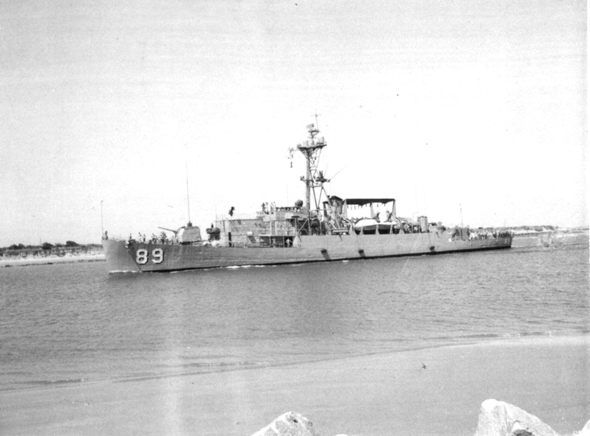 |
| USS RUCHAMKIN in the Port Canaveral, Florida channel returning from sea. Photograph by F. Odell |
 |
|
The two equipment vans installed on the after deck of RUCHAMKIN. To the left is the Communications and Timing Van and to the right is the Flight Safety Van. Photograph by F. Odell |
A SOO is a Ship Of OpportunityBy Frank Odell (KA1FCF) (This area is under construction) USS RUCHAMKIN was such a ship to the Fleet Ballistic Missile program (FBM) in support of the Polaris project during the late 1960s. Mission SupportMission
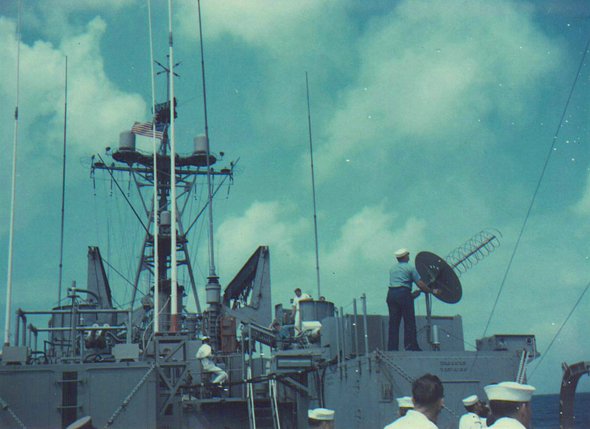
USS RUCHAMKIN'S ROLENormally the mission support requirements were satisfied by USS OBSERVATION ISLAND, however there were several times during the 1960s when USS OBSERVATION ISLAND was needed elsewhere. During those time periods USS RUCHAMKIN became our Ship Of Opportunity and she filled the Launch Area Support Ship role. The Instrumentation Equipment we installed aboard USS RUCHAMKIN provided the required at-sea and dockside support for the Polaris Submarine being tested. The Instrumentation Equipment took data, via telemetry, while the submarine crew were completing their training in preparation for actually launching a missile(s) at-sea. During the launching operations telemetry signals from the missile aboard the submarine were transmitted to USS RUCHAMKIN where the information was recorded and displayed in the Flight Safety Van located on the starboard (right) side of the ship, see picture above. This enabled Flight Safety personnel in the van to comply with range safety requirements. The information provided to Range Safety was a series of pen-graphs that depicted the missile's actual and predicted flight path. The equipment located in the Flight Safety Van also calculated and provided Point of Impact Prediction information, in graphic form, to the Flight Safety personnel. If the missile was outside safe limits (veered off flight profile) then the Flight Safety personnel would destroy the missile by sending a coded message via the Command Destruct Transmitters to the missile. The initiation of a Command Destruct Signal was accomplished by pushing a big red button, just like in the movies. The Command Destruct Transmitters used to transmit the coded destruct message were located in the Communications Timing Van that was located on the port (left) side of the ship, see picture above. PreparationShip When USS RUCHAMKIN would arrive at the Port Canaveral Naval Pier to begin a support evolution we would load the two equipment vans, see picture above, on her after deck. The deck was pre-prepared for the operation by the installation of pad eyes and electrical power cables. These modifications allowed the ship to accept the vans with a minimum of effort. These modifications remained in place waiting for the next time we needed support. The vans contained all the communications, timing, telemetry and flight safety equipment needed to transform USS RUCHAMKIN into an Mini-Instrumentation Ship prepared to support Polaris Missile launching operations. Equipment VansThe two vans of equipment were manned by a combination of; US Navy technicians, Interstate Electronics Corp. technicians and USAF Civil Service Range Safety personnel. The Range Safety personnel were the guys that blew-up the missile(s) if it strayed off course. The port side van, see picture above, contained radio communications equipment, timing generator (atomic clock) and command destruct transmitters. The starboard side van contained the telemetry receivers, missile track display devices and a Flight Safety Operations Station for the use of the Flight Safety personnel. Much of the equipment was redundant. The redundancy was needed to track more than one in-flight missile at a time. Also, the redundancy some times provided a back up in case of equipment failure. The sailor standing atop the starboard van (see picture above) is hand pointing the telemetry tracking antenna towards the in-flight missile. This was done to improve the reception of the various radio signals from the missile. This was in the 1960's and the FBM program did not have the money for auto-tracking equipment. At that time, the FBM program was just an after thought by the legislative/administrative branches of our government. Later, the FBM program became the nation's primary strategic weapons system, and funding for things like auto-tracking equipment became available. The back up tracking antenna, not seen in this picture, was a shoulder aimed antenna build by Bob Anderson (W4PRK) of Interstate Electronics Crop. in his home garage in Cocoa Beach, Florida. It was a piece of wood made to resemble a gun stock and it had a helix antenna mounted on the stock. A sailor would hold the antenna to his shoulder, like a rifle, and aim it at the missile in flight. |
![[Navy Banner]](images58/logonavy.gif)

