|
A Frank Odell Web Page
|
|
Page 1 |
 |
|
From USS RUCHAMKIN visitor's pamphlet |
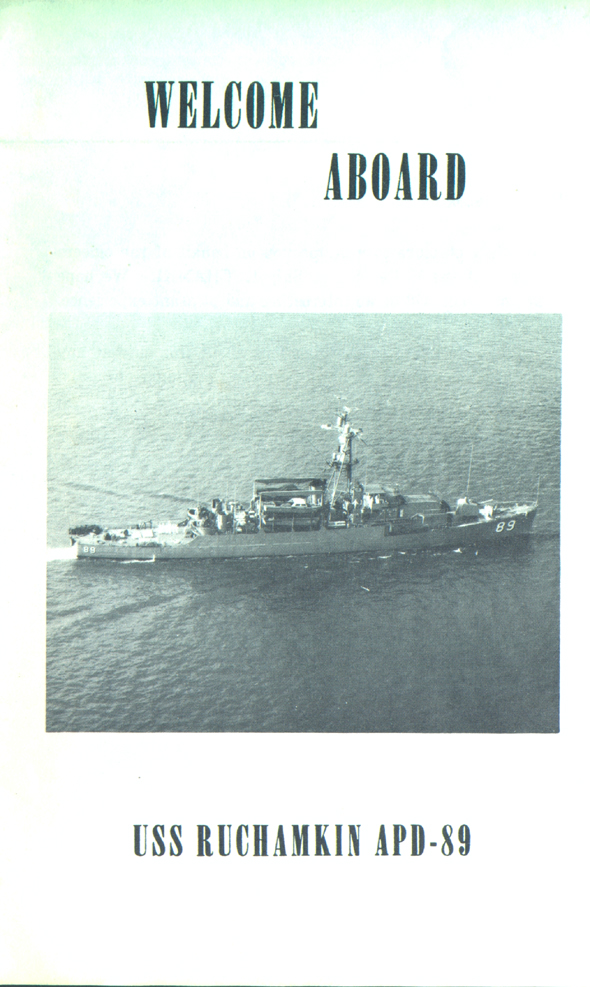
| Welcome aboard: It is a pleasure to welcome you on behalf of the officers and men of the United States Ship RUCHAMKIN. We hope that your visit will be an interesting and pleasant experience. Please feel free to ask questions about this ship at any time. The officers and men will be more than happy to assist you.
|
|
Retyped from USS RUCHAMKIN visitor's pamphlet |
| During October and November 1964
RUCHAMKIN participated in Operation Steel Pike I, the
largest amphibious exercise since World War II. RUCHAMKIN
controlled Ship to Shore movement over Green Beach. The exercise saw over
25,000 Marines land on the beaches of Huelva, Spain, by waves of landing
craft in a waterborne movement and by helicopter employing the vertical
envelopment concept of amphibious warfare. RUCHAMKIN is propelled by two turbo electric drive units and is capable of steaming at 23 plus knots. She is 306 feet long with a beam of 36 feet. Her armament consists of one 5 inch 38 caliber dual purpose gun and two twin 40 millimeter anti-aircraft guns. For purposes of anti-submarine warfare RUCHAMKIN carries six torpedoes and four depth charges. |
|
Retyped from USS RUCHAMKIN visitor's pamphlet |
 |
|
From USS RUCHAMKIN visitor's pamphlet |
 |
|
From USS RUCHAMKIN visitor's pamphlet |
|
AMPHIBIOUS FORCE HISTORY
|
|
Retyped from USS RUCHAMKIN visitor's pamphlet |
|
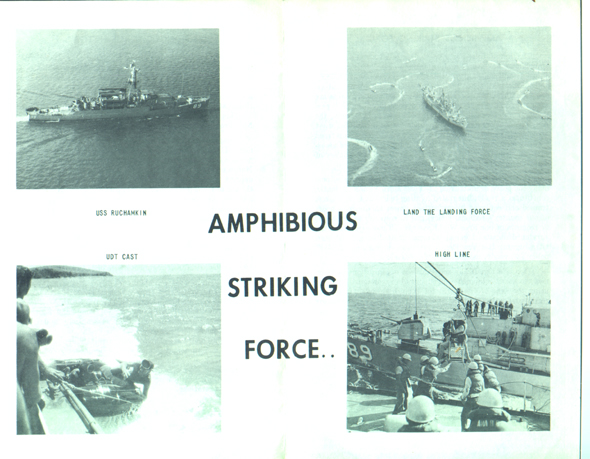
AMPHIBIOUS STRIKING FORCE The Amphibious Force specialized in all naval aspects of amphibious warfare. Its ships include amphibious command ships, assault ships, attack transport and cargo ships, landing ships dock, high speed transports, landing ships tank and assault landing craft. Screening and gunfire support ships are assigned from other type commands as required for each particular amphibious operation. In addition to the ships, the Amphibious Force contains an underwater demolition unit (frogmen), tactical air control group, naval beach group troop training elements and the command and staff structures necessary to plan, train for and carry out the many phases of amphibious warfare. This force, teamed with an embarked landing force, normally composted of unit of the Fleet Marine Force, Atlantic, constitutes a ready integrated fighting team. It is organized, trained and equipped to project sea power ashore in support of our country's national policy, and in response to the needs or requests of our Free World partners. Tailored to meet the varying demands of global tensions, limited or general war, this organization provides a precision instrument of U. S. policy...ready, mobile, versatile, flexible and strong. This is a logistically self-sufficient organization that carries necessary equipment and supplies in sovereign U. S. ships using the seas of the world for their highways. It is ever ready to deploy, fight and stay in position as long as any specific situation requires. This versatile team and Force-in-Readiness capability is maintained and highly developed through constant training and deployment of units of the Atlantic Fleet Marine Force and Amphibious Force. While the majority of our ships are of World War II ventage, our goal is to achieve a 20-knot capability in the entire Amphibious Force. Speed, faster ships and landing craft development of new techniques and the training of dedicated men...are essential to modernization of the Amphibious Force in meeting present and future responsibilities throughout the world. |
|
Retyped from USS RUCHAMKIN visitor's pamphlet |
|
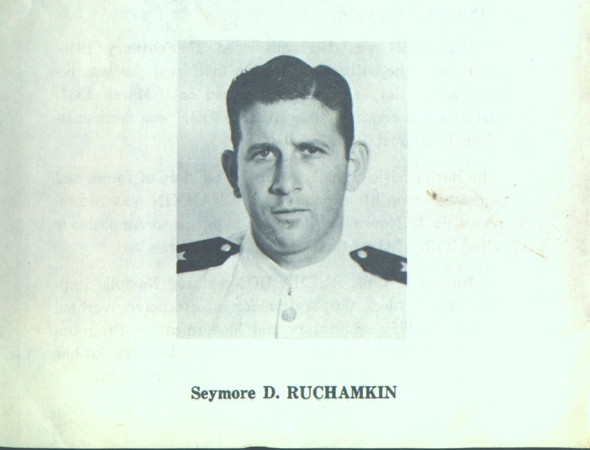
USS RUCHAMKIN (APD-89) The mission of RUCHAMKIN is to transport at high speed, and land an underwater demolition team, raiding party, reconnaissance unit or small troop unit and their essential equipment and act as a control ship in amphibious assault. The ship is also capable of operating defensively against submarines as part of a coordinated Anti-Submarine-Warfare system, and provide limited gunfire support for amphibious assault and land forces. USS RUCHAMKIN was laid down in 1945 at Philadelphia Naval Shipyard as Destroyer Escort 228. However, it was converted to a high speed transport at Duane Shipbuilding Corporation, and was commissioned as such 16 September 1945. The ships name commemorates LTJG Seymore D. Ruchamkin of Brooklyn, New York who lost his life trying to save his ship, USS CUSHING, in the battle of Savo Island in World War II. LTJG Ruchamkin was posthumously awarded the Navy Cross for his valor. RUCHAMKIN was decommissioned 27 February 1946. However with the outbreak of action in Korea she was recalled to active duty and recommissioned on 9 March 1951. As a part of a conservation move RUCHAMKIN was decommissioned on 13 August 1957. The Berlin crisis of 1961 required a build up of forces and an increase in troop lift capability. RUCHAMKIN was recommissioned on 18 November 1961 and assigned to Amphibious Squadron TEN of the Atlantic Amphibious Force. In November 1963, RUCHAMKIN entered Norfolk Shipbuilding and Drydock Corporation for an extensive overhaul under the Fleet Rehabilitation and Modernization Program. This overhaul provided an increased capability to carry out her assigned mission and better living conditions for her men. |
|
Retyped from USS RUCHAMKIN visitor's pamphlet |
|
History The designation APD-89 was changed to LPR-89. RUCHAMKIN was one of the LPR-87 Class. RUCHAMKIN was Stricken on 10/31/1977 and sold to Colombia, SA, on 03/01/1978. |
![[Navy Banner]](images58/logonavy.gif)

