|
TB wipes out 27.5 B pesos in foregone income every year
18 million Filipinos have TB;
75 die of TB everyday
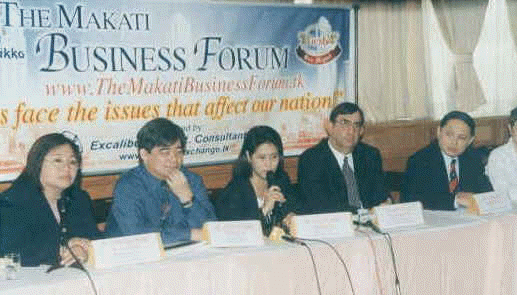
(from left-right) Dr. Irene Santos, co-chair anti-TB committee, Rotary Int'l. district 3780; Dr. Juan Antonio Perez
III, head of party, PHILTIPS (USAID); Dr. Rosalind Vianzon, NTB manager, DOH; Dr. Michael Voniatis, WHO TB officer, Phils.; Dr. Jupert
Benedicto, secretary, PhilCAT and Esther Gallardo, forum moderator (partly hidden) during the Presentation of the "Philippine Rotary
Initiative Against TB" at the Makati Business Forum.
TB or tuberculosis is a highly
contagious illness caused by the germ mycobacterium tuberculosis that is breathed into the lungs. Once breathed in, these germs can settle
anywhere in the body and cause TB. The most common sight for TB is in the lungs. However, TB can also affect other parts of the body such as
the brain, bones, intestines and liver.
There are 2 billion currently
afflicted with TB worldwide, with 8 million new cases annually. All over the world, two million die of TB each year.
Eighteen
million Filipinos are infected with TB, the fifth leading cause of sickness and sixth cause of death in the country. It is a curable but
socially misunderstood disease; it kills an average of 75 Filipinos every day and affects adults in their economically most productive
years.
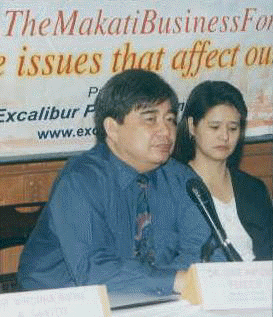 Juan Antonio Perez III, (left) head of Party of the
Philippine Tuberculosis Initiatives for the Private Sector (PhilTIPS), a USAID funded institution, said that TB robs an average Filipino
worker of P225 (US$4) per day for women and P450 (US$8) per day for men. The loss in wage is more than 8 billion pesos (US$144 million) a
year. Juan Antonio Perez III, (left) head of Party of the
Philippine Tuberculosis Initiatives for the Private Sector (PhilTIPS), a USAID funded institution, said that TB robs an average Filipino
worker of P225 (US$4) per day for women and P450 (US$8) per day for men. The loss in wage is more than 8 billion pesos (US$144 million) a
year.
A study
made by the PhilTIPS, showed that disabilities and premature death from TB wipe away a staggering 27.5 billion pesos (about US$490 million)
in potential income and benefits every year.
In order to
save more lives and lighten the economic burden of the disease, the private sector like the PhilTIPS and the Philippine Coalition Against TB
(PhilCAT) another USAID-funded institution, help the government by improving the private sector’s practice of Directly Observed Treatment
Short Course (DOTS) for TB diagnosis and treatment, and reduce the prevalence of TB.
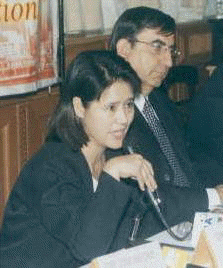 TB is curable and treatment is
available everywhere, said Dr. Rosalind Vianzon (left) of the DOH. For those who cannot afford the medicine, treatment is free
of charge, Vianzon added. Medication should be given religiously during the prescribed time, she stressed, because treatment will be at a
higher level and for a longer time due to the resistance that the TB virus develops against the medicine. According to Dr. Vianzon there are
300,000 TB cases prevailing in the Philippines every year, and for every 100,000, 134 are new cases. TB is curable and treatment is
available everywhere, said Dr. Rosalind Vianzon (left) of the DOH. For those who cannot afford the medicine, treatment is free
of charge, Vianzon added. Medication should be given religiously during the prescribed time, she stressed, because treatment will be at a
higher level and for a longer time due to the resistance that the TB virus develops against the medicine. According to Dr. Vianzon there are
300,000 TB cases prevailing in the Philippines every year, and for every 100,000, 134 are new cases.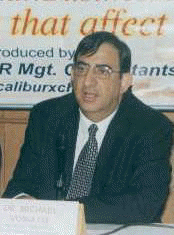
Dr. Michael
Voniatis, (right)Philippine TB officer of the World Health Organization, said that DOTS is a cost-effective strategy promoted
by the World Health Organization WHO for controlling TB. It is in the forefront of the efforts being exerted in combating TB globally, he
said. WHO has been supporting the program for the last 8 years, Voniatis added. By the end of 2005 the program will cover the whole country,
as it is the focus to the regular program, he said.
Voniatis recognized the Philippines as one of the fastest countries to adopt and expand DOTS in the government health
system – from about 0% in 1995 to nearly 100% of all government clinics by 2000. In 2001, the WHO credited the Philippines as being one of
only four countries having outstanding performance in TB control by the government health system. According to Dr. Voniatis, the WHO
estimated that everyday, DOTS cure some 164 Filipinos of TB. 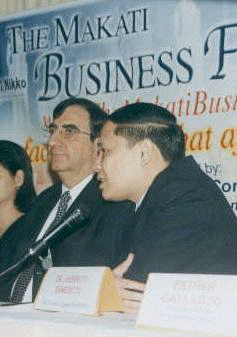
In February 2003, Philippine Health Insurance Corporation (PhilHealth) signed an agreement with PhilCAT to launch an
outpatient benefits package that carries TB diagnosis and treatment, said Dr. Jupert Benedicto (rght) of the Philippine
Coalition Against TB (PhilCAT). This TB package is unprecedented in the country, Benedicto emphasized. It makes available P4,000 per TB
patient to public and private clinics certified as DOTS-ready by PhilHealth, he said. PhilCAT assumes the job of training the referring
physicians and certifying these centers.
The foregoing partnerships lead the way in promoting public-private mix in TB control. Rotary’s Philippine Initiative Against
TB is a welcome addition to the fight.
(Excalibur News)
▲ top
.
Rotarians join fight against
TB
..
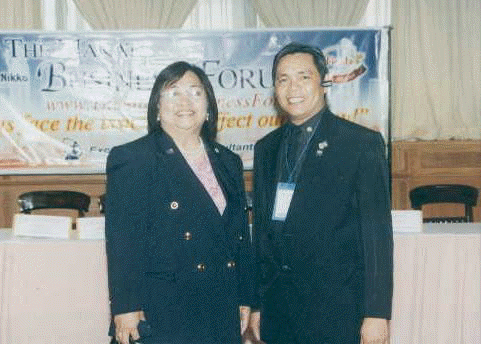 Dr. Virginia Irene Santos,
president of RC Agham, Quezon City and co-chair of RI District 3780's Anti-TB Committee, with the Forum host who is also a Rotarian,
during the presentation of the Philippine Rotary Initiative Against TB at the Makati Business Forum Dr. Virginia Irene Santos,
president of RC Agham, Quezon City and co-chair of RI District 3780's Anti-TB Committee, with the Forum host who is also a Rotarian,
during the presentation of the Philippine Rotary Initiative Against TB at the Makati Business Forum
The Rotary Int'l.
District 3780, under the leadership of its Centennial Governor George L. Howard (RY 2004-2005), with its 88 different Rotary Clubs in the
entire Quezon City, rallied behind the Dept. of Health’s call to combat tuberculosis in the country.
Rotarians led by Dr. Virginia Irene R. Santos, president of the Rotary Club of Agham, Quezon City and co-chair of the Rotary district
3780 anti-TB committee, introduced the “Philippine Rotary Initiative against TB” to the media at the Makati Business Forum held at the
Fiesta San Miguel Bar, Dusit Hotel Nikko, Makati.
The Rotarians
offered to help in identifying TB cases in the different schools and communities throughout Quezon City. Rotarians also further offer to buy
the necessary anti-TB vaccines for children, which the DOH does not have ample stocks of. This is in response to the DOH’s call for a more
active private sector participation in combating TB in the country.
Others partners in
the fight against TB who attended the forum included Dr. Michael Voniatis, TB officer, Phils., WHO: Dr.
Juan Antonio Perez III, head of party, Phil. Tuberculosis Initiatives for the Private Sector or PhilTIPS (USAID); Dr. Jupert Benedicto,
secretary, Phil. Coalition Against TB (PhilCAT); Dr. Rosalind Vianzon, manager, NTB, DOH.
Rotary
International is known for the success of its anti-polio campaign worldwide. Bringing their management acumen into play, we expect that the
participation of business leaders in eradicating TB in the country will end up as the same story of success. (Excalibur News)
▲ top
.
|