
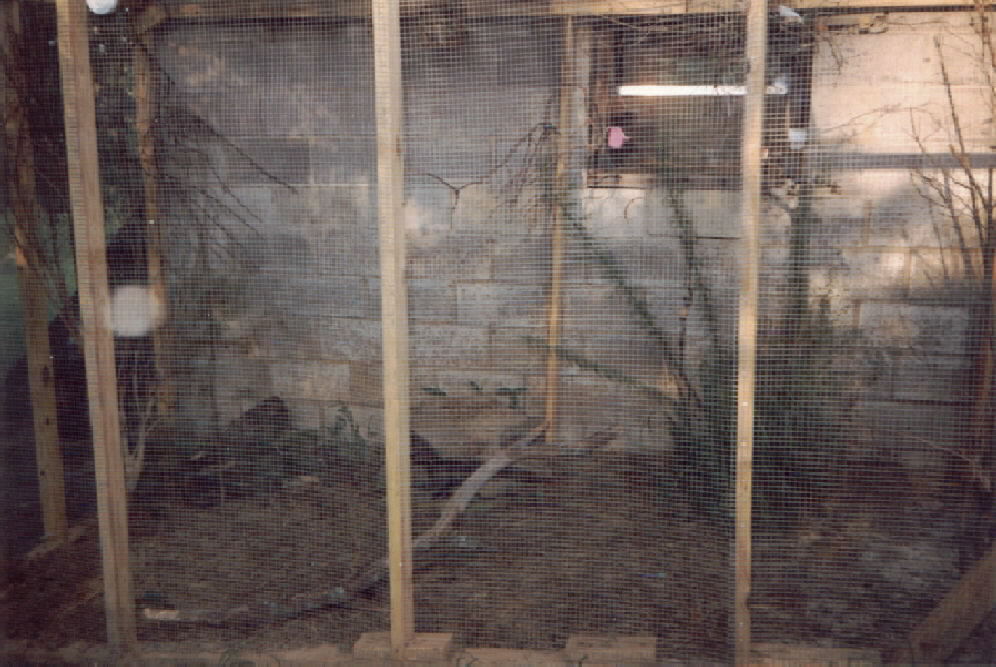
Well, gang this is where it all started. I think it turned out nicely. If you read my article in the upcoming NFSS Bulletins, you will see that I talk about this aviary. Actually, I talk about my 12' x 12' aviary which was made the following year by adding 6' onto this 6' x 12' aviary. You will see the crack in the barn wall. Its located under the window sill.
As you can see, the bottom of the aviary is earth, covered with dried grass. To the left, there is a pine tree growing in the corner, with a wooden stump just behind it. If you look closely you will see some type of weed growing up the barn wall next to the stump. To the right of the stump is a collection of flat rocks. I thought this was a good addition to the aviary. The zebra fledglings loved to play in that area, on the stump, and all of the finches loved to sit on the fallen branch located in the middle on the aviary floor. I did not have a sitting tree in this aviary, because at the time I built this I only had one pair of zebras in here. To the right of the rocks there are some more native plants growing. To the right of that, you would have entered the antechamber section of the aviary. When building an aviary, you always want an antechamber. What is an antechamber? Its part of the aviary from which you enter. It has two doors located, so you can safely open one door without birds escaping. Then you can open the door to the aviary. But I did not have two doors to my antechamber. My finches would always fly away, when I would come near the door. But, that is not good practice. I had my only nest box located in my antechamber. This gave me access to it without having to walk through the aviary.
At the end of the breeding season, I released all of my finches into this, including my first pair of gouldians.