





A May Basket Full of Love
May is finally here. The flowers are beautiful in May. Flowers are for any occasion. The month of May celebrates Mother's Day and Memorial Day. Flowers are great gifts for all. We live in Massachusetss and our state flower is the Mayflower.

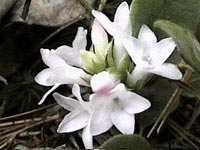
Massachusetts State Flower
The mayflower, or trailing arbutus, was favored for adoption as Massachusetts� state flower at least as early as 1893. Mayflower bills were introduced in 1900 and 1901, but both were defeated. A bill to adopt the mountain laurel was similarly defeated in 1905.
In 1918, Representative Myles A. O�Brien, Jr. introduced another mayflower bill. Later that day, another bill was introduced to designate the water lily. Other flowers were then proposed.
The matter was turned over to the Department of Agriculture. They wanted nothing to do with it and passed it on the State Board of Education.
Thus, Massachusetts school children were given the chance to vote for their state flower. The mayflower won with 107,617 votes. The water lily was second with 49,499 votes. The mayflower was adopted as the state flower on May 1, 1918.
Some people claim the mayflower was named for the month of May. However, it blooms from March to May.
It may have been named for the ship that brought the pilgrims to Massachusetts� shores. Ironically, the Pilgrim�s ship, the Mayflower, was named after the hawthorn, which is called �mayflower� in England. Still, the early blooming arbutus must have cheered the colonists after they survived their first harsh winter in a strange land.
The trailing arbutus, or mayflower, grows abundantly in the vicinity of Plymouth, and was the first flower that greeted the Pilgrims after their fearful winter. The name mayflower was familiar in England, as the application of it to the historic vessel shows, but it was applied by the English, and still is, to the hawthorn. Its use in New England in connection with Epigaea repens dates from a very early day, some claiming that the first Pilgrims so used it, in affectionate memory of the vessel and its English flower association.
Trailing-arbutus has long evoked rich sentiments in poetry and lore. In New England and elsewhere, the common name is mayflower. This name is said to date to the Pilgrims, who found it abundant around Plymouth, Massachusetts, and the first bloom to assure them that their first terrible winter was over. John Greenleaf Whittier, who was born in our hometown of Haverhill, Massachusets wrote a poem, "The Mayflowers," that captures the timeless lure of this wildflower. As the name of the English hawthorn and the ship that brought them to America, "Mayflower" evoked fond memories for the Pilgrims.
THE MAYFLOWERS
by John Greenleaf Whittier
Sad Mayflower! watched by winter stars,
And nursed by winter gales,
With petals of the sleeted spars,
And leaves of frozen sails!
What had she in those dreary hours,
Within her ice-rimmed bay,
In common with the wild-wood flowers,
The first sweet smiles of May?
Yet, "God be praised!" the Pilgrim said,
Who saw the blossoms peer
Above the brown leaves, dry and dead,
"Behold our Mayflower here!"
"God wills it: here our rest shall be,
Our years of wandering o'er;
For us the Mayflower of the sea
Shall spread her sails no more."
O sacred flowers of faith and hope,
As sweetly now as then
Ye bloom on many a birchen slope,
In many a pine-dark glen.
Behind the sea-wall's rugged length,
Unchanged, your leaves unfold,
Like love behind the manly strength
Of the brave hearts of old.
So live the fathers in their sons,
Their sturdy faith be ours,
And ours the love that overruns
Its rocky strength with flowers.
The Pilgrim's wild and wintry day
Its shadow round us draws;
The Mayflower of his stormy bay,
Our Freedom's struggling cause.
But warmer suns erelong shall bring
To life the frozen sod;
And through dead leaves of hope shall spring
Afresh the flowers of God!

Trailing-arbutus is an unpretentious, little, evergreen shrub that trails on the forest floor. It is an early harbinger of spring, much beloved for braving late-winter�s cold to produce spicy, pinkish-white blooms among its leathery, veiny leaves. The frosty flowers seem to epitomize purity and virtue. Trailing-arbutus is a "belly" plant: one must lie on one�s stomach to catch a legitimate moment of putting eye and nose to the beauty and perfume

Trailing-arbutus typically grows in sandy or rocky, acid soils in woods and clearings, often on hillsides and banks, including road banks, especially under oaks and pines or hemlocks with such other ericads as mountain-laurel. It is native throughout eastern North America, from Labrador to Manitoba and south to Florida and Mississippi. Despite its wide range, however, it seldom is common and usually is rare, localized by its specialized ecology. Over its range as a whole, it blooms from February to May.
Propagation
Many authorities caution that trailing-arbutus is almost impossible to cultivate by any means, and native plant gardeners should not attempt to grow it. Attempts to transplant it will almost certainly fail and, in the process, result in the further destruction of the species in the wild.
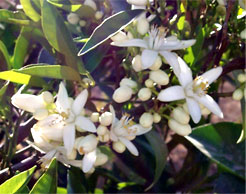
Jessie Cat writes:
The state flower for Florida is the fragrant and
lovely orange blossom. The beautiful white flowers and
green waxy leaves are a beautiful sight to behold on a
spring day.
Florida�s orange blossom is one of several state
flowers that are not native to North America. Oranges
are thought to be native to China. The camellia and
the gardenia have been suggested as possible state
flowers. But the camellia is also native to Asia, and
who can argue with Florida�s multi-billion-dollar
citrus industry?
The waxy, white blossoms of the orange tree are very
fragrant. It has been said that it is the only state
flower from which a commercial perfume has been made.
Tons of Florida orange blossoms were once shipped to
weddings across the country.
In 1967, Florida adopted a state beverage: �The juice
obtained from mature oranges of the species Citrus
sinesis and hybrids thereof . . .� In other words,
orange juice! Concentrated orange juice was developed
during World War II. After the war, a frozen
concentrate was developed, and orange juice production
exploded into a multi-billion dollar industry. Some of
Florida�s biggest events celebrate its citrus
industry. These include the Orange Blossom Festival
and the Orange Bowl.
Another citrus fruit, the lime, is an important symbol
in the Conch Republic, better known as Key West, which
is also famous for its Key Line Pie.
The state nickname is the Sunshine State, the state
motto is "In God we trust." and the state song is
"Swanee River"
Selkie Sue sent this article in about her state flower.
Dear Flower Society Members,
I thought since I live in So. Indiana that I would do a short piece on Peonies since they are the Indiana state flower. I have included 2 pictures showing them both up close and at a distance. They are beautiful in the spring when they bloom here!
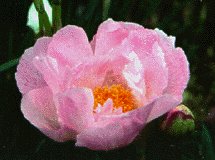
PEONIES, Queen of the Garden Flowers
Peonies are one of the oldest plants cultivated for their flowers and were thought to in cultivation in China up to 4,000 years ago. The Chinese name for the Peony is "Sho Yo" or "Most Beautiful." Poetry, legend and romance all have the Peony prominently involved. The 4th month of the Chinese calendar was named "moon of the Peony". When missionary Buddhist monks traveled to Japan, they brought knowledge of the Peony.
In Japan it quickly became a part of their culture and is a symbol of prosperity. Originally, it was confined to the possession of the elite or wealthy and was associated with wealth.
Legend and superstition have always been close to the Peony. It is known for healing powers during the Trojan wars. It has also been said that powerful forces reside in the blossom of the plant that glow in the dark on the night to a full moon. To contain that magic, the roots could only be dug during the night. If one were to disturb the Peony during daylight hours, Woodpeckers would appear and proceed to peck your eyes out.
Literature depicting an English garden of 1157 describes cultivation of the plant and Shakespeare makes reference in "The Taming of the Shrew" in 1603, "peonied and lilied brims" of a stream. Here in America, Thomas Jefferson was writing about his experiences with Peonies in Virginia in 1771.
Bloom colors range from pristine white through pinks, cherries reds, and corals and near-yellows. Many blooms will open to one color and then age to a second. Many are very fragrant as an added bonus.Healthy Peonies can outlive humans and do not like to be disturbed once planted.
Here in Indiana, they are an important part of spring, blooming in May, and producing heady fragrance all around them. The buds are tightly wound and need ants to eat the sticky sap from them before they open, so all those people who dust their Peonies thinking the ants are overtaking them, only succeed in keeping the buds from opening. A vase full of Peonies brighten up the house and make everything smell wonderful, even if several ants come in along with the flowers.
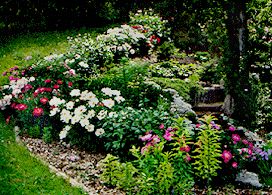
We love our state flower and encourage others to grow and enjoy it!
I hope this will be informational to the Flower Society and that you will enjoy the pictures! Purries from Selkie Sue
The activity for this month is to send in research about your own state flowers and please include graphics so that we all may enjoy the beautiful flowers to fill our basket with love. It will help us to learn about where all of us kitties live. Mew to us girls, Shirley and Sophie by using the mail button below. Happy May to all.

This beautiful midi "Spring Rain" is from Bruce De Boer's selection of Earthtones.


| | |
| | |
5 May 2002.
Floater java script courtesy of
Kurt Grigg.
All graphics on this page are © of Lil Kitty, 2001-2002.
|