Welcome to my country's page . Here you will find Inforamtion about my Country and some usefull link. Please Enjoy your time and let me know what you think :)
Welcome to my country's page . Here you will find Inforamtion about my Country and some usefull link. Please Enjoy your time and let me know what you think :)
HISTORY
Palestine is the ancient name of a Middle Eastern country situated on the eastern coast of the Mediterranean Sea. Its size has varied greatly throughout its history and its exact borders are even now in dispute. Its location at the junction of trade routes linking three continents has meant that it was a melting pot for religious and cultural influences. It has also, unfortunately, been a natural battleground for the region's powerful states and thus subject to domination by them, the first of these being Egypt in the third millennium BC. When Egyptian power began to wane in the 14th century BC, the country was again invaded: this time by Hebrews, who were a Semitic tribe from Mesopotamia, and by Philistines (from whom the country took its name), an Indo-European people. THE WEST BANK
The West Bank is a term used to mean the disputed lands located west of the Jordan River between Israel and Jordan. Its area is about 5900 sq km (2278 sq mi) and it holds many sites of religious importance to Jews, Christians and Muslims. The largest cities of the West Bank are Hebron (Arabic: El Khalil) and Nablus. Part of biblical Samaria and Judaea, the West Bank was a part of the British Mandate for Palestine from 1920-1948. It was formally annexed by Jordan in 1950 -- an act that was not recognized by the Arab League, the United Nations or the United States. After the 1967 Arab-Israeli War, the area came under Israeli control.
THE GAZA STRIP
The Gaza Strip is a narrow area of desert land along the western Mediterranean Sea. It is about 42km (26 miles) long and 6.5 to 8km (4 to 5 miles) wide. It too, like the West Bank, was a part of the British Mandate from 1917 to 1948. Egypt controlled the Gaza Strip from 1948 until the 1967 Arab-Israeli War (except for a brief period of Israeli occupation in 1956-57) when it passed to Israeli control. The Gaza Strip is densely populated -- an estimate in 1993 gave the figure as 800,000 -- with more than 99% of its population being stateless Palestinian Arabs. The majority are refugees from Israel who have lived under extremely difficult conditions in refugee camps since 1948. The flimsy economy is based upon agriculture, livestock, fishing and some small industry. Poverty and unemployment are widespread and the success of the 1993 peace accord between the Palestinians and Israel depends in no small way upon whether economic progress for the people of the Gaza Strip is an outgrowth of the accord.
THE INTIFADAH
The intifada is a revolt by Palestinian Arabs against Israeli military occupation of lands taken in the 1967 Arab-Israeli War. It began in late 1987 in the Gaza Strip and soon spread to the West Bank and East Jerusalem. It involved throwing stones at Israeli soldiers, strikes and business boycotts. Neither the Israeli government nor the Palestine Liberation Organization (PLO) were prepared for the movement. The cause of the intifada is undoubtedly the frustration growing out of the many diplomatic failures to address the grievances of the Palestinian Arabs. Israeli response to the movement drew worldwide criticism for its harshness, and the intifada in fact compelled the Israeli government to re-evaluate Palestinian nationalism as well as the depth of Palestinian discontent, anger, and utter frustration. In September 1993, the PLO and Israel signed an agreement on Palestinian autonomy in the Gaza Strip and the West Bank town of Jericho. The last Israeli troops withdrew on 18 May 1994.

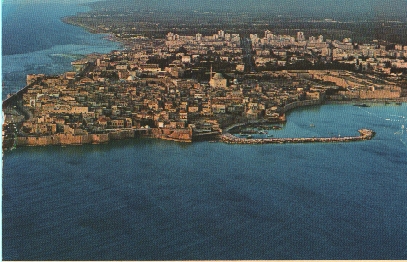
Acre {ahk'-ur} (Arabic: Acca) is a coastal city of Palestine, on the Bay of Haifa. Acre is famous for its surrounding high walls
and is called the city of "Sh. Ahmad Basha al-Jazzar", who prevented French Napoleon from conquering it. Acre is also famous for its
old Arab inns and the mosque of Ahmad Basha al-Jazzar (shown above with the tallest minaret). To the left is a side view of al-Jazzar mosque.
Acre has been under occupation since 1948. Many of the Islamic and Palestinian historic landmarks have been radically changed by occupation.
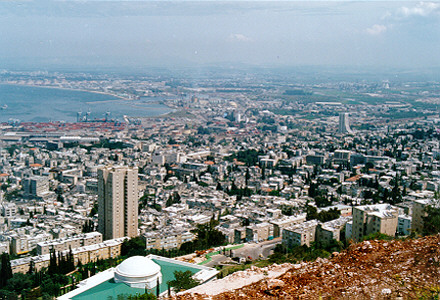
Haifa {hy'-fah} situated at the foot of Mount Carmel and at the southern end of the Bay of Haifa, 19 km (12 mi) south of Acca. Haifa is
Palestine's leading Mediterranean seaport. Haifa has been under occupation since 1948. Many of its remaining mosques have been turned into bars and museums.
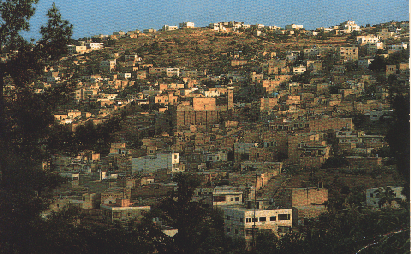
Hebron {hee'-bruhn} (Arabic: El Khalil) is a city in the southern part of the West Bank. More than 100,000 Palestinians live in Hebron.
Glassware and leather-goods manufacturing as well as food processing are the principal industries, and in the surrounding region grains,
grapes, and vegetables are grown. Hebron is a sacred place for Muslims. Founded in the first half of the 2nd millennium BC,
it was the home of Ibrahim (pbuh) and his family. El-Khalil is named after Khalil al-Rahman, nick name for Prophet Ibrahim (pbuh).
The city was under Islamic rule from 635 to 1100, when the Crusaders gained control. Retaken by Muslims in 1260, it came iunder Ottoman
control in the 16th century. Hebron was part of the British mandate of Palestine from 1922 until 1948 when it was incorporated into Jordan.
Since the Six Day War of 1967 it has been under Israeli occupation. The Ibrahimi Mosque, has a burial site of Prophet Ibrahim (pbuh) and his family.
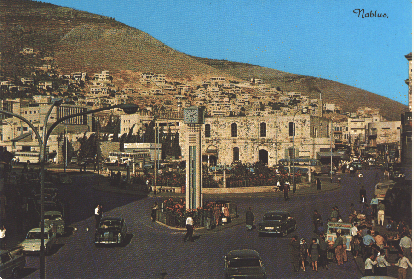
Nablus {Na-blos} Nablus is the largest town on the West Bank. Situated 67 kms north of Jerusalem, 570 m above sea level in the valley between the biblical Mount Ebal (called in Arabic Jabal Sitt Sulaymiyya) and Mount Gerizim (Jabal alTur). Nablus is the natural capital of the mountain region of northen Palestine. The surrounding land is notable for its olive groves and orchards, including figs, walnuts, apricots, mulberries, pomegranates and vines, with a few date palms. Yet the town boasts almost two millennia of continuous history, with buildings from Roman to Ottoman times, shrines of biblical prophets, bath-houses, palaces and soap factories where soap is still made in the traditional way, all set amid the colourful bustle of a typical Middle Eastern market town. The city is famous of Middle Eastern sweets. Nablus has a population of 130,000 Palestinians.
In 636 the Muslim Arabs opened the town. The famous tenth-century geographer al-Muqaddasi wrote that the town abounded in olives and was named "the little Damascus" and that its market place was very extensive. It had a Great Mosque very finely paved, the houses were built of stone and a stream of running water flowed through the town. In 1099, Crusaders invaded the city and took control of it, until 1187 when it was liberated by Salahuddin. At the time of Ottoman control, Nablus became capital of a district (sanjak) under the control of a local governor in the province of Damascus. The Ottomans built palaces with iron gates similar to the medieval family palaces in Italian cities. It was said that the largest building, the Tuqqan Palace, could accomodate l,OOO soldiers. Many of the religious buildings in Nablus also date from that period, as do the soap factories.
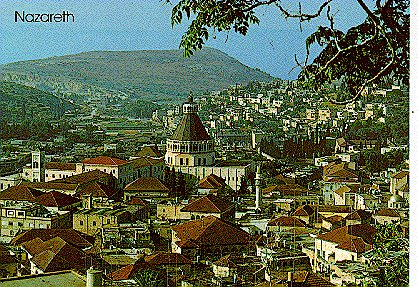
Nazareth {naz'-uh-reth} (Arabic: al-Naserah) is a town in Lower Galilee (Arabic: al-Jalil), near the Sea of Galilee. Most of the inhabitants are Palestinians and have been under occupation since 1948.
Jerusalem: The Holy City :
Jerusalem has been crowned queen of the world's cities for 50 centuries. Chosen by God to be the bulwark of monotheism,
Jerusalem was first mentioned in the Bible during the time of Abraham under the name of Salem, meaning peace. The King of
Salem was a Jebusite and in the 10th century BC, David captured the city from the Jebusites and made it his capital.
First inhabited by the Canaanites, Jerusalem has been besieged more than 50 times, conquered 36 times, and destroyed 10
times. In 330 AD, Constantine converted Jerusalem into a Christian city and sent his mother, Helena, to build its first
churches.