Revisiting the Leonids: Observations of the 2001-2004 Showers
By Frank Loso
October 2005
Just a few years ago, with November approaching, the attention of both casual sky gazers and seasoned amateur astronomers alike was focused on the Leonids. The reason for all the interest in this normally average meteor shower was the possibility of witnessing a spectacular meteor storm like the one that occurred during the Leonids of 1966. Much has been written about this incredible shower, possibly the most intense meteor storm in history, where in the predawn hours of November 17, meteors were seen at rates of up to several hundred per minute with a peak rate of 40 per second. Several eyewitness accounts of the 1966 shower can be found at the NASA Leonid archive, http://leonid.arc.nasa.gov/1966.html and the American Meteor Society website at http://comets.amsmeteors.org/meteors/showers/leonidsrecoll.html and make interesting reading. Descriptions such as “awe inspiring” and even “life altering” are used. Several people describe the event as being similar to the sight of driving into a snowstorm. Now this would be something to see!
It was with such anticipation that I observed the Leonids for several clear Novembers beginning in 1998 until the perfect storm finally did occur in 2001 and 2002. I will describe my observations in this article, but before that, a bit of background material might be of interest.
Meteors are observed when the earth sweeps up bits of interplanetary debris during its orbit around the sun. This debris, mostly sand to pebble sized particles eroded from comets by the heat and radiation pressure of the sun, is burned by friction with the earth’s atmosphere resulting in the glowing streaks seen in the night sky as ‘shooting stars.’ While sporadic meteors are seen randomly on any clear night, named meteor showers such as the Perseids and Leonids occur annually around fixed dates when the earth passes the point in its orbit where it intersects with the orbit of the parent comet for that particular meteor shower. In the case of the Leonids, the parent comet is 55P/ Tempel-Tuttle, a periodic comet with a 33 year orbit. Occurring annually in mid-November, the Leonids are known for bright swift meteors which often leave behind visible trails. Generally the Leonid shower displays an average of perhaps 10 to 15 meteors per hour, which is not particularly great compared to more active showers such as the Perseids or Geminids where rates of perhaps 100 per hour are typical. What makes the Leonids most noteworthy is their association with several meteor “storms” like the one of 1966. Besides the 1966 storm, the Leonid shower is known to have produced storms in 1799, 1833 and 1866 as well as several other spectacular displays that did not quite reach “storm” levels.
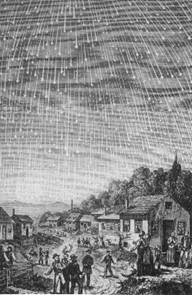 Of the earlier Leonid storms, the one of 1833, depicted at
left, is especially noteworthy. As with the 1966 storm, meteors were seen
falling at a rate so great that the entire sky appeared to be covered with them
at once, as if it were literally raining meteors. The fact that this
display occurred before the widespread use of outdoor electric lighting must
have made it even more spectacular. Aside from the visual spectacle, the
Leonid shower of 1833 is important in that it led to an accurate modern
understanding of meteors in general. Until this time, there was still
speculation about the nature of meteors and whether they were meteorological or
astronomical phenomena. The 1833 Leonids helped to answer this question,
revealing that meteors, while appearing in the atmosphere, were the results of
particles from space. It was also through observations of this shower
that the first precise determination of a meteor shower’s radiant (point
in the sky from which the meteors appear to originate) was made by Professor
A.C. Twining of West Point, New York, and W.E. Aiken of Emmittsburg,
Maryland. Perhaps even more interesting, is the fact that information
compiled in the years following regarding past Leonid showers led to the
determination, by Heinrich Wilhelm Matthias Olbers in 1837, that the Leonids
possessed a period of about 33 years in which activity significantly
increased. As a result, he predicted a return Leonid storm in 1867.
Of the earlier Leonid storms, the one of 1833, depicted at
left, is especially noteworthy. As with the 1966 storm, meteors were seen
falling at a rate so great that the entire sky appeared to be covered with them
at once, as if it were literally raining meteors. The fact that this
display occurred before the widespread use of outdoor electric lighting must
have made it even more spectacular. Aside from the visual spectacle, the
Leonid shower of 1833 is important in that it led to an accurate modern
understanding of meteors in general. Until this time, there was still
speculation about the nature of meteors and whether they were meteorological or
astronomical phenomena. The 1833 Leonids helped to answer this question,
revealing that meteors, while appearing in the atmosphere, were the results of
particles from space. It was also through observations of this shower
that the first precise determination of a meteor shower’s radiant (point
in the sky from which the meteors appear to originate) was made by Professor
A.C. Twining of West Point, New York, and W.E. Aiken of Emmittsburg,
Maryland. Perhaps even more interesting, is the fact that information
compiled in the years following regarding past Leonid showers led to the
determination, by Heinrich Wilhelm Matthias Olbers in 1837, that the Leonids
possessed a period of about 33 years in which activity significantly
increased. As a result, he predicted a return Leonid storm in 1867.
The expected storm occurred in 1866, as did strong displays in both 1867 through 1869. The year 1867 was another milestone in the increased understanding of meteors. In December the previous year, a faint comet was discovered near Beta Ursa Majoris by Ernst Tempel of Marseilles, France. The comet was also discovered independently in January 1867 by Horace Tuttle of the Harvard College Observatory, and was given the name of Tempel-Tuttle. This comet reached perihelion (the point where it is closest to the sun) on January 12, 1867 after which it quickly receded and faded from view. When its orbit was accurately computed, Tempel-Tuttle was determined to be a periodic comet that returned every 33.17 years. Shortly after this determination, the astronomer Urbain LeVerrier (who mathematically predicted the existence and position of the planet Neptune, leading directly to its discovery in 1847) was able to compute an accurate orbit for the parent meteoroid stream of the Leonids, noting a strong similarity with the orbit of comet Tempel-Tuttle. This connection was discovered independently by several others, including Giovanni Schiaparelli, of the Martian “canali” fame. And so, the connection between comets and meteors was first made.
With the comet/meteor connection having been made, the periodicity of Leonid activity made sense. As a comet orbits the sun, material in the form of gas and dust is eroded by solar heating and radiation pressure. Near perihelion, the rate of erosion greatly increases, forming a trail or “stream” of material that is pushed outward by the solar radiation pressure and follows the comet closely in a similar orbit. This debris is gradually spread over the comet’s entire orbit like litter along a highway, but remains most dense close to the comet. Since there is some debris dispersed over the comet’s entire orbital path, meteor activity is seen each year when the earth passes through the point in space where its orbit intersects that of the comet near the perihelion point. In years when the comet is nearby, however, the earth may pass through the dense area of the stream, and the meteor activity will be above average - hence, the relationship between the period of increased meteor activity with the period of the parent comet.
With the periodicity of the Leonids having been established in 1867, the world awaited the Leonids of 1899. Unfortunately, when this year finally came, the Leonids failed to deliver. While the shower of 1899 reached rates of about 40 meteors per hour, which was above average, it came nowhere close to the thousands per hour anticipated. The best showers in this time period were those of 1898 which reached rates of 100/hour, and 1901 which reached up to 400/hour. Another 33 years later, the Leonids around the years 1928-32 behaved similarly, reaching peak rates of about 100/hour in 1930 and 1931, but failing to reach storm levels. Leonid activity remained above average (about 40/hour) through 1939, before settling back to the more normal rates of 10-15 per hour. Finally, in 1966, the greatest meteor storm of all history broke loose.
From the historical record, the 33 year periodicity associated with the Leonids was clearly evident. It was also clear from the variation in the peak rates observed, however, that something still needed to be explained. It was in 1998 that the pieces began to really fall together. In this year, David Asher of Armagh Observatory in Northern Ireland, and Robert McNaught of the Australian National University and Siding Spring Observatory published a paper describing a model of how meteor streams, the dense trail of debris that closely follow comets, evolve. By understanding the structure and orbits of these streams, they were able to make predictions for the Leonid activity for the expected peak of 1999. At the same time, another team of astronomers, Esko Lyytinen of Finland, and Tom Van Flandern of Meta Research in Washington, D.C. developed their own meteor stream model which utilized a different methodology than Asher and McNaught, but which provided similar predictions.
In early 1998, Comet Tempel-Tuttle reappeared, reaching perihelion in February. While the world awaited the Leonid shower of that year, the meteor stream models were predicting increased activity in 1999 and 2000, and peak activity in 2001 and 2002. Sure enough, the 1998 Leonid activity was above average, up to a few hundred meteors per hour, and the 1999 shower resulted in rates of up to 1 meteor per second with a peak predicted by the Asher McNaught model to within 6 minutes. Unfortunately this peak was not visible in North America. As an aside, the 1998 shower was noteworthy in an unusually high percentage of bright fireballs over a period of about 18 hours. This was also ultimately explained by Asher/McNaught.
The 2000 Leonids occurred during a bright moon period, and no storm was observed. By this time the now-refined models were indicating that 2001 would be the year for a full blown Leonid storm. Asher/McNaught predicted two peaks for November 18, one at 1001 UT resulting from an encounter with a meteor stream originating from the 1767 apparition of Tempel-Tuttle, and a second at 1820 UT from the 1866 stream. The first peak was expected to result in a ZHR of up to 3000 meteors/hour, and the second a ZHR of over 9000 per hour.
And so, on the morning of November 18, 2001, I set my alarm clock early. At 0400 EST, I went outside. The sky was clear. Dressed warmly, I set up a lounge chair in my backyard, and with a thermos of coffee and a notepad, sat down with a good view to the south and waited. By this time it was 4:15. By 4:21, I had seen 14 meteors. Clearly something exceptional was happening. I had planned to keep count, recording the number of meteors seen every 10 minutes, but since they were coming faster than I expected, I shortened the interval to around 5 minutes. My timer was a watch with no alarm, so my timings were based on periodic glances at the watch. Because of this, the interval strayed a bit. Also, I found that at times several meteors would appear at once, adding to some inaccuracies in my counting. In any event, the display that year was truly spectacular, with meteors visible at a rate I had never seen before, including multiple simultaneous bursts, some of which looked almost like spokes from an umbrella pointing back to the radiant point in Leo.
My observations for that morning are graphed in figure 1. The graph shows the number of meteors seen in each time period, which as noted above is somewhat variable from one sample to the next. Also shown is the cumulative number of meteors observed, and the calculated hourly rate, which is simply the number observed in each period extrapolated to 60 minutes. For example, 5 meteors observed over a 5 minute period (1/minute) correspond to a calculated rate of 60 per hour. The calculated rate is a raw rate, i.e., no corrections were made to convert to Zenithal Hourly Rate (ZHR), the number of meteors that would be seen if the radiant was overhead and the limiting magnitude 6.5. ZHR, the metric usually used to describe meteor activity, also includes correction factors for the percentage of sky observable, percentage of sky obscured by clouds, and “population index” (a correction factor based on the magnitude distribution of meteors for the particular shower).
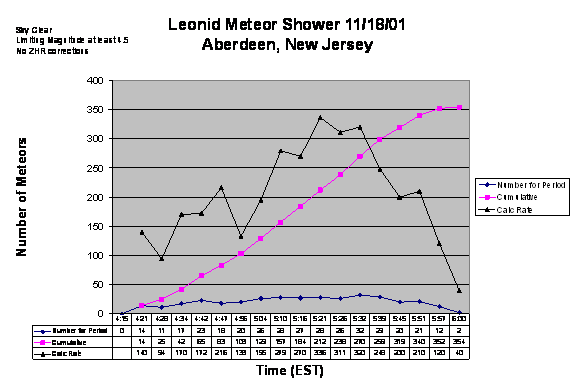
Figure 1 – 2001 Leonids
As the graph shows, over 2 hours and 45 minutes of observing I counted 354 meteors for an average raw rate of 128 meteors per hour. My peak observed rate of 336 meteors per hour occurred between 0520 and 0540 EST. According to the results published in Sky and Telescope and on the International Meteor Organization (IMO) website (http://www.imo.net), the maximum rate for the 1767 stream was a twin peak with one maximum at 0539 EST and another at 0603 EST. Interestingly, my observation also indicates two peaks (at 0521 and 0532 EST), but since this separation is close to the five minute resolution of my recorded observations, I wouldn’t speculate as to whether this is real or not. My observed peaks differ from the published results by 20 to 30 minutes. This could be due to a number of factors including the accuracy of my timing, i.e., an unsynchronized wristwatch, the less than ideal observing conditions of my light polluted back yard, or my less than ideal recording technique. Nevertheless, my observations did show a pronounced peak followed by a falloff that is at least generally consistent with the published results.
My original goal for this shower was to simply observe it, hoping to see a meteor storm, while maintaining an observing log. I hadn’t intended to use the data for analysis, so my observations and data recording were pretty casual; however after plotting it, I thought it would be interesting to see how my observed maximum hourly rate of 336 compared with the ZHR of 1500 that was eventually published by the IMO based on worldwide observations. I located a formula for ZHR at http://skytour.homestead.com/zhr.html and http://www.namnmeteors.org/guidechap8.html.
ZHR = HR * F * ( r ^ (6.5-LM)) / Sin A
Where HR = hourly rate
F = correction factor for % of sky observable (e.g., F=2 for 50%)
LM = limiting magnitude at zenith
r = population index
A = altitude of the radiant
According to the IMO, a reasonable figure for the Leonid population index r=2. Values for the other parameters, from my observations, are HR = 336, LM = 4.5, A = 60 degrees (at 0420 EST), F = 2.
Using these figures, the resulting ZHR for my observations is 3104, which is a factor of two higher than the IMO value of 1500. Investigating sources for error, I found that relatively small variations in LM and F could account for the difference. I focused on these parameters since my estimates for both were really only “guestimates.” If the value for limiting magnitude is increased to 5 (which is possible at the zenith from my location), and % of sky observable is increased to 75% (F= 1/0.75), which is also feasible, the new ZHR value becomes 1463 which agrees much more closely with the IMO value of 1500. And so, although my observations have a wide margin for error, it is reassuring to see that my results are at least generally consistent with other observations.
As the 2002 Leonids approached, predictions indicated excellent prospects for a repeat performance of 2001. The earth would once again intersect the 1767 and 1866 dust streams of Comet Tempel-Tuttle, resulting in two Leonid peaks, one of which would be well placed for North American observers. A ZHR of 2600 was predicted for about 0540 EST on November 19. Unfortunately, a full moon would make observing difficult, but having met with success in 2001, I decided to try again.
On the morning of November 19, in addition to the bright moon in the east, the sky was covered with a thin layer of cirrus which further reduced visibility. Nevertheless, I decided to observe. My observations are shown in figure 2. As in 2001, my recording intervals are variable, this time with a target window of ten minutes. From 0447 to 0550 EST I recorded 110 Leonids in spite of the moon and clouds which reduced the limiting magnitude to about 3.0. A surge of activity was seen around 0540 EST, in which I recorded 32 meteors in a ten minute period. Included in this window was a near simultaneous burst of five Leonids from the radiant at 0537. Without the interference from the moon and clouds, I am sure that this shower would have been as visually spectacular as the 2001 display - perhaps more so.
The results for 2002 reported by the IMO indicated a peak ZHR of 2660 around 0550 EST, just ten minutes later than my observed peak. My peak hourly observed rate was 191. Applying the corrections for ZHR, my peak observed rate corresponds to a ZHR of 7057 which exceeds the published value by about a factor of three. I can only explain this by speculating that my estimates for limiting magnitude and % obscuration were in error, as in 2001. The limiting magnitude was particularly hard to estimate due to the changeable sky conditions. Still, as in 2001, my observations appear to be at least in the right ballpark.
Looking beyond 2002, both the Asher/McNaught and Lyytinen models indicated no further good opportunities for Leonid storms. I was unable to observe in 2003, but conditions were good last year (2004) so I went out once again. The results of my observations as plotted in figure 3. show that the 2004 Leonids were somewhat more active than the normal 10 to 15 per hour, but not even close to the storm level activity of 2001-2002. The time for Leonid storms indeed appears to be over.
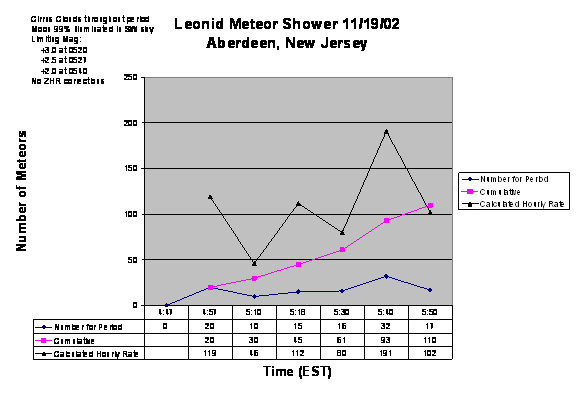
Figure 2 – 2002 Leonids
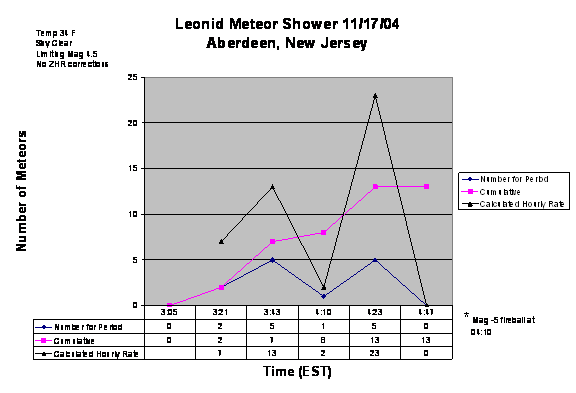
Figure 3 – 2004 Leonids
In summary, the Leonids of 2001 and 2002 delivered as advertised, producing meteor storms with rates of well over 1000 meteors per hour which were observed worldwide. Peak observed rates of over 300 meteors per hour were seen even from my light polluted backyard in New Jersey. I am pleased that my observations appear consistent with those from other parts of the world. Both showers were something that I will remember for a long time. While the showers of 2001/20002 failed to produce the phenomenal rate of meteors seen during the 1966 storm, the activity was fast and furious for short periods, giving a good hint at what it must have been like to witness that historic shower – unless one was observing from New Jersey, that is. One of the eyewitness accounts of the 1966 Leonids, from a gentleman named Forest Markowitz, is especially interesting for those of us in the Garden State.
“I was 16 and interested in astronomy. I lived in suburban New Jersey. In 1963 the Perseus shower was exceptionally good as the weather was quite cool and clear so I was really looking forward to the 1966 (Leonid) shower. Well, the night was cloudy as it had rained all day. The local 11 pm news on TV had radar and reported that the sky was clear south of New York City over the New Jersey coast. A friend of mine who was old enough to drive convinced his father to let us take the family 1959 Plymouth to a dark location along the Jersey Shore. We settled for a farmer’s corn field in Holmdel, New Jersey, away from the city lights. Sure enough the sky was fair with some haze, not good but acceptable for all the effort. We were all set by 1:30am when two things happened; the local police came by to see what we were doing and then the clouds began to thicken. While the police cooperated, Mother Nature didn't and we were clouded out by 2am. We called it quits at 5:00 without seeing a single meteor! On the drive back it began to rain.”
And so goes the story of astronomy in New Jersey.
In closing, one final note on the future deserves mention. According to information on the Armagh Observatory website (http://www.arm.ac.uk/leonid/dust2006.html) there is a possibility of one last outburst of Leonid activity next year (2006) due to an intersection with the 1936 Tempel-Tuttle stream. The current estimated time for the peak activity is 0445 UT on November 19 (1145 pm EST on November 18). A ZHR of about 100 is anticipated, with a geometry favoring observers in Western Europe. The radiant will be just below the horizon for observers on the east coast of North America during this period, so we will not be well placed for this event. Even so, the Leonids remain worth watching.
Return to –
©Frank Loso, October 2005