|
Astronomy: Pushing the Envelope
by Frank Loso
November 2005
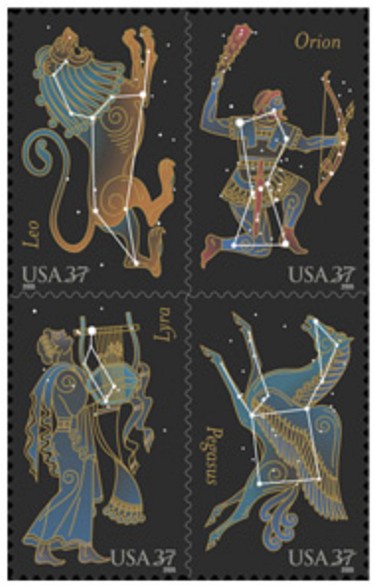 In October 2005,
the U.S. Postal Service issued the set of four stamps depicting prominent
constellations shown on the left. Stamps such as these are referred to as
“commemoratives” since they are issued to commemorate events, places, persons
or topics that are noteworthy or of special importance. The
constellation stamps were issued as a promotion for National Stamp Collecting
Month with the theme, “Be a stargazer: Let the stars be your guide to
becoming a stamp collector.” While these stamps are obviously
intended to appeal to the general population’s fascination with the stars,
they should also have a special attraction to amateur astronomers. They
provide us with an easy opportunity to show our interest in astronomy and to
promote our hobby by using them on our mail instead of more mundane stamps
such as the flag “definitives” (stamps printed in mass quantities that are
available long term) that we’re most likely to pick up at the post
office. At the time this article is being written, the constellation
stamps are still available for sale in most post offices and from the Postal
Service web site at www.usps.com.
Since commemorative stamps are printed in relatively limited quantities, it
would be advisable to pick some as soon as possible. In October 2005,
the U.S. Postal Service issued the set of four stamps depicting prominent
constellations shown on the left. Stamps such as these are referred to as
“commemoratives” since they are issued to commemorate events, places, persons
or topics that are noteworthy or of special importance. The
constellation stamps were issued as a promotion for National Stamp Collecting
Month with the theme, “Be a stargazer: Let the stars be your guide to
becoming a stamp collector.” While these stamps are obviously
intended to appeal to the general population’s fascination with the stars,
they should also have a special attraction to amateur astronomers. They
provide us with an easy opportunity to show our interest in astronomy and to
promote our hobby by using them on our mail instead of more mundane stamps
such as the flag “definitives” (stamps printed in mass quantities that are
available long term) that we’re most likely to pick up at the post
office. At the time this article is being written, the constellation
stamps are still available for sale in most post offices and from the Postal
Service web site at www.usps.com.
Since commemorative stamps are printed in relatively limited quantities, it
would be advisable to pick some as soon as possible.
On the issuing theme for these stamps and the title of
this article, stamps can be of more value than just pushing mail through the
postal system. The constellation stamp set opens the door between two
hobbies, astronomy and stamp collecting, which while not obviously related,
can actually be quite complimentary. As it were, there is a
surprisingly large amount of astronomically related stamps and related
material that is both fun and educational to collect, and which can provide
astronomical enjoyment that is not dependent on clear
skies.
While the most serious areas of stamp collecting involve
concentrating on particular countries of interest, topical collecting which
involves collecting stamps based on a particular subject has been growing in
popularity for some time. People collect stamps on topics ranging from
airplanes to zoology, with everything in between. One of the most
popular topics to collect is space exploration, for which an amazing amount
of material exists. There is quite a bit of overlap between space
and astronomy, but in its own right, astronomy collecting also includes
material in subtopics ranging from astronomers to celestial objects,
telescopes and the zodiac.
I started collecting astronomy stamps around 1979,
inspired by an article on the subject in Sky and Telescope. I
had been collecting stamps since my early childhood, and had concentrated mainly
on stamps of the United States, but the article planted the seed that it was
possible to combine my stamp hobby with my astronomy hobby. There were
already several stamps in my U.S. collection that fit the topic, so I was off
to a quick start.
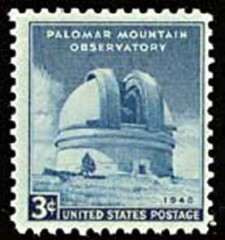 The first
astronomically related stamp issued by the U.S. showcases the Mount Palomar
Observatory in California. Shown on the left, this stamp was released in
August 1948 to commemorate the dedication of the observatory two months
earlier. Home of the 200 inch Hale telescope, Palomar would remain the
world’s premier astronomical observatory until 1993 when the 10 meter Keck
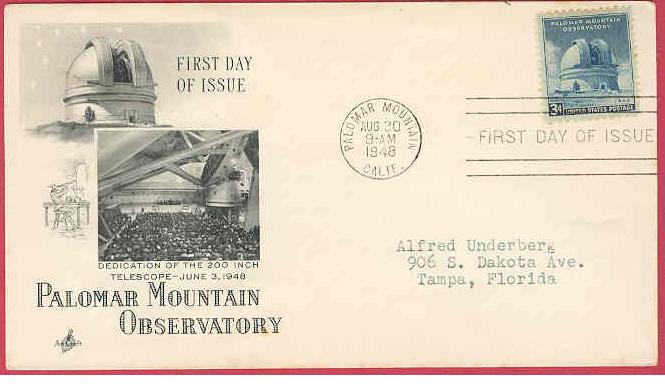
telescope became operational on Hawaii’s Mauna Kea. Shown below is
another philatelic item related to this issue known as a First Day Cover.
Stamps are generally issued with a ceremony held at a location connected with
the subject matter, in this case Mount Palomar. On the first day of
sale, the stamps are available only in this issuing city. Postal usage
of the stamp on this day is indicated by a “first day of issue”
cancellation. First Day Covers are popular collectables and often
include colorful or elaborately engraved designs, or “cachets” on the
envelope. There are several companies that produce these cached covers, but
FDCs range from plain addressed envelopes prepared by collectors, to
those with hand drawn or painted designs. The first
astronomically related stamp issued by the U.S. showcases the Mount Palomar
Observatory in California. Shown on the left, this stamp was released in
August 1948 to commemorate the dedication of the observatory two months
earlier. Home of the 200 inch Hale telescope, Palomar would remain the
world’s premier astronomical observatory until 1993 when the 10 meter Keck
telescope became operational on Hawaii’s Mauna Kea. Shown below is
another philatelic item related to this issue known as a First Day Cover.
Stamps are generally issued with a ceremony held at a location connected with
the subject matter, in this case Mount Palomar. On the first day of
sale, the stamps are available only in this issuing city. Postal usage
of the stamp on this day is indicated by a “first day of issue”
cancellation. First Day Covers are popular collectables and often
include colorful or elaborately engraved designs, or “cachets” on the
envelope. There are several companies that produce these cached covers, but
FDCs range from plain addressed envelopes prepared by collectors, to
those with hand drawn or painted designs.
The next U.S. stamp with an astronomical theme was issued
in 1958 to commemorate America’s participation in the International
Geophysical Year (IGY), a coordinated international scientific study of the
earth as a planet. As described in more detail in my article on the history of S*T*A*R in the February
2005 Spectrogram, IGY activities included studies of aurora and
airglow, cosmic rays, geomagnetism, glaciology, gravity, ionospheric physics,
longitude and latitude determination, meteorology, oceanography, rocketry,
seismology, and solar activity. The U.S. IGY stamp, shown 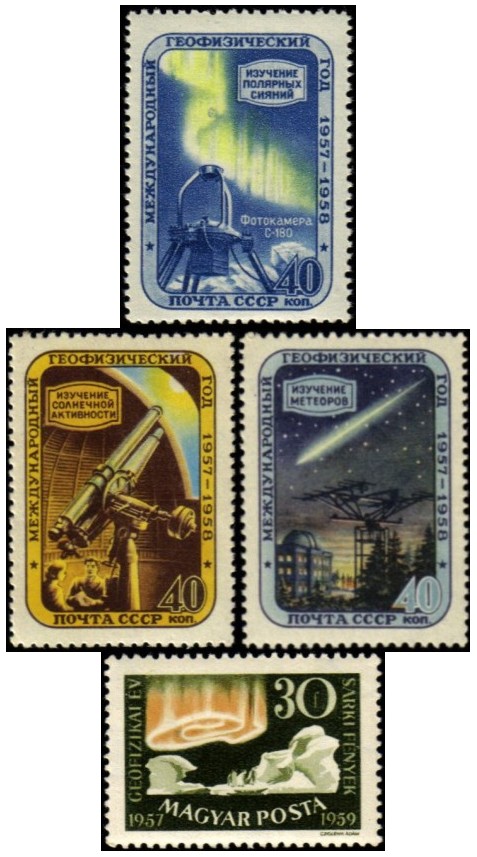 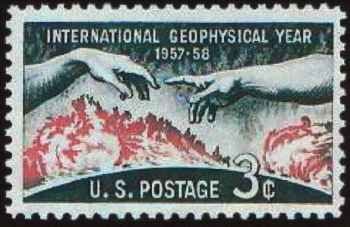 at left, depicts the hands of God and Adam, from
Michelangelo’s masterpiece, The Creation of Adam, over the surface of an
occulted sun, alive with prominences. Since the IGY was an
international effort, several other countries issued similar stamps. A
few examples of these are shown on the right. Included are three stamps
from an IGY set issued by the Soviet Union; one showing an aurora, one
showing a view of the sky from inside an observatory, and a third showing a
meteor streaking across the sky. The fourth stamp is a Hungarian issue
showing an aurora over an icy polar scene. at left, depicts the hands of God and Adam, from
Michelangelo’s masterpiece, The Creation of Adam, over the surface of an
occulted sun, alive with prominences. Since the IGY was an
international effort, several other countries issued similar stamps. A
few examples of these are shown on the right. Included are three stamps
from an IGY set issued by the Soviet Union; one showing an aurora, one
showing a view of the sky from inside an observatory, and a third showing a
meteor streaking across the sky. The fourth stamp is a Hungarian issue
showing an aurora over an icy polar scene.
Although most would agree that the space age began with
the IGY and the launch of Sputnik in 1957, the U.S. manned space program
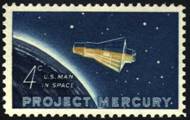
began in 1961 with Project Mercury. The first manned orbital flight, of
John Glenn, is depicted in the Project Mercury stamp shown below. This
stamp began a series of space stamps that chronicle important space
achievements by the United States. Several of these, including
the Project Mercury stamp, also have an astronomical flavor. The
Project Mercury stamp, for example, shows Glenn’s Friendship 7 illuminated
from below by the sun while orbiting Earth, its thin atmosphere glowing
against a star filled sky. An aspect of this stamp that makes it
particularly interesting is that it was a surprise issue, which while planned
in advance, was not released until Glenn was successfully in orbit.
Some additional stamps with astronomical crossover appeal
that have been issued by the U.S. are also shown below. These include
the six cent Apollo 8 issue which shows the first photograph of Earth taken
from lunar orbit and includes the beginning of the quote from Genesis that
was read by astronauts William Anders, James Lovell and Frank Borman as part
of the crew’s live 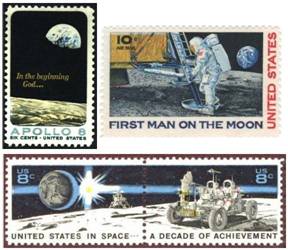 television
broadcast from lunar orbit on Christmas Eve 1968. The ten cent
“First Man on the Moon” airmail stamp shows Neil Armstrong’s first steps on
the moon, with the earth rising in the background. The eight cent
“Decade of (Space) Achievement” stamp is a se-tennant issue (joined
stamps with different designs) showing David Scott and James Irwin riding in
the lunar rover near Hadley Rille with a stylized Earth and Sun in the
background during the Apollo 15 mission. television
broadcast from lunar orbit on Christmas Eve 1968. The ten cent
“First Man on the Moon” airmail stamp shows Neil Armstrong’s first steps on
the moon, with the earth rising in the background. The eight cent
“Decade of (Space) Achievement” stamp is a se-tennant issue (joined
stamps with different designs) showing David Scott and James Irwin riding in
the lunar rover near Hadley Rille with a stylized Earth and Sun in the
background during the Apollo 15 mission.
Leaving space exploration and considering stamps with a
purely astronomical theme, there are many subtopics of interest. For example,
stamps have been issued which depict astronomers, observatories, planetaria,
astronomical objects and special events such as eclipses and comet
apparitions. The best known astronomers such as Galileo and Copernicus
are very well represented on stamps – enough to form mini collections of
their own.
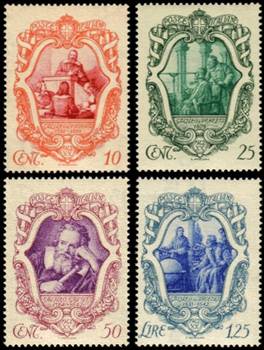 Several Galileo
stamps are shown at left. The set of four beautiful and surprisingly
modern looking stamps was issued by his native Italy in 1942 to commemorate
300th anniversary of the astronomer’s death. The orange 10c
shows Galileo
teaching at the University of Padua, where he was appointed professor of
mathematics in 1592 and remained for 18 years; the green 25c shows Galileo
demonstrating his new telescope at Venice in 1609; the purple 50c shows
Galileo in portrait, telescope in hand; and the blue 1.24 lire shows a
Galileo at his villa in Arcetri, where he was kept under house arrest by the
Inquisition from 1633 until he died. Several Galileo
stamps are shown at left. The set of four beautiful and surprisingly
modern looking stamps was issued by his native Italy in 1942 to commemorate
300th anniversary of the astronomer’s death. The orange 10c
shows Galileo
teaching at the University of Padua, where he was appointed professor of
mathematics in 1592 and remained for 18 years; the green 25c shows Galileo
demonstrating his new telescope at Venice in 1609; the purple 50c shows
Galileo in portrait, telescope in hand; and the blue 1.24 lire shows a
Galileo at his villa in Arcetri, where he was kept under house arrest by the
Inquisition from 1633 until he died.
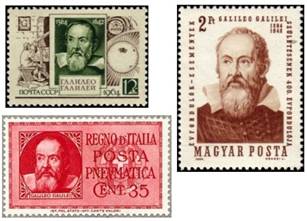 At right, a 1964
issue from the Soviet Union marks the 400th anniversary of Galileo’s birth,
showing his portrait over images of him observing through his telescope and
of the sun with sunspots, of which he is credited with discovery. Also
shown below are a 1964 Hungarian stamp and an interesting 1933 “pneumatic”
post stamp issued by Italy. At right, a 1964
issue from the Soviet Union marks the 400th anniversary of Galileo’s birth,
showing his portrait over images of him observing through his telescope and
of the sun with sunspots, of which he is credited with discovery. Also
shown below are a 1964 Hungarian stamp and an interesting 1933 “pneumatic”
post stamp issued by Italy.
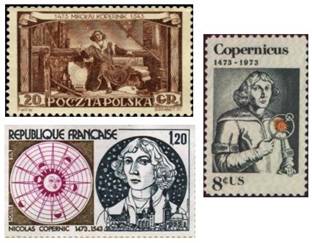 A few stamps
depicting Copernicus are shown at left. These include a 480th
birthday issue by his native Poland showing a famous portrait of the
astronomer by the Polish historical artist, Jan Matejko. As might be
expected, Poland has been a prolific issuer of stamps honoring
Copernicus. The second stamp, issued by France in 1974 for the
Copernicus’ 500th birthday, shows him in portrait next to a
diagram of his sun centered solar system. The U.S. issue on the right, also issued for Copernicus’ 500th birthday, shows a
portrait of him holding a model of his sun centered solar system. A few stamps
depicting Copernicus are shown at left. These include a 480th
birthday issue by his native Poland showing a famous portrait of the
astronomer by the Polish historical artist, Jan Matejko. As might be
expected, Poland has been a prolific issuer of stamps honoring
Copernicus. The second stamp, issued by France in 1974 for the
Copernicus’ 500th birthday, shows him in portrait next to a
diagram of his sun centered solar system. The U.S. issue on the right, also issued for Copernicus’ 500th birthday, shows a
portrait of him holding a model of his sun centered solar system.
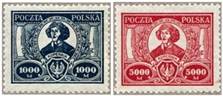
Interestingly, Copernicus is the first astronomer to be
depicted on a stamp, not surprisingly by Poland, in 1923. The
dual issue is shown below.
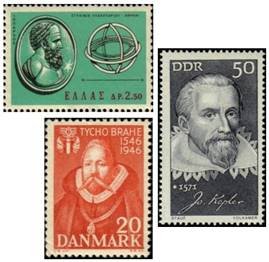
Other astronomers depicted on stamps include most of the
obvious all-stars. Among these are Hipparcus, who in the 2nd
century B.C. compiled a star catalog, devised the stellar magnitude system
still used today, and determined the distance to the moon using
parallax. Similarly honored is Tycho Brahe, the greatest observer of
the pre-telescopic era. His painstakingly accurate stellar position
measurements were later used by Johannes Kepler to derive his laws of
planetary motion. These greats are shown on stamps from Greece, Denmark and East Germany below.
Many lesser known astronomers have also been honored with
stamps. Among these are the examples shown below. The first of
these, issued by Croatia in 1943, honors Roger Boscovic, the 18th
century Croatian astronomer and mathematician who first developed a method of
computing an orbit from three position measurements, and who first recommend
the use of compound optics to overcome chromatic aberration in
refractors. Also shown is a Polish stamp honoring Jan Hevelius, the 17th
century astronomer from Danzig (now Gdansk) who is known for his lunar
cartography and for his Uranographia star atlas, based on his own star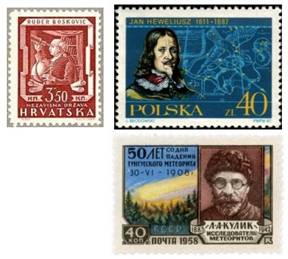 catalog and published posthumously by his wife in 1690.
Another lesser-known astronomer honored with a stamp is the Russian
meteorologist Leonard Kulik who led several expeditions to the Tunguska
region of Siberia to investigate the colossal explosion caused by what is now
known to have been a powerful meteorite impact. Kulik is shown on the Soviet
stamp issued at the 50th anniversary of the Tunguska impact and
the 75th anniversary of his birth. catalog and published posthumously by his wife in 1690.
Another lesser-known astronomer honored with a stamp is the Russian
meteorologist Leonard Kulik who led several expeditions to the Tunguska
region of Siberia to investigate the colossal explosion caused by what is now
known to have been a powerful meteorite impact. Kulik is shown on the Soviet
stamp issued at the 50th anniversary of the Tunguska impact and
the 75th anniversary of his birth.
In the theme of the Kulik issue, transient phenomena such
as meteors, eclipses and comets are all popular topics for stamps.
Several examples can be seen below. The first of these, from New Zealand, 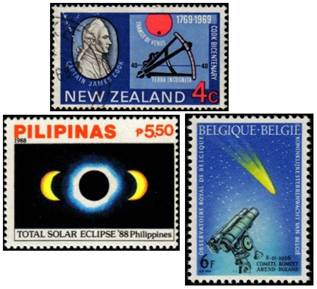 marks
the 200th anniversary of James Cook’s expedition of the ship
Discovery to Tahiti and the South Pacific to explore the region and observe
the 1769 Transit of Venus. The second stamp, a Philippine issue from
1988, marks the total solar eclipse visible there that year. Eclipse
stamps are another subcategory that is quite popular. Finally, the last
stamp in this group, from Belgium, shows comet Arend-Roland. This comet was
discovered in November 1957 by Belgian astronomers Silvain Arend and
Georges Roland. Arend-Roland was the brightest comet visible since
Comet Halley in 1910, reaching a maximum brightness of magnitude -1 and
developing a 30 degree long tail and a prominent antitail. marks
the 200th anniversary of James Cook’s expedition of the ship
Discovery to Tahiti and the South Pacific to explore the region and observe
the 1769 Transit of Venus. The second stamp, a Philippine issue from
1988, marks the total solar eclipse visible there that year. Eclipse
stamps are another subcategory that is quite popular. Finally, the last
stamp in this group, from Belgium, shows comet Arend-Roland. This comet was
discovered in November 1957 by Belgian astronomers Silvain Arend and
Georges Roland. Arend-Roland was the brightest comet visible since
Comet Halley in 1910, reaching a maximum brightness of magnitude -1 and
developing a 30 degree long tail and a prominent antitail.
The Comet Arend-Roland stamp provides a convenient segue
to what is without a doubt the single celestial event yielding the largest
number of stamp issues, covers, and special cancellations ever - the 1986
apparition of Halley’s Comet. Although the visibility of Halley didn’t
come close to that of its 1910 apparition, or any of several other 20th
century comets such as Arend-Roland, Ikeya-Seki, Bennett or West, this
celestial event seemed to have touched the world’s imagination like no
other. The fact that apparitions of Halley’s Comet occur at intervals
of 76 years, making it a once in a lifetime event for most people, is
undoubtedly a contributing factor to its mystique and popularity. From
a philatelic standpoint, a complete collection of Halley’s Comet stamps,
covers and special cancellations would number close to 1000 items!
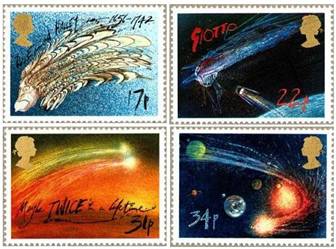 A few examples of
the many Halley’s Comet stamps are shown on the left. First is a set of
four issued by Halley’s native Great Britain in February 1986. This
fanciful set was designed by British cartoonist Ralph Steadman. The 17
pence stamp shows a rendition of the comet with Halley’s face as its head and
his hair as its tail, with the text “Dr. Edmond Halley, 1656-1742.” The
22 p stamp commemorates the encounter of the European Space Agency’s Giotto
probe with the comet. The 31 p stamp shows two images of the
comet with the text “Maybe twice in a lifetime,” while the 34 p stamp shows
the comet rounding the sun during its orbit. A few examples of
the many Halley’s Comet stamps are shown on the left. First is a set of
four issued by Halley’s native Great Britain in February 1986. This
fanciful set was designed by British cartoonist Ralph Steadman. The 17
pence stamp shows a rendition of the comet with Halley’s face as its head and
his hair as its tail, with the text “Dr. Edmond Halley, 1656-1742.” The
22 p stamp commemorates the encounter of the European Space Agency’s Giotto
probe with the comet. The 31 p stamp shows two images of the
comet with the text “Maybe twice in a lifetime,” while the 34 p stamp shows
the comet rounding the sun during its orbit.
A more conventional looking set of three stamps was also
issued by the British Channel Island of Jersey. These are shown on the
right. Each stamp includes a caption “Years of the Comet” and depicts
two comet apparitions. The 10p stamp, covering the apparitions of 912
and 1066, shows shows King Harold, William of Normandy and the Comet, as
depicted on the famous Bayeux Tapestry. The 22p stamp covers the 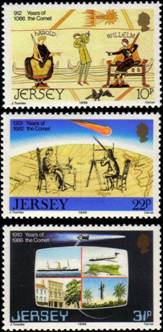 apparitions of 1301 and 1682, weaving together a somewhat
convoluted story. The stamp shows Lady Elizabeth Carteret, the widow of
Sir George Carteret who left Jersey to become governor of New Jersey.
The map of the Atlantic Ocean in the background of the design symbolizes the
Jersey/New Jersey connection. It is an apparent connection between Lady
Carteret and Edmond Halley, however that warrants her appearance on the
stamp, along side Halley who is depicted observing the comet in 1682.
The image of the comet above them on the stamp is based on the painting,
Adoration of the Maji, by the Italian artist Giotto di Bondone, believed to
be inspired by the appearance of the comet in 1301. The third
stamp covers the apparitions of 1910 and 1986, showing the comet as seen in
1910 being visited by the European Space Agency’s (ESA) Giotto probe in 1986
above a television screen with images contrasting the technological
advancements between 1910 and 1986. apparitions of 1301 and 1682, weaving together a somewhat
convoluted story. The stamp shows Lady Elizabeth Carteret, the widow of
Sir George Carteret who left Jersey to become governor of New Jersey.
The map of the Atlantic Ocean in the background of the design symbolizes the
Jersey/New Jersey connection. It is an apparent connection between Lady
Carteret and Edmond Halley, however that warrants her appearance on the
stamp, along side Halley who is depicted observing the comet in 1682.
The image of the comet above them on the stamp is based on the painting,
Adoration of the Maji, by the Italian artist Giotto di Bondone, believed to
be inspired by the appearance of the comet in 1301. The third
stamp covers the apparitions of 1910 and 1986, showing the comet as seen in
1910 being visited by the European Space Agency’s (ESA) Giotto probe in 1986
above a television screen with images contrasting the technological
advancements between 1910 and 1986.
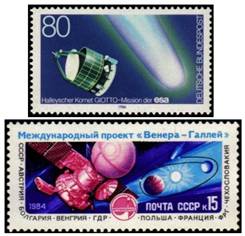 Having mentioned
the ESA’s Giotto mission to Comet Halley, some additional stamps related to
the space based study of the comet during the 1986 apparition are shown on
the left. The first stamp, from West Germany in which the ESA is
headquartered, shows the Giotto probe next to the comet. The second
stamp, issued by the Soviet Union, depicts the orbital path of their two Vega
probes to Comet Halley. Known formally as Venera-Halley 1 and 2, these probes
used an orbital slingshot past Venus where they dropped entry probes before
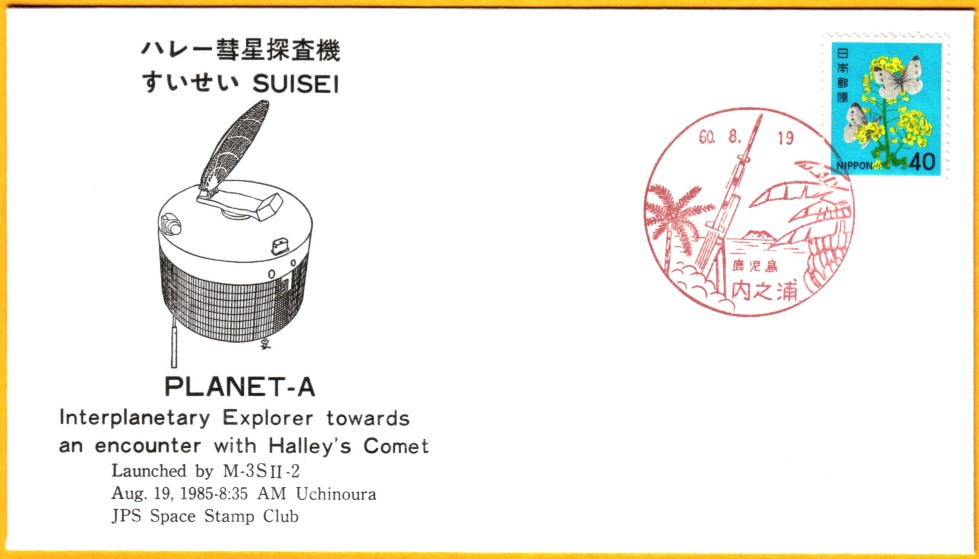
heading outward for their flyby rendezvous with Comet Halley. Another
pair of flyby probes was sent to Halley by Japan. These were named
Suisei (Planet-A) and Sakigake (Pioneer). Suisei is shown on the
cacheted cover below, which is cancelled on the date of the probe’s launch. Having mentioned
the ESA’s Giotto mission to Comet Halley, some additional stamps related to
the space based study of the comet during the 1986 apparition are shown on
the left. The first stamp, from West Germany in which the ESA is
headquartered, shows the Giotto probe next to the comet. The second
stamp, issued by the Soviet Union, depicts the orbital path of their two Vega
probes to Comet Halley. Known formally as Venera-Halley 1 and 2, these probes
used an orbital slingshot past Venus where they dropped entry probes before
heading outward for their flyby rendezvous with Comet Halley. Another
pair of flyby probes was sent to Halley by Japan. These were named
Suisei (Planet-A) and Sakigake (Pioneer). Suisei is shown on the
cacheted cover below, which is cancelled on the date of the probe’s launch.
And so, with Halley’s Comet leaving the vicinity of the
solar system for another 76 years, I will wrap up this article. My
intent was to provide a glimpse of the universe of astronomy as depicted on
stamps. The examples I have shown are just a small sampling of the
wealth of material available to collectors. Starting such a collection
is a great way to have fun and, with a little research, learn more about both
the science and history of astronomy.
None of the stamps shown in this article are particularly
valuable or expensive. Most can be found for no more than a couple of
dollars. As far as locating material, today it is relatively easy to
find stamps on the internet. Websites such as ebay and zillionsofstamps.com
are handy resources for connecting buyers and sellers. A general web
search on “astronomy stamps” will also result in links to stamp dealers as
well as other collecting resources. I will end with a word to the
wise. As with most hobbies involving collectables it is advisable to
keep in mind that purchasing with the intent of investment is always a
gamble, so a “fair” price is whatever price you are willing to pay for the
enjoyment of owning the item. Values listed in Scott’s Stamp Catalog,
which can be found in most libraries, give a general idea of stamp prices,
but actual prices will vary based on stamp condition, demand, etc. With that
in mind, a lot of enjoyment can be found through stamps for surprisingly
little monetary investment. Starting a collection is as simple as a
trip to your local post office.
Back
© Frank Loso, November 2005
|