Flat 'n' Flaffy
Black Russian Terriers
Home
Our Dogs
Standard
Gallery
About Us
Grooming
Litters
Links
Contact
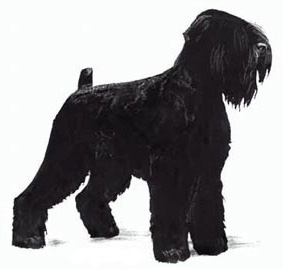
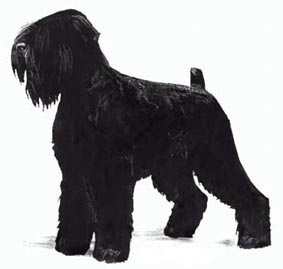
BACK: Straight, large, muscular. Faults: Weak back, narrow or insufficiently muscled. Major faults: Concave or convex back. LOIN: Short, wide, muscular and slightly arched. Faults: Long, insufficiently rounded. Major faults: Badly coupled, narrow or very arched. RUMP: Large, muscular, with a barely visible slope towards the tail, which is set high on the croup. Faults: Horizontal rump or slightly sloping rump, insufficlently muscled. Major faults: Slanting or narrow rump. TAIL: Set high, thick and docked short, leaving 3 to 4 vertebrae. Faults: Tail set low, incorrectly docked tail. Major faults: Tail not docked. FOREQUARTERS: Seen from the front, the legs are straight and parallel. The angle of the shoulder-blade with the upperarm is approximately 110 degrees. The elbows must point backwards. The forearms are short and vertical. The pasterns are short and straight. Faults: Shoulder slightly too straight, elbons slightly turned inwards or outwards; pasterns weak, outwards or inwards. Major faults: Upright shoulder; strong deviation of the elbows; deviation of the forearm; knuckling over, down or pastern. HINDQUARTERS: Seen from behind, the legs are straight and parallel, but held more wide than the front legs. The thighs are muscular and well developed. The lower thighs are long and set obliquely. The hock joint is dry and well developed. The hocks (metatarsals) are massive, long and almost vertical. Faults: Weak muscle tone, short legs, slightly cow hocked legs (or bow-legged). Angulations slightly too straight or the angle at the hock too narrow. Hare feet. Major faults: The same as above, but more pronounced. Rump too high. Hock jointsperfectly straight or with a very narrow angulation. FEET: (Fore- and hind feet) : Thick, with well arched pads, rounded in shape. Faults: Feet pointing outwards or inwards. Major faults: Feet flat or crooked. MOVEMENT: Easy, harmonious and fluid. A slow trot or the gallop are the most typical movements. When trotting, the legs must move in a straight line, with the front legs converging towards a median line. The back and the loin show an elastic movement. Faults: Slight deviation from the requirement that the legs move in a straight line. Insufficient extension of the front or hind legs. Major faults: Restricted or clumsy movement, movement of the hind legs not straight (crab-like movement), unbalanced movement of the rump (rolling movement of the hindquarters), pacing movement. FAULTS: Any departure from the foregoing points should be considered a fault and the seriousness with which the fault should be regarded should be in exact proportion to its degree. DISQUALIFYING FAULTS: Any deviation from the scissors-bite requirement. Parti-coloured coat. White markings on feet. Red patches. Gray coat. Absence of an incisor or a canine. Absence of any third premolar or any fourth premolar. Absence of any molar. A dog showing any sign of aggressiviness or physical abnormality must not be qualified. N.B.: Male animals should have two apparently normal testicles fully descended into the scrotum. Standard FCI N� 327/19.2.96