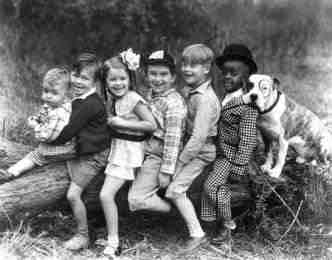
Little rascals our gangs(U.S.A.1935)
 For the
Italian version click here!
For the
Italian version click here!
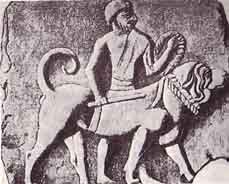
Bassorilievo assiro (Londra-British Museum)
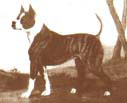
Bull & terrier 1812c.a .
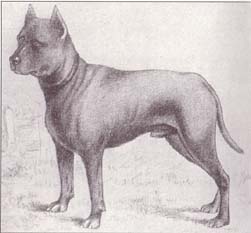
Blue Paul Terrier
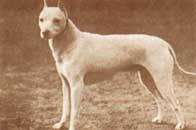
Old English White Terrier
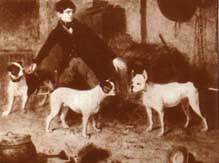
Jack Shephered with his bulldogs "Duchess","Crib" e "Ball"
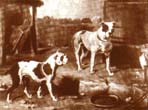
"Crib" e "Rosa"
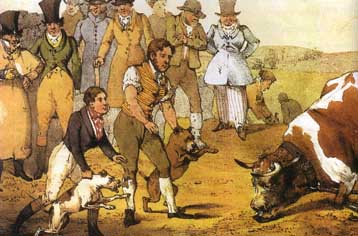
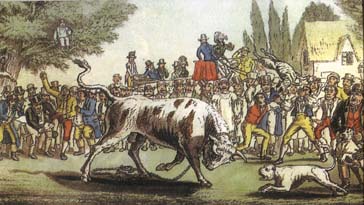
Some pictures of Bull Baiting
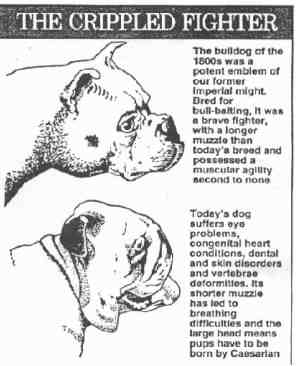
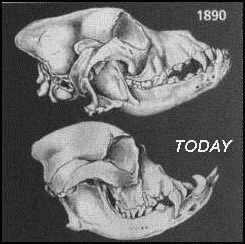
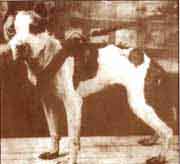
Armitage's Brandy
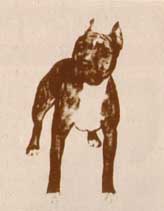
Ch.The Ruffian
American Staffordshire Terriers History
Origins:
The origins of the American Staffordshire Terrier can be traced with reasonable certainty tolate 18th century England. Bull baiting, a variety of other baiting sports, and dog fighting were all common pastimes. Vivid accounts of these barbarous and gory contests are still readily available. The bulldog, a large rangy dog of up to 90 pounds in weight, and the possessor of phenomenal courage, was used in the baiting of bulls and bears. Terriers, usually smooth coated and frequently of black and tan coloration, were involved in rat killing contests, badger baiting, dog fighting, and in other situations where a small, fast and courageous dog excelled. In an effort to produce ever more efficient fighting machines to participate in dog fighting,numerous crosses between bulldogs and working terriers were carried out over a period of several decades. Sources dating to this period describe the breeding of bulldogs to large terriers in order to add speed to the former and size and power to the latter. The gameness of both forebears was maintained in the resulting "bull-and-terriers." The products of these crosses depicted in publications as early as 1806 bear a striking resemblance to today's American Staffordshire Terrier. In the study of these early dogs, it must be kept in mind that breeds as we know them today did not exist until well into the 19th century. The "terrier," for example, was a dog that would go to ground after game; the designation "terrier" referred to the dog's utility rather than to his appearance. Any dog used in this way, regardless of breeding background, was then designated a terrier. For this reason, efforts to assign to one or another of today's terriers or to terriers of the mid-19th century a foundation position in the development of "bull-and-terriers" are not reasonable. None of the candidates were themselves in existence. Bulldogs of this period were larger and much rangier than today's dogs of that name. Again, the term "bull dog" referred to the function of the dog rather than to his appearance although variations in appearance were apparently less pronounced than with terriers. Bulldogs pictured in "The Sporting Magazine" from 1798 to 1824 resemble today's American Staffordshire Terrier far more closely than the modern bulldog. In fact, the type of the modern bulldog is so vastly different from his working ancestors that the latter must be considered extinct. With the passage, in England, of the Cruelty to Animals Acts of 1835,l baiting, dog fighting, and other blood sports were driven underground. Public participation was greatly reduced. About 1860, the white bull terrier emerged as a distinct offshoot of the basic bull-and-terrier. The originator of this cousin of our American Staffordshire Terrier was James Hinks. According to his son, James Hinks the younger, the white bull terrier was bred using a combination of bull-and-terrier, white English terrier, and Dalmatian. The type of these early white dogs has been altered considerably in the intervening century. Hinks had success in the pit with this "White Cavalier." There is no hard evidence, however, that the white bull terrier has been used for that purpose more than occasionally since the mid-19th century. In the early 1900's the colored bull terrier was developed by crossing the white bull terrier back to the pit bull.
The Breed in the United States ---- 1850-1930:
Many
dogs were brought to this country before 1860. For example, the great dog
Spring was imported by McCaffrey in 1857 and started a line of great dogs.
About 1880, "Cockney" Charlie Lloyd imported Paddy and Pilot, both destined
to win fame in the
fighting
pits of the northeast. By this time the breed was already well known in the
States. Designated as the Pit Bull, or Pit Bull Terrier, the breed became
increasingly popular. Dog fighting contests were openly held and widely
publicized. Champion fighters became famous along with their owners and
breeders. In 1898 the United Kennel club was founded in Kalamazoo, Michigan,
by C. Bennett for the purpose of registering the American Pit Bull Terrier.Owned
by such famous persons as John L. Sullivan and Theodore Roosevelt, the breed
became one of the most popular dogs during the first quarter of the century.
Patriotic posters from World War I depict the American Pit Bull Terrier
along with representative dogs from the other allied nations as the
defenders of the allied cause. In fact, the most decorated American war dog
of World War I was an American Pit Bull Terrier. This dog and a special
exhibit depicting her heroic feats were long on exhibit at the Smithsonian
Institution in Washington, D.C. One of James Thurber's best loved short
stories is a nostalgic tale of the American Pit Bull Terrier of his
childhood. He was also the loyal and familiar companion to Buster Brown in
an early comic strip."Pete," the famous dog with the ring around his eye of
the "Our Gang Comedies," was the first Staff registered by the American
Kennel Club in 1936. He was the only dog to survive the transition from
silent movies to sound --- a tribute to the intelligence of the dog and to
the skill and ingenuity of his trainer, Harry Lucenay.The American Bull
Terrier Club, founded in 1921 in Clay Center, Kansas, published a standard
from which our present standard is derived. (W. M. Whitaker, June 1966 AKC
Gazette.) "The Dog Fancier," a magazine of national circulation, was devoted
to the American Pit Bull Terrier. Accounts of pit winnings were also carried
in "Bloodlines," the journal of the United Kennel Club.
It
should be noted that while the American Bull Terrier or American Pit Bull
Terrier was being developed in the is country, the English continued to
develop their version of the pit bull. This dog, distinctly smaller and of
somewhat different type, was recognized in 1935 by the British Kennel Club
under the name Staffordshire Bull Terrier.
Modern History:
By
1930 a number of fanciers of the American Pit Bull Terrier began to work
toward American Kennel Club recognition. The man most responsible for
achieving this recognition was Wilfred T. Brandon. Mr. Brandon almost single
handedly convinced representatives of the AKC that this was a breed of
sufficiently documentable background and uniform physical type to warrant
inclusion by the registry. He adopted and modified previously existing
standards to forge the standard which had now survived unchanged for over
forty years.
The
original petition called for recognition under the traditional name
"American Bull Terrier," a designation still considered by some the most
appropriate for the breed. This was denied, at least in part, as a result of
opposition by the Bull Terrier
Club
of America. It is interesting to note that the restriction on white, which
is in the current standard, was not a part of the original document as
submitted by Mr. Brandon. At this time, Captain Will Judy, publisher of "Dog
World" magazine and a strong supporter of the breed, proposed the name
"Yankee Terrier" was never acceptable to more than a few fanciers.
The
recognition by the British Kennel Club in 1935 of the Staffordshire Bull
Terrier proved an important step in the subsequent recognition the following
year
of
the Staffordshire Terrier. It was intended from the start that the
Staffordshire Terrier and the Staffordshire Bull Terrier be preserved as
separate breeds. This was due to the considerable physical differences which
had evolved through 60 to 80 years of totally unrelated breeding in England and the United States.
That the similar names would eventually cause confusion should have been
appreciated at that time. However, recognition was a difficult and often
tenuous matter. A compromise was therefore reached and the breed recognized
in 1936 as the Staffordshire Terrier --- an acknowledgement of the distant
relationship to a far away English county.
The
final step in this long evolution of names occurred in the early 1970's as a
result of the coming recognition by the AKC of the Staffordshire Bull
Terrier. Reacting to the untenable similarity of names, the AKC offered
"American Staffordshire Terrier" as the final designation of the breed. The
Staffordshire Bull
Terrier was finally recognized by the AKC in 1975.
This sequence of name changes from Bull-and-Terrier, Pit
Bull, Pit Bull Terrier, American Pit Bull Terrier, American Bull Terrier,
Yankee Terrier, Staffordshire Terrier, and finally, American Staffordshire
Terrier, has created an incredibly complicated and confusing situation,
especially to the novice who must also contend with the related breeds, Bull
Terrier and Staffordshire Bull Terrier.Added to this complex picture is the
fact that many breeders of American Pit Bull Terriers chose not to register
their dogs with the American Kennel Club. This decision was made for a
variety of reasons including distrust of the show medium as a worthwhile
vehicle for the advancement of the breed and distaste for the name
"Staffordshire Terrier." As a result, we find many dogs registered as
American Pit Bull Terriers by the united Kennel Club and other
organizations. Furthermore,
many
breeders registered their dogs as American Staffordshire Terriers with the
American Kennel Club and as American Pit Bull Terriers with he United Kennel
Club --- a situation that is still in common practice.
Pascoe, H. Richard, The American Staffordshire Terrier, Williamson Printing Corp, Dallas, Texas, 1977.
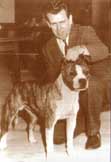
Ch.Knight Crusader