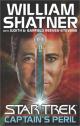
Why, one is tempted to ask? Why has William Shatner - who once retreated from his Trek alter ego's persona at warp nine - done such an about-face? "Captain's Peril" forms the first part of a new trilogy written in conjunction with Judith and Garfield Reeves-Stevens, following the "Odyssey" and "Mirror Universe" sagas. The conclusion of "Preserver", Shatner's last novel, seemed to mark the end of the cycle: it ended with an epilogue set in the year 2400; it killed off the love of Kirk's life; and it gave him a son. But "Captain's Peril", which takes place in 2378 (i.e., before the events of Star Trek: Nemesis), sets off a whole new adventure. And typically, it introduces a grandiose new threat to the Federation which borders on the unbelieveable.
At this point, there is little to suggest what will link the "A" plot of this novel (Kirk and Picard vacation on Bajor, discover a plot to retrieve a lost Orb, return it to a big squid thing which may or may not be a god) with the "B" plot (Kirk relives a mission aboard the original Enterprise, where he was sent to intercept a vessel with advanced technology and competed for it against a Klingon vessel). There is much pseudo-philosophy ("The sins of the father are not always visited upon the child ... Anything is possible"), but unless such musings links up with the next two novels in this trilogy, it will be for naught. Perhaps Kirk's "sins", whatever they are, will be visited upon his son, Joseph. Readers of "Preserver" will recall that Joseph is some kind of miracle child, made up of the fused genes of humans, Klingons and Romulans. Perhaps his destiny is upon him.
But this is speculation. Until such time as the next two books are published, we can only judge this novel on its own merits - and the overall impression is of a book which wanders, switching between two unrelated stories with little linkage between them, save for the fact that Kirk is relating the story to Picard at irregular intervals. The stories themselves are passable enough: one a murder-mystery, the other a fraught first contact. But even here there are faults. The Bajoran story is really quite dull, as Kirk goes through the motions of solving another riddle with his propensity for "changing the rules". The spiritual element is difficult to square with Kirk's established personality, which has never to my mind been religiously inclined. Perhaps he's mellowing in his old age. All too often, when he snaps "You will answer my questions!" and manipulates another 'simple' Bajoran into helping in his quest to "complete the mission", it feels like we're being given a recycled Kirk who's been through one mission too many.
The story set in 2266 is better, involving as it does hints for the future direction of the trilogy. But there are elements of unoriginality: the plot borrows heavily from "Enterprise: The First Adventure" (1987), although I very much doubt that Shatner is aware of that particular novel. Nevertheless, the notion of a huge, advanced starship, which inside looks like Eden, with mysterious aliens who seem not to share our belief system, which could help the Federation's advancement if its secrets are learned, is a familiar one. The "contest" with the Klingon commander is also rather pointless, as not only does Shatner contrive a scene where Kirk skydives from the Enterprise down to a planet to establish why the captain loves that activity in the future, but the whole thing is anticlimatic, as the crew lose to the Klingons regardless. Even this is a red herring, because the aliens claim that someone called "Centurion Deimos" has won the contest and they warp off into the ether. What's the point?
Frustratingly, despite all of these faults, Shatner still manages to keep you turning the pages, if only because you have to know how the two plots tie together. Spock and McCoy make their token appearance at the end (Bones is now 152 - isn't this getting slightly ridiculous?), but they are no closer to understanding Kirk's sudden conversion to elements of the Bajoran faith than the rest of us. In "The Return", where Kirk was resurrected by the Borg-Romulan Alliance, there was a similar sense of unreality about the plot, but it all came together by virtue of the sheer audacity of the endeavour. Here, there is just a sense of fatigue - of going through the motions.
Perhaps the epilogue here offers some clues. The U.S.S. Monitor (which made an appearance in "The Return") is trapped in intergalactic space, between the Milky Way and Andromeda - in the Totality, which is what the alien ship in the novel's "B" plot was fleeing. Monitor manages to fire off a desperate transmission to Starfleet before she is overtaken by a seemingly intelligent spatial distortion. The anomaly deposits "cubes of matter" on the hull, which multiply and turn the ship and its crew to little more than dust. It's a spooky ending, and as the distortion resumes its course for the Milky Way (with some kind of revenge on Kirk in mind), we get some hint of where the next two novels will take us. I just hope that some way will be found to tie the events of this instalment, particularly as regards the Prophets and Kirk's revelations, into the wider plot arc. Because if it isn't, this first book of the trilogy will just be a badly assembled confluence of plot threads, and that would do a disservice to the Reeves-Steveneses as much as any reader. |