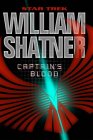
A quick glance at the cover of this tome and one could be forgiven for thinking that the series of which it is a part is called "Star Trek: William Shatner". A recurring complaint about Shatner's Trek fiction has been the fact that the universe seems to go through painful contortions to ensure that James Kirk remains at its centre. Little has changed in this second instalment of "Star Trek: Totality", Shatner's third Trek trilogy.
The first book in this series, "Captain's Peril", was schizophrenic and decidedly unengaging, but the first books in trilogies are often (too often) largely nonsensical - plot points seem unrelated, events disparate. In such circumstances, one would expect the second book to clear up inconsistencies and point us towards the conclusion of a story we can understand. "Captain's Blood" fails to do this. Along the way, it takes us through one of those reorganisations of the Trek multiverse that are excruciatingly poorly executed.
Shatner has indulged in 'reverse continuity' before, as he did in "Avenger" and the "Mirror Universe" trilogy, particularly with regards to Voyager. Here, he's at it again, this time hammering a square peg into a round hole in the form of the events of Star Trek: Nemesis. Whether it was always planned or not I suppose we'll never know, but the appearance of the Remans in this book seems cheap and unimaginative. Once again, the surviving members of the TOS crew are thrown together with that of TNG; Kirk gets uppity with Picard (and Janeway, for good measure); McCoy undergoes yet more cybernetic enhancement (the difference between Bones and a Borg is no longer entirely clear) so that he can keep pace with the action. I think that my patience with this tired refrain has worn out.
The plot (ha!) does at least bring together the "Totality" phenomenon which claimed the U.S.S. Monitor at the conclusion of "Captain's Peril" with the alien ship commanded by the siren Norinda. Bizarrely, the way in which they are brought together completely contradicts the first novel (they were never running at all, it seems; it was just a way to worm into our galaxy) and Norinda holds total thrall over a group of brain-dead Romulans who are acting nothing like the proud species we've come to know over years of Trek. Although Norinda can be quite sinister in a Borg Queen-type way, the truth is that her persona is a pale imitation of that cybernetic matriarch and, as such, she is as predictable as the rest of the novel.
I'd stopped taking bets on whether Kirk's mutant son Joseph would be under threat by the end of this novel - and lo, so it proved. The Remans think he's their prophecied saviour (shades of Voyager's "Prophecy" here - Shatner can't ever plagiarise decent Trek episodes) and as such want him to be their Shinzon. Which is not the name of Picard's clone; only the name of those who lead the Remans ... please.
Increasingly, Shatner's ability to depict Trek characters across many generations is slipping. He lapses into gross caricature, particularly when it comes to Voyager's holographic doctor, who despite a promising role switch as an undercover operative of sorts in this novel just comes across as insufferable. Picard is, as always, straitjacketed and inflexible, while the Starfleet higher-ups (Janeway included) are morons who dare to stand in The Kirk's way. It's the same old story, and we know how it's going to end: Joseph will be sacrificed to protect the galaxy from assimilation/disintegration by the Totality. Kirk will probably blame Starfleet. And that'll be it. Until the next trilogy (surely Kirk can't find another eternal love, and go through the whole cycle again ... can he?).
"Captain's Blood" should be the penultimate showing from a man whose name is keeping him in print rather than the quality of his Trek fiction. If the Reeves-Stevenses had any sense, they would have jumped ship after "Avenger". As it is, they are accessories to something like Trek manslaughter. When I get to the last page of "Captain's Glory", the last book in this series, I don't want to have to suffer another effort in the "Star Trek: William Shatner" series for an extremely long time. |