 |
|
|
|
|
|
|
|
|
|
|
|
|
|
|
|
|
|
|
|
|
|
|
|
|
|
|
|
|
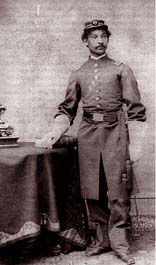
Dr. Anderson R. Abbott, surgeon |
|
|
|
 |
|
Born in Canada in 1837, Anderson R. Abbot was the son of Wilson R. Abbott formerly of Richmond, Virginia. As the child of free parents at the beginning of the nineteenth century, Wilson Abbott married Ellen Toyer in 1830 and moved to Mobile, Alabama. They opened a store they left after the Nat Turner "insurrection" made whites suspicious of all people of African Descent. The Abbotts left the south in hopes of greater opportunities and safety by moving to the north. Not finding itt in New York City, they moved to Canada in 1835, accumulated a modest fortune and raised a distinguished family. |
|
|
|
|
|
Anderson, who was born in 1837, was one of the first graduates of the King School in the Elgin settlement. He studied medicine at the University of Toronto and became licentiate of the Medical Board of Upper Canada in 1861. In 1863 he petitioned President Lincoln to be allowed to join the Union Army and served as a surgeon for United States Army. |
|
|
Dr. Abbott as U.S. Army Surgeon |
|
|
|
|
|
|
He was one of only eight black surgeons which brought him to the president's attention and led to their friendship. Dr Abbott, however, refused to serve in the United States Colored Troops. |
|
|
Instead, he opted to work as a contract surgeon. In 1907 Dr. Abbott wrote a letter explaining that he felt equal to operating on any man and that having been born in a land where all men are free, he was not going to submit to government-endorsed segregation. While he was surgeon in charge at the Washington Hospital, he performed medical procedures on any wounded soldier. |
|
|
His petitioning and desire to serve the country of his father's birth began a correspondence that blossomed into a friendship with President Lincoln. As a token of that friendship. Mrs. Lincoln gave Dr. Abbot the shawl her husband wore at his first inauguration. His refusal to serve in a Colored unit had a negative persoanl side effect. Not being a soldier meant his widow was denied a Civil War Widow's Pension when he died. |
|
|
Dr. Abbott returned to Canada and in 1871 he married Mary Ann Casey and opened a medical practice medicine Chatham, Ontario.While in Canada, he was very involved in community affairs. He was president of the Wilberforce Educational Institute from 1873 to 1880. He was the Associate Editor of the Missionary Messenger, a monthly paper published by the British Methodist Episcopal Church, and president of the Chatham Literary and Debating Society. During 1878, he was President of Chatham's Medical Society and one of the first coroners for the County of Kent and the first Black coroner in Canada. |
|
|
|
In 1881, he moved from Chatham to Dundas, Ontario then left Canada in 1894 to return to the United States. Dr. Abbott became medical superintendent of the segregated Provident Hospital in Chicago where he created the first nursing program for women of African descent. Although he still resented working in a segregated setting, Dr. Abbott was determined to provide Black women the opportunity to become health care professionals. When he retired from Provident, he returned to Toronto Canada where he died in 1913. |
|
|
The Abbott family legacy of service to others was continued by his son Wilson R Abbott who also became a doctor and practiced in Chicago. Dr. Wilson Abbot was a lung and heart surgeon but unlike his father, Wilson wasn't relegated to practice in a segregated hospital. The laws had not changed, this Dr. Abbott was believed to be white. His mother, Mary Ann Casey, was of mixed racial background so Wilson was much lighter than his father, married a white woman, and chose to live as if he were white. Their descendents followed suit by living with and marrying whites. Anderson Abbott's great-great-granddaughter Catherine Slaney only learned that she was part black in 1975 when she was approached by the Ontario Black History Society to ask about her distinguished great-great grandfather. |
|
|
Read more about this revelation and what she learned in about other descendents of Dr. Abbot in Family Secrets, Crossing the Colour Line by Catherine Slaney |
|
|
|
Biographies |
|
|
|
Africans in Canada |
|
|
Home |
|
|
|
|
|
|
|
|
|
|
For more information on Filling in the Gaps in American History (F.I.G.A.H), biographies and other research on people of African Descent who do not usually appear in text books, contact us at email. |
|