|
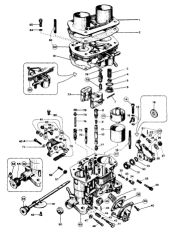
Weber 40IDF Series Carburetors
About the IDF • Upgrading • Operation • Installing • Tuning • Jetting
About the IDF
Installed as stock on mostly European Fiat 1600 Sport Spiders, Weber IDF carburetors continue to provide the most “bang for the buck” for any carbureted Fiat twin-cam engine. Despite being in production
for well over 25 years, the IDF series is still very much in production (a 40IDF10 carburetor from 1971 can still be in service today and running like new!) This is very good for many Fiat owners looking
to either bring their 1600 series cars to “European Spec” or simply breathe new life (and lots of it) into any twin-cam Spider.
The process of switching to the IDF series is extremely simple: first, find a set of IDFs that suit your needs. An original set of 40IDF13/15 carburetors in good condition, including the intake
manifold and air cleaner can be found if you are willing to look far enough. These parts were common in Europe and Australia, by the way! Once found you should either rebuild the carbs yourself or
have a reputable shop do the work for you. I can recommend one if you email me.
Another option is to find a set of brand new 40IDF70 carburetors on a custom manifold. These come jetted for your engine and need little more than syncronizing and mixture adjustment to get you
running. You can buy these carbs from a few places; send me an email and I’ll point you to the ones I recommend.
Upgrading
What engine modifications make IDFs a realistic venture? I like to repeat this over and over in my carburetor pages: no matter what year car you have you should consider using the 4-2-1 exhaust
system (stock on non-California and fuel-injected cars), and cams from cars made prior to 1975. The 4-2-1 exhaust system is better than any aftermarket system you can bolt on (it doesn’t leak). It
flows very nicely, allowing your engine to exhale easier. The cams are simply a mild upgrade: after 1974 Fiat used a fairly sluggish profile on their camshafts. You can get fairly radical
with 124 camshafts - the good news is that the IDFs are well suited to just about any cam available for these engines.
Operation
Before you upgrade, you should understand some things about how these carburetors work. Weber IDF carburetors are simple in design yet extremely effective in their delivery. A single, central float
bowl services two 40mm barrels. Both barrels operate simultaneously and with mechanical precision. The operation can be summarized as follows:
Fuel is brought (via engine mounted fuel pump) from the tank to the float bowl. The level of fuel in the bowl is regulated by a needle valve that is actuated by a float. The engine sucks air,
creating a vacuum proportional to air flow in the venturi of the carburetor. This vacuum draws fuel from the float through an emulsion tube where it is mixed with air from the air corrector jet.
This mixture is then passed through the main jet and into the main carburetor barrel where it is finally drawn into the cylinder.
More detailed explanations are available - the Pat Braden book Selecting and Tuning Weber Carburetors is an excellent resource. Old Fiat 124 Spider shop manuals also describe the operation of the IDF carburetor but the manuals are fairly rare.
Installation
With the possible exception of the 1400 series Spiders, the IDFs will work on every other engine type installed in a 124. That being said, understand that Spiders with flat hoods will need special air
cleaners to work - the “turtleback” stock Fiat air cleaner will bump and bend those flat hoods. One final note - if you have a block-mounted distributor on your car then you may have to switch to a cam
mounted type - which means getting a new cam box and camshaft for the exhaust side of your engine.
I am not going to attempt to explain to you how to install and tune IDFs on your specific engine. The short version: drain the radiator, unplug the battery, unbolt your old manifold (with or without the
carb installed), clean up the gasket surface, install a new gasket, bolt on IDF manifold and IDFs. The connection of your linkages can then either be easy or require some minor engineering.
Once linked up, tune the carbs:
Tuning
The short version of that procedure (you really should get a book): set the air bleed screw on each carb to fully seated. Set the mixture screw to fully seated then 1 1/2 turns counter
clockwise. Start the car and expect an uneven idle. Set the idle speed screw to about 1000 RPM. Using a syncrometer and working one carb at a time, check each barrel for flow rate, then
adjust the low barrel (using the air bleed screw) to match the high barrel. Repeat for the other carb. Now adjust the carb linkage to balance the carbs at equal air flow rates.
Adjust the idle speed to about 850 RPM. Working one barrel at a time adjust the mixture screw - in or out - to the point at which the engine is running the fastest and smoothest. Repeat for each
barrel then, if necessary, for the entire series.
Once you think “I’ve got it!” remove the spark plugs and either clean or replace. Run the car and pull the plugs. White is too lean - adjust each barrel mixture 1/4 turn counterclockwise and check
again. Black is too rich - adjust each barrel mixture 1/4 turn clockwise and check again. Perfect plugs have little coloration or just slightly brown. Do nothing, smile and drive.
Those of us living in emissions friendly states can also smile: all of the upgrades I suggest in this section of the site will pass the emissions slated for your model year - unless you have to pass
visual inspection (which is utter b.s. if you ask me). If you tune it right, it will pass!
If you’ve read this far then you’re ready for the final notes. IDFs should deliver acceptable MPG rates: about 13-17 in the city, 22-26 on the interstate. This is very dependent on engine
type; a 1608 engine will get better city mileage with IDFs than a 2000. Conversely, the 2000 seems to do better on the interstate than the 1608. It’s all a matter of engine efficiency (and where
that efficiency really “happens”), a subject for another document.
Checkups: expect to tune these IDFs almost seasonally. This should be a minor mixture adjustment, nothing more. Check the brass nuts that hold in the bleed and mixture screws every oil change
or so; they tend to get loose - a little locktite imight help if it becomes a problem.
Jetting (based on the 1608 engine)
|
|
Both Barrels Identical
|
Imperial (in)
|
Metric (mm)
|
|
Venturi Diameter
|
1.260
|
32
|
|
Main Jet
|
.047
|
120
|
|
Idle Jet
|
.021
|
55
|
|
Main Air Jet
|
.083
|
210
|
|
Float Level
|
.0394
|
1
|
|
Idle Air Jet
|
.045
|
1.15
|
|
Pump Jet
|
.015
|
.38
|
|
|
|
|