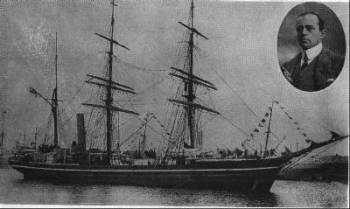
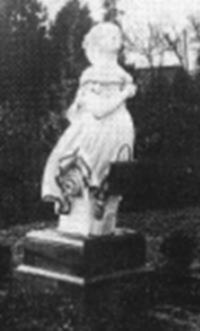
| The figurehead of the British Antarctic expedition ship "Terra Nova", originally took pride of place in Roath Park,Cardiff. She now resides in the Maritime Museum in the Docks. She is a wonderful sight, with her blonde locks and summery white dress, trimmed in blue. A red rose is placed in the middle of her bosom, two more cover each ear. Her inscription reads. "FIGUREHEAD OF BRITISH ANTARCTIC EXPEDITION SHIP "TERRA NOVA". IN WHICH CAPTAIN SCOTT, AND OTHER MEMBERS OF THE EXPEDITION SAILED ON 15TH JUNE 1910, FROM THE PORT OF CARDIFF. PRESENTED TO THE CARDIFF CORPORATION BY FREDERICK CHARLES BOWRING ESQ JP OF LIVERPOOL 8TH DECR 1913. The Terra Nova was built in Dundee in 1884, and was used as a whaling ship by the whaling company, C.T.Bowring and Sons. When built she was the world`s largest whaler. From 1894, she was used on a number of Arctic and Antarctic expeditions. Scott had undertaken the first British National Antarctic Expedition on the Discovery between 1901 and 1904. He wanted to use the Discovery again for his second expedition, the ship was unavailable.For his attempt to reach the South Pole, Scott managed to get the backing of a number of Cardiff businessmen, and that was the reason he set off from Cardiff, first having been given a fine send off dinner, with his backers and the Lord Mayor in the Royal Hotel. Scott stayed as a guest of honour in the Mansion House on The Walk before he left. Before leaving, the Terra Nova took on coal and "patent fuel" from the docks in Cardiff. Patent fuel, now almost forgotten, was small coal moulded into shapes with binding substances, for use in ships`s boilers. South Wales was famous for its rectangular blocks of patent fuel, varying between 9 and 26 pounds in weight. Scott was later to use his ingenuity and stack these rectanguler blocks to build stable shelters in the frozen wastes. They may well still be there, a touching testimony to South Wales`s industrial past. Scott left Cardiff with leeks tied to the mast of his ship, and with the Red Dragon flag streaming proudly in the wind. Tryggve Gran, the Norwegian skiing expert, who sailed with Scott, described the day. "Neither before or since in time of peace have I heard such an uproar as that which made the air tremble as Terra Nova glided out of the docks. People in their thousands yelled as if they had taken leave of their senses. Railway wagons were rolled over a line covered with dynamite detonaters, and vessels in their hundreds completed the noise with whistles and sirens. At the last lock gates we were met by a little squadron of beflagged boats and with this escort we steamed out into the open sea." |
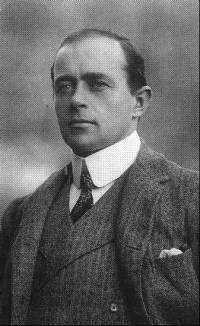
| After much difficulty, Scott reached the South Pole. "Great God, this is an awful place," he wrote. "And terrible enough for us to have laboured without the reward of priority". Scott was surely depressed because the Norwegians under Amundsen had got there first, a month before. Scott very nearly made it back to base, but some time in March 1912, his party ran out of provisions and ran into a nine day snowstorm, 11 miles from safety. On 12th November, Scaott and his companions were found dead. In Scott`s diary, he wrote, "Had we lived, I should have a tale to tell of the hardiness, endurance and courage of my companions which would have stirred the heart of every Englishman. These rough notes and our dead bodies must tell the tale". The sad Terra Nova returned to Cardiff in August 1913, fulfilling its Captain`s pledge. Scott had re-registered the home port of the Terra Nova as Cardiff, and had promised that the ship would return first to Cardiff after its adventure. The Lord Mayor, Scott`s widow and his forlorn son, "the little boy Peter" - late the naturalist, Sir Peter Scott - were there to greet the mourning ship that had carried the hero away. His father had left a dying message, "Make the boy interested in natural history if you can". The figurehead was erected in Roath Park and stayed there weathering until 1932. It was then taken in for safekeeping by the National Museum of Wales. In January 1989, she was restored, and given to the Maritime Museum. The Terra Nova reverted to use by Bowring`s and worked on the seal fisheries around Newfoundland. In1943, at the age of 59, she sprang a leak and sunk. Scott is also remembered by the lighthouse built by public-subscription in Roath Park Lake in 1915. The lighthouse was officially presented to the City on the 14th October 1918 by the same F.C Bowring JP who donated the figurehead. |
| Figurehead of the Terra Nova |
 |
 |
 |
 |
 |
 |