|
Solving Linear Systems By Graphing
|
| A linear system can
consist of any number of equations, but in our
case, we will use two. If variables X and Y are
used, the stardard form for two linear equations
is as follows: Ax+By=C
Dx+Ey=F
The
solution for the system is the only set of
numbers that satisfies both equations. The
solution is given in an ordered pair (x,y).
If we
graph both equations, the point at which they
intersect each other will be the solution because
the set of numbers satisfies both equations.
|
|
| Finding
Number of Solutions It is
possible to determine the number of solutions a
system of eqautions has by looking at its graph.
The examples below show the three possible number
of solutions.
|

|
|
One
Solution
|
No
Solution
|
Infinitely
Many Solutions
|
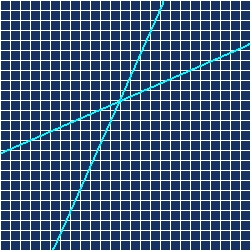
| One solution occurs when
the two lines intersect at exactly one
point. |
There is no solution when
the two lines are parallel. |
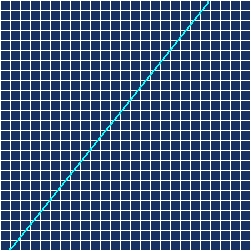
There are infinitely many
solutions when both lines lie on top of
each other. |
|
| Example Travel
between concourses at the Atlanta airport is done
by either taking the train system or walking. Two
passengers must travel from Concourse B to
Concourse C. The first chooses to walk while the
second takes the train. The train departs after
the first passenger had already walked 216 feet.
If the first walks at 2 feet per second and the
train travels at 20 feet per second, how many far
will they be from Concourse B when they meet?
|
| Answer Start the
problem by creating a verbal model for the two
equations.
[Speed
of Train] x [Time Traveled] = [Distance Traveled]
[Walking
Speed] x [Time Traveled] + [Distance Already
Traveled] = [Distance Traveled]
Now
change the values to make an algebraic model.
Speed
of Train = 20 (feet per second)
Time Traveled = X (seconds)
Distance Traveled = Y (feet)
Walking Speed = 2 (feet per second)
Time Traveled = X (seconds)
Distance Already Traveled by Walker= 216 (feet)
Distance Traveled = Y (feet)
20X
= Y
2X + 216 = Y
Next,
graph the equations.
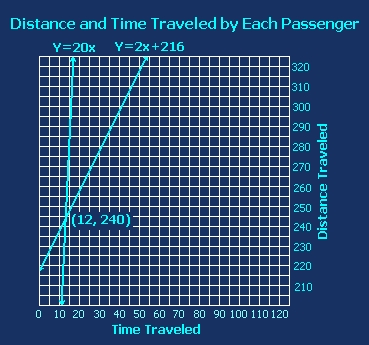
| If the equations Y=
20X and Y = 2X + 216 are graphed, it
would look similar to the graph on the
right. To solve this system of equation,
we would need to look at where they
intersect each other. In this case, it is
a point (12, 240). This means that the
first passenger and the second passenger
are the same distance from Concourse B
240 feet from the Concourse. |
 |
|
| Problem Okay, now
it is your turn to try one. A Delta flight takes
in about $60,000 from a flight from Atlanta to
Orlando. A Business class ticket costs $400 and a
Economy class ticket costs $200. Assuming the
flight sold a total of 250 seats, how many
tickets were sold for each class?
|
Answer
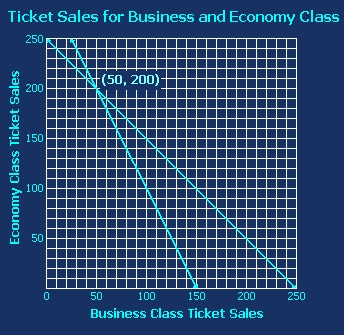
| To solve this
problem, you would first write two linear
equations. 400X + 200Y = 60,000
represents the amount of money made,
where X is the amount of business class
seats sold and Y is the amount of economy
class seats sold. X + Y = 250 represents
the total number of tickets sold. The
easiest way to graph the first equation
is to reduce the numbers. This can be
done by dividing everything by 200, and
the new equation is 2X + Y = 300. Next
graph the two equations using the
intercept method. Where the two lines
intersect is your answer. Delta Airlines
sold 50 business call seats and 200
economy class seats on this flight. |
 |
|
Home
|
Graphing
Method
|
Substitution
Method
|
Combination
Method
|
Back to
Projects
|

|
|
|
|
|
Copyright
© 2004 by Aviation Equations Inc. by John Tarleton
|