Solve the system.
2x - 3y = 1
x + y = 3
2(2) - 3(1) = 1 Equation 1 checks
2 + 1 = 3 Equation 2 checks
Therefore since there is one point of intersection, then there is one solution which is (2,1).
SOLVING SYSTEMS GRAPHICALLY When solving a system graphically, you take the two equations and graph them to find the solution. Using the equations: |
||||||
Ax + By = C Dx + Ey = F To make things easier put the equation in y = mx +b form like so: Y = -A/Bx + C/B Y = -D/Ex + F/E Graph both of the equations and find the point of intersection to find the solution. You can have three different solutions to the problem when solving graphically.
|
| Example: Solve the system. 2x - 3y = 1 x + y = 3 |
|
| Begin
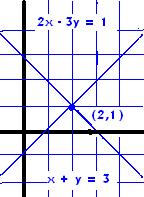
by graphing both equations as shown at the right. From
the graph, the lines appear to intersect at (2,1). You
can check this algebraically as follows. 2(2) - 3(1) = 1 Equation 1 checks 2 + 1 = 3 Equation 2 checks Therefore since there is one point of intersection, then there is one solution which is (2,1). |
|
| Example: Solve the system. 2x - y = 5 -4x + 2y = -10 |
|
| Begin
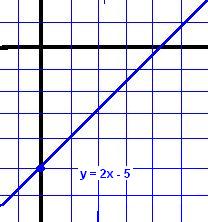
by graphing both equations as shown at the right. From
the graph, the lines appear to be the same. You can put
these equations in slope-intercept form to check as
follows. y = 2x - 5 Equation 1 checks y = 2x - 5 Equation 2 checks
Therefore since the equations are exactly the same, then they are the same line. That means there are many points of intersection, which also means there are infinite solutions. |
 |
| Example: Solve the system. -x + 5y = 8 2x - 10y = 7 |
|
| Begin
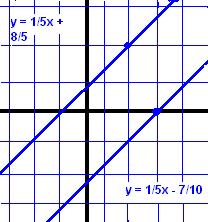
by graphing both equations as shown at the right. From
the graph, the lines appear to be parallel. You can put
it in slope-intercept form to check as follows. y = 1/5x + 8/5 Equation 1 checks y = 1/5x - 7/10 Equation 2 checks Therefore since the slopes are the same, the lines are parallel. That means there is no point of intersection, which also means there is no solution. |
 |