

Cheyenne Autumn has an acquaintance who visited Greece and noted all the
cats! They were everywhere and being fed by both locals and tourists.
They are frequently photograped and depicted in artworks. They are not
"pets"...mostly they are wild but there are a lot of them.
Here is a quote we found:
It is said there are a lot of cats in Greece. But not so many that it is a problem, even if it�s not unusual to have a cat under your table while your dining at a taverna. The Greek cats looks to be of another race than the Norwegian cats. They�re always a lot skinnier and their fur is a bit shorter.
 Definite classes of cat exist on the Cycladic Islands: there are the true rogue cats--scavenging for food, unkempt, with a missing piece of ear or two--and then there are the more privileged class members, regularly fed by Islanders and allowed the honor of a doorstep on which to perch (but still denied entrance into the home). These cats live not indoors, but neither are they strays. Greeks allow no pets in their homes, except for their canaries. Yet the cats are true domestic cats, not abandoned or wild, and they have for centuries shared the lives of human beings. The sunny outdoors is their domain.
The felines of The Mediterranean Cat are an eclectic bunch. Some are a little rough and tumble, the end result of a territorial battle over the best spot in the sun. Others are regal, as they sit nose in air on an honored whitewashed doorstep, or slink up a step with a prized (and no doubt stolen) fish in tow. Here are tabbies and Russian blues, cats with pristine white fur, others with matted orange. Some are wild and feisty, others are well fed and tended to by a caring Greek household. Yet all retain their independence and self-assured aloofness. The Greek fishing boats and sunny promenades, the cobblestone streets and high rooftops all belong to the cats.
From researching for this article, we got the feeling that animals are not always treasured in Greece and some are mistreated. There are rescue groups, of course, and we hope the siutation continues to improve.
 The Kritikos Ixnilatis, said to be the most ancient dog in Europe.
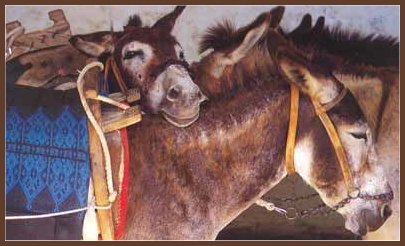 Many visitors to Greece admire the hard-working donkeys who transport passengers up the cliffs of Santorini. While these animals certainly work for their living, they are among the best-cared for animals in Greece. The decorative beads which adorn their harnesses are there for protection - the loss of one of these cherished though often stubborn animals is a blow for its owner. The donkeys on Santorini carry a certain superstitious dread as well - souls of vampires are said to reincarnate as the beasts of burden. On many small islands the locals still use donkeys for their transportation. |