
|
Greece has a history stretching back almost 4,000 years. The people of the mainland, called Hellenes, organized great naval and military expeditions, and explored the Mediterranean and the Black Sea, going as far as the Atlantic Ocean and the Caucasus Mountains. One of those expeditions, the siege of Troy, is narrated in the first great European literary work, Homer's Iliad. Numerous Greek settlements were founded throughout the Mediterranean, Asia Minor and the coast of North Africa as a result of travels in search of new markets.
In the second half of the 4th century B.C., the Greeks, led by Alexander the Great, conquered most of the then known world and sought to hellenize it.
In 146 B.C. Greece fell to the Romans. In 330 A.D. Emperor Constantine moved the Capital of the Roman Empire to Constantinople, founding the Eastern Roman Empire which was renamed Byzantine Empire or Byzantium for short, by western historians in the 19th century.Byzantium transformed the linguistic heritage of Ancient Greece into a vehicle for the new Christian civilization.
The Byzantine Empire fell to the Turks in 1453 and the Greeks remained under the Ottoman yoke for nearly 400 years.
On March 25, 1821, the Greeks revolted against the Turks, and by 1828 they had won their independence. As the new state comprised only a tiny fraction of the country, the struggle for the liberation of all the lands inhabited by Greeks continued.In 1864, the Ionian islands were added to Greece; in 1881 parts of Epirus and Thessaly. Crete, the islands of the Eastern Aegean and Macedonia were added in 1913 and Western Thrace in 1919. After World War II the Dodecanese islands were also returned to Greece.
Piraeus/Athens, Greece
Greece has about 2,000 islands altogether. Despite their superficial
similarities, each has a distinct indentity and an idiosyncratic history.Greeks have sailed around the islands for thousands of years; there are more than 50 inhabited isles. Greece has a long shipping tradition. There are ferry boats provided for travel between the islands.
Delos, Greece 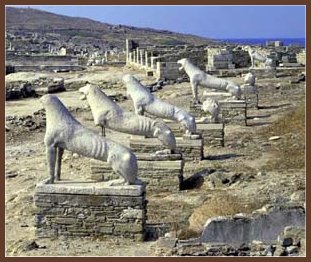 Kos is known as the home of Hippocrates, father of medical science. The town is an archeological repository of Archaic, Classical, Hellenistic, and Roman ruins. Take a tour to the ancient Asklepeion and the island's archaeological museum.
Mykonos, Greece
Patmos
GREEK OLYMPICS HOME |