
The step you have not seen is preparing and pouring the footing. The footing
is a 2 foot wide, 8 inch thick concrete ring under the pictured walls.
This footing MUST stand on what is referred to as 'undisturbed soil'. The day after
the basement was dug, we started putting up the concrete forms for the footing.
The footing was leveled using an optical surveyers level and came out
to within 1/4" of difference in overall height. The footing had no reinforment
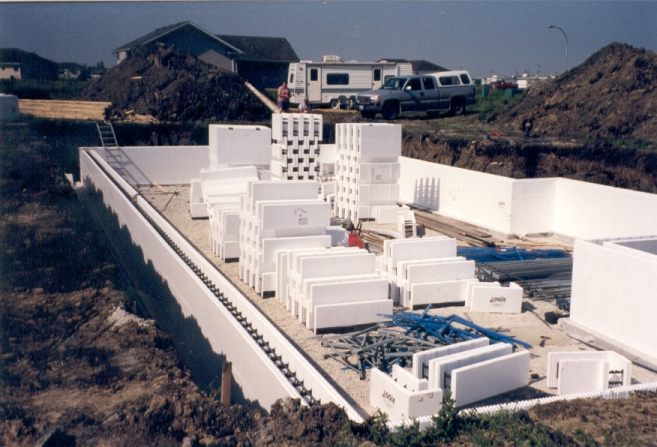
bar (rebar). After the footing was poured, it's forms came off and drain tiling was installed. Drain tile ran around the outside perimiter of the footing and at 6 different points, crossed under the footing to meet at the sump hole. This hole is located under where the basement stairs will be. All inner drain tile was levelled for proper water flow. After Crushed rock was then poured within the footing to the proper depth (the white rock in the picture). Depth was crucial and again surveyed as 2" of insulating styrofoam will come over the stones and at least 4 inches of concrete for the basement floor. As pictured, assembly of the basement walls started. A 2x4 perimiter was nailed to the footing and the first level of Logix blocks was assembled within it. Rebar had to be placed in each layer of blocks. Overall assembly took about 2 days. The bracing, shown here as the blue and grey steel and assembled on the next page, took another morning. Blocks are zip-tied to the block beneath and beside it at the corners for strength during concrete pouring. Much thanks goes to Peter Ginter, a concrete contractor and friend who not just sold us the block but loaned manpower and advice for the assembly and pouring of the walls. If we learned anything from the process with regards to the footing or the walls, it is to get the footing forms as level as possible. If the walls are level, then all of the layers of the house on top are much easier to build from the main floor walls to how the shingles go on. |
To |

Assembling Basement Walls |
The basement walls were assembled using Logix Integrated Concrete Forms, a lego-like styrofoam block, as pictured. |
Last update: Oct 25.03 |
Back to House |
Back to Digging |