|
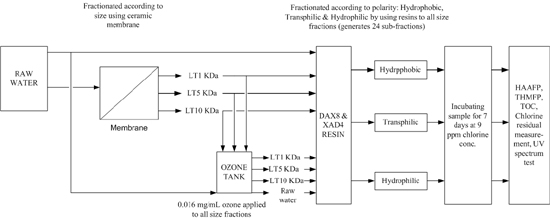
CHARACTERIZATION OF NATURAL ORGANIC MATTER (NOM) IN WATER AND THE EFFECT OF OZONATION ON THE NOM AND CHLORINATED DISINFECTION BY-PRODUCTS The presence of Natural Organic Matter (NOM) in water supplies can impact drinking water quality by reacting with chlorine during the disinfection step of drinking water treatment to form disinfection byproducts (DBPs). Therefore, it is important to reduce NOM levels prior to chlorine disinfection to produce a drinking water that is safe and of high quality. Flow diagram of the project
The physico-chemical characteristics of the NOM highly influence the ability of various drinking water treatment processes to remove these DBP precursors. Of particular interest are the physical size and the polar characteristics (hydrophobic/transphilic/hydrophilic) of the NOM components. The present study focuses on these characteristics. The first part of the study is to characterized two water sources based on the physical size and the polar characteristics of the NOM components. The two major raw water sources in British Columbia , the South Thompson River , and the Capilano Reservoir, were characterized. Second, the study investigated the impact of the size and hydrophobic/transphilic/hydrophilic distribution of the NOM in these water sources on the DBP formation potential. The formation of trihalomethanes and haloacetic acids, the two groups of DBPs present at the greatest concentrations in raw water was investigated. Third, the study investigated the impact of ozone on these characteristics as well as the formation of DBPs.
|