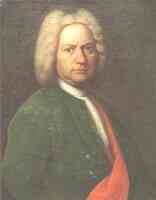
Johann Sebastian Bach (1685-1750)
Johann Sebastian Bach (1685-1750)
| Johann Sebastian Bach, one of the giants of the Baroque age, was born in Eisenach, Germany in 1685 to a family which produced no less than sixty professional musicians in seven generations. He began his professional career in 1700 when he became a chorister at the Church of St. Michael at Lueneburg. In 1703, he was hired by Prince Johann Ernst of Weimar to be a violinist in the court orchestra. However, he moved to Arnstadt later that year to became church organist. In 1705, Bach secured a leave of absence to study with Swedish organist Detrich Buxtehude in Luebeck. Buxtehude's organ music became one of Bach's greatest influences. After marrying his second cousin, Maria Barbara Bach in 1707, Johann went to Muelhausen to be organist at the the church of St. Blasius. He returned to Weimar the next year and took up employment in the court of Duke Wilhelm Ernst as an organist and violinist. By 1714, he was concertmaster of the court orchestra. In 1717, Bach moved to Anhalt- K_then where he was appointed chapelmaster and director of chamber music for the court of Prince Leopold. This appointment gave Bach the opportunity to write secular works for ensembles and solo instruments. During his six-year employment under Prince Leopold, he also wrote books to teach his wife and children the clavier. In 1720, Maria Barbara died, and in the following year he married a young singer named Anna Magdalena Wilcke. In 1723, Bach received his last posting, in Leipzig as musical director and choirmaster of St. Thomas' church. Bach died in 1750. Bach's music is typified by its technical facility as well as its expressiveness. Although his work constitutes the ultimate use of counterpoint and contains some of the most intricate harmonies found in Baroque music, it never sounds mechanical; in fact, it conveys the humanity of a truly great composer. |
