There and Back Again
I must say that my adventure through Vietnam was something that MTV Real World executives could only touch in their wildest fantasies. There we were, 11 students, each from a different cubbyhole of the United States, arranged together to traverse a remote and unfamiliar world. Nine of us met one rainy night in September as we gathered one by one into a dim corner of some quiet terminal in LAX airport. It was getting late, and I felt jetlagged, though the longest stretch of the journey hadn't even begun. I could read my watch, though my body gave up on trying to make any estimation about the time. Still, I was in high-spirits and I savoured every minute of the accumulating excitement as I waited to meet the people that would become my family for the next four months. That night was literally the longest night of my life as we traveled westward into the darkness so that we didn't reach morning light until some 20 hours later. Yet I didn't mind the long ride at all. I looked upon it as an opportunity to reflect upon my undefined expectations. And then, finally, after 30 hours of anticipation both in the air and in transit laying over, there was touchdown. We were so happy to get off the plane, and yet most of us didn't have a clue as to what might lay beyond the confines of the airport terminal.
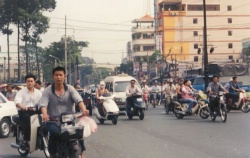
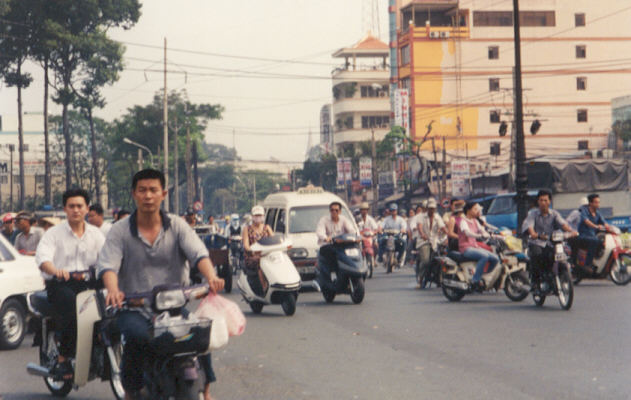
I'll never forget my first sights of Vietnam. At the airport exit, the nine of us were joined by Tin and Jacky, two students who had arranged on their own to come to Vietnam a little earlier, along with the program director, and we all cramped into a large loaded van. I sat with my face pressed up against the window, staring dumbly into the chaotic streets of Ho Chi Minh City. Endless motorbikes encircled us as we drove along, seemingly trying to hug our van, though we were just another float in a perpetual parade.
After settling into our rooms at the guesthouse, we met downstairs to eat dinner and then decided to enjoy our first night by spending it together out on the town, exploring much of District 1 guided by Tin's cousin, a local of Ho Chi Minh City. After dinner I realized just how different this new place would be, as the lot of us tried to cross the street. A boundless sea of motorbikes perturbed the streets of Ho Chi Minh City, so that even venturing across the street was a challenge, as if we were playing Frogger with upped stakes. While the larger avenues have streetlights, most other streets don't, and even if they do, most merely serve as decorative suggestions. Yet even the chaos of Ho Chi Minh City streets follows a system. Though it's a learned skill, if you just get out there and walk at an even pace, the motorbikes will anticipate your course and naturally flow around you, letting you part the sea and safely move across. The problem exists mostly with tourists who cross the street at a shaky pace, bumbling forward and backward as they hokey pokey their way across the street. You see, traffic expectations are much different in Vietnam than in the US. In Vietnam, everyone, including motorbike drivers and pedestrians, expects to encounter obstacles at all times. They never drop their guard. It's the first rule of driving 101, unlike the US, where Sunday drivers continually ride along, tuning out the passing world.
The next several days consisted of heavy-duty orientation. We were told what to eat, where to go, and what to carry in cases of emergencies, as we were quickly weened into our new home. In addition, we got our first allowance money, part of which we used to buy bicycles. Once equipped with our new mode of exploration, we set off together on a bike tour around the city led by the program assistants, who pointed out many of the historical sites as well as the route to school. I won't make any attempt to cover up the fact that I was a little nervous at first to jump into the midst of the hustle and bustle. After all I had just perfected the pedestrian art of crossing the street. Still, it wasn't long before I acquired a taste for Ho Chi Minh City traffic and then I was off, uninhibited, driving on a Ho Chi Minh City highway leading to the stars. Eventually I became hell-on-wheels, racing motorbikes (and beating many of them I might add) and playing games where I passed anyone who had the audacity to honk at me, which, in a city where motorbikes rule the land like giant monstrous dinosours in their day, honking is considered as common as breathing. A friend of mine even clocked me at speeds reaching about 60 kilometers per hour, which is roughly equivalent to 35 miles. The flat land of Ho Chi Minh City is perfect for reaching impressive speeds if you have the leg power. For those who are a little apprehensive, I'd recommend bringing two rear view bicycle mirrors along with a helmet, though after a little adjustment, practically no one really used their mirrors, and soon even our helmets became a thing of the past, though I wouldn't endorse riding in traffic without one.
The SIT educational paradigm is really one that can be a bit difficult to explain. The program is directed by none other than Thay Stu, or more "formally", the elusive Stu-Stu. Though Stu isn't Vietnamese, he did an excellent job leading us along, always flowing to the brim with tales of adventure gathered from his worldly travels, including outlandish journeys as the previous SIT director in Africa. Of course he'd never have been able to do it all without the brilliant aid of Anh Hung and Anh Tang, two assistants who were always there to provide us with an in-depth understanding of Vietnamese customs.
The language training was intense, but effective. Each weekday for six weeks began with a three hour language class at 7:30 am, where we studied in small classes at the University of Humanities and Social Sciences (Dai Hoc Khoa Hoc Xa Hoi va Nhung Vang). There were three levels of language instruction, ranging from absolute beginner to advanced. Twice a week we would also attend three-hour lectures from different professors at the university. Each lecture covered a particular aspect of Vietnamese history and culture, from medieval wars to the changes brought about through Doi Moi, socio-economic reformations begun in 1990. The lectures were given in Vietnamese with Thay Thong translating everything into English for those of us who couldn't completely understand. Every Thursday there was also a class devoted to understanding the unique situation in which we were in, held downstairs at our guesthouse. Assignments always encapsulated some light-hearted, whimsical task to help us get accustomed to our new environment, like going to a café and interviewing one of the patrons.
After staying at the guesthouse for about a month and a half, we spent three weeks with a homestay family. The daily itinerary was still the same, though our locations changed. The program chose families for each student to stay with, though students with relatives in Ho Chi Minh City could opt to stay with their families if they preferred. I decided to stay at the house of a friend's relatives. It was a bit far from school, but I didn't mind the distance, though I often reached school sweating like a pig. My record was 25 minutes, through 11 kilometers of some of the most congested traffic that Sai Gon could offer. The students who lived with families designated by the school only had to travel ten minutes tops each way. Anh Tang and Anh Hung did most of the arranging for homestays, and they tried their best to match interests between students and families so that we would have local friends to spend time with.
SIT kept us pretty busy, yet with all the educational bulk, there were still opportunities to go out and have fun. With my eternal partner in crime, Tin, I would explore the nightlife of Vietnam, hopping from club to club in our vain quest to see Vietnam from every possible angle. Though our preference for music was a bit different from the bubblegum style techno music popular in Vietnam, only three bucks gets you in the door and even pays for your first drink, so you really can't complain.
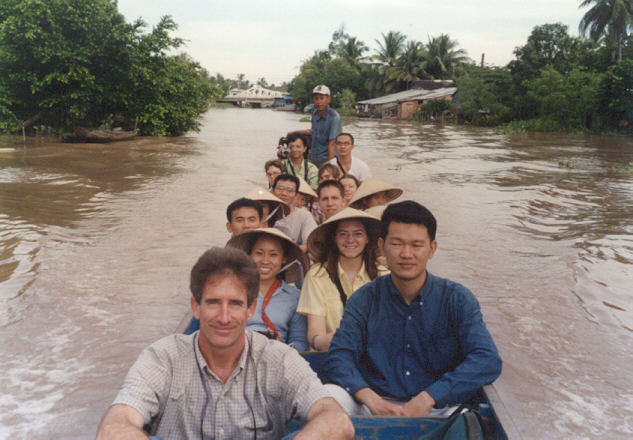
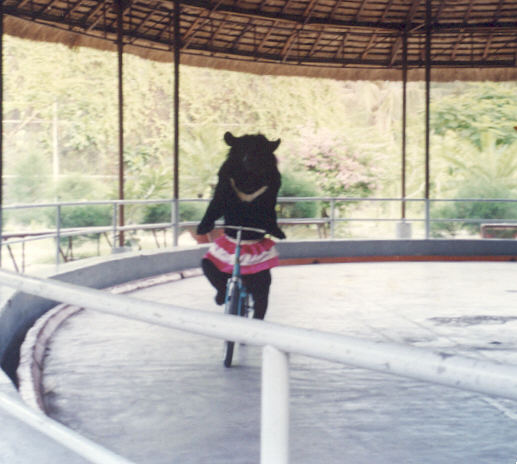
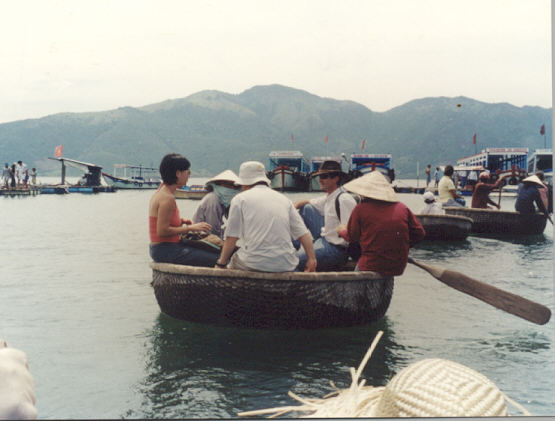
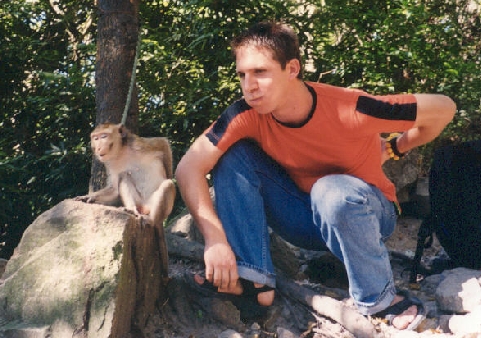
Though we based ourselves in Ho Chi Minh City, our trip was packed with excursions leading us throughout Vietnam. They ranged from a few days to a week and covered cities in the south and the lower part of Central Vietnam, including Can Tho, Da Lat, Nha Trang, Phan Thiet, and Mui Ne, among others. We had countless more adventures on the excursions, like snorkeling around a coral reef, taking a basket boat out to visit an ethnic minority school, and listening to classical Vietnamese music while riding a boat along the Mekong River, just to name a few. One of the most memorable events was a side trip several of us took on our own, where we rented a car over to Monkey Island, a peculiar but comical place boasting a circus where monkeys ride bicycles and bears drive motorbikes. There is also an isolated section on the island where monkeys roam free and you can hang out with them if you like.
Even though we weren't in a classroom for the excursions, there was still homework to complete, though often homework was in an unusual form that made it interesting. For example, we each had to interview a particular vendor about the Doi Moi reformations. Mine was a chicken vendor, and before I could interview her, I was required to politely purchase one of her wares: a live chicken! It was even more unusual for me, since I'm a vegetarian. There's nothing more ironic than a vegetarian carrying a plastic bag with a chicken peeping out its head. I felt like Chris Tucker from Rush Hour 2. I should have taken a picture of it, but damn it, I wasn't thinking. We would also take turns creating two-page reports on particular sites that we would visit and present them at the designated locations so that we would become our own tour guides.
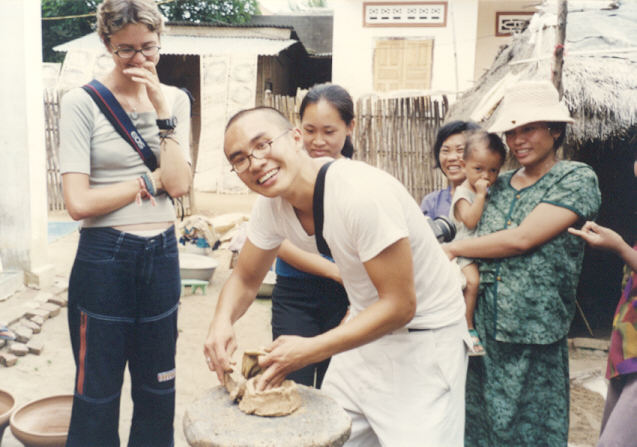
Even when we visited the locations overrun by tourists, we never did the tourist thing. Instead of just traveling to different sites and pagodas and calling it a day, we would interview resident monks and nuns. We also visited several different villages where assignments included interviewing the inhabitants. Occasionally there were also assignments to do on the bus since we spent much time traveling, like when Anh Tang and Tung made us memorize the words to the classical song, Tieng Hat Chim Da Da, and even the Elusive Stu Stu sang it karoake style over the bus loudspeaker.
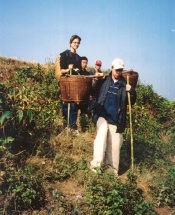
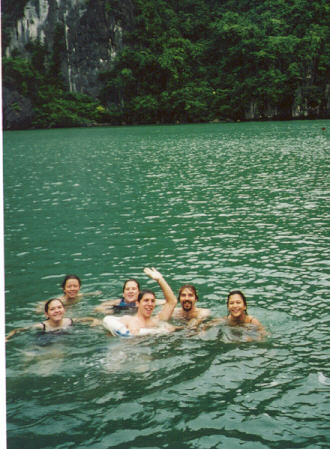
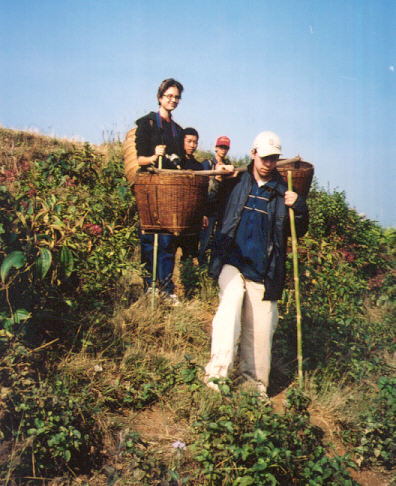
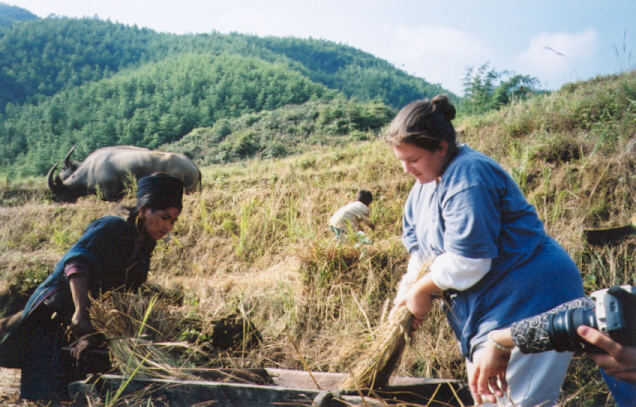
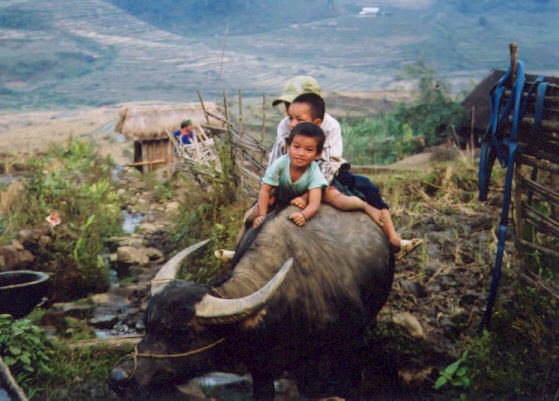
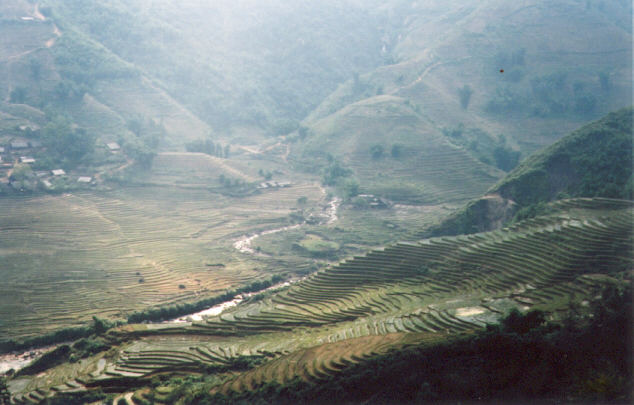
After two and a half months, we took our party up north for two weeks, basing ourselves in Hanoi, but also taking several excursions there, like the one to Chua Huong, the Perfume Pagoda. With some local university students, we took a bus ride, a boat ride, and climbed up some mountains to reach the main temple inside an enchanting cave. We also spent two days at the wondrous Ha Long Bay where it is said that a dragon descended to the waters, and its tale swooshed around to create massive mountainous humps rising above the sea. Not only did we take a boat ride among the great soaring islands, but we also got to swim in the bay itself! Finally we ended our northern trip with three days in Sapa in Northwestern Vietnam. After hiking several hours up a mountain, we stayed in a Hmong minority village. I've never seen a more beautiful starlit night than in Sapa, where millions of previously coy stars crept out of their hiding places to parade along the canopies of the sky. We spent the next day "doing as the Romans do in Rome", or more accurately, as the Hmong do in Sapa. We helped farm, harvest rice, carry firewood, and other daily chores that the Hmong are accustomed to do.
When we returned to Hanoi, it was time to begin our Independent Study Project (ISP), in which we had to complete 120 hours of field research on a topic concerning Vietnamese culture or history. We had been working since the beginning of the program to develop contacts for our ISP and advisors knowledgeable in our specific topics were appointed to each of us. From that point on we were on our own, even having to get back to Ho Chi Minh City by ourselves. Stu provided us with an allowance consisting of $8 a day for lodging and $6 for food, which goes pretty far in Vietnam. Finding a way back to Ho Chi Minh City wasn't as difficult as it might sound since Hanoi is littered with travel agents ready to send you on your way by air, or if you choose to, you can buy a train ticket at the station. I opted to fly because I felt a bit travel weary at the time, though I regret now missing the opportunity to see Da Nang and the marvelous Marble Mountains. Da Nang was perhaps the only big city that we didn't cover as a class, though several students took a train there and then flew to Ho Chi Minh City.
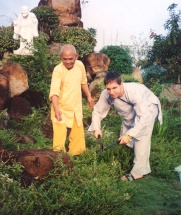
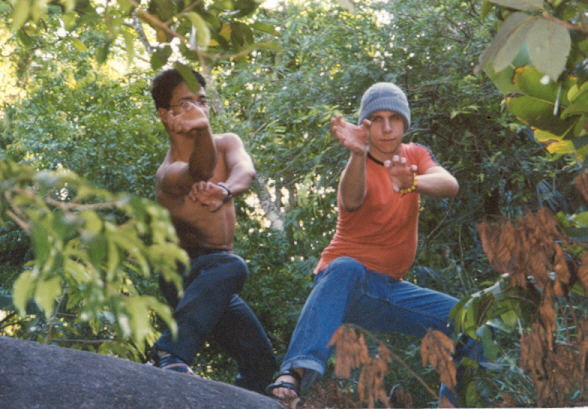
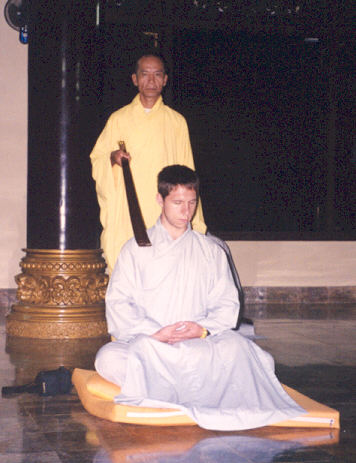
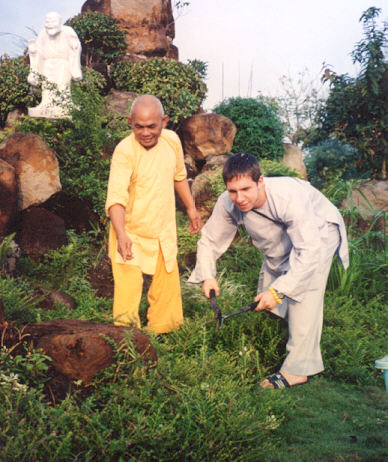
During ISP, we were in charge of finding a place to stay on our own. Several students decided to return back to the guesthouse where we had been based at the beginning of the program. However, the rest of us decided to take the opportunity to see Ho Chi Minh City from a different light. Tin found a wonderful hotel in the ritzy area of District 1. With a little bargaining on Tin's part, Tin and I were fitted with our own furnished room for a mere $10 a night per room, while others shared double rooms for $14. The ISP was perhaps the most exciting portion of the trip and each of us had very unique adventures. Though we weren't required to, many of us went to the extreme to get an in-depth understanding of our topic. My topic was Buddhist meditation, and I traveled to several different monasteries around southern Vietnam to learn particular forms of practice. With the help of my homestay brothers, I even visited sacred mountains associated with the martial art style that I've been studying since I was fifteen.
The last days in Vietnam were spent presenting the results of our adventures in ISP to the class. Tin described his midnight expeditions along his endless struggle to give to the nameless street kids a voice. To help them speak up, he created an artwork contest where street kids painted pictures to accompany their hard-lived stories. There was Hana with her emotional descriptions about the underground culture of Vietnam and its harsh realities. Tung learned many of the secrets involved with businesses owned by foreign Vietnamese, while Phuphu educated us about the customs and superstitions of Vietnamese weddings. Sarah studied the politics and strategies of beer advertisements in Vietnam, and Ben was more than happy to do some taste testing during her presentation. We feasted on some tasty dishes fashioned by Katie who worked at several restaurants as she accumulated different myths associated with traditional Vietnamese dishes (Yeah Katie with the che chuoi!!) Kelly (not to be confused with Katie) lived at a Buddhist nunnery for two weeks near one of the monasteries that I spent a few days at. My Linh learned some impressive Vietnamese painting techniques and painted some really cool stuff, which she sold for some nice dough. Jack...oi! studied different postwar monuments, and we gotta give her props for travelling 20 hours each way on the train (by herself!) to study first-hand the monuments associated with the tragedy of My Lai.
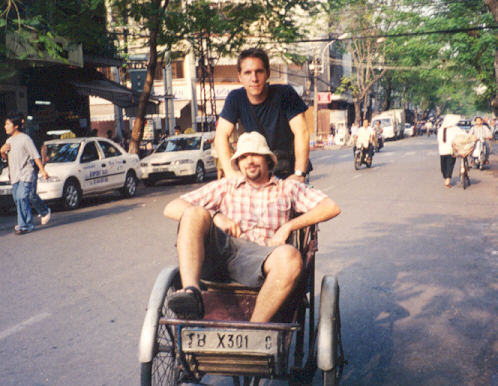
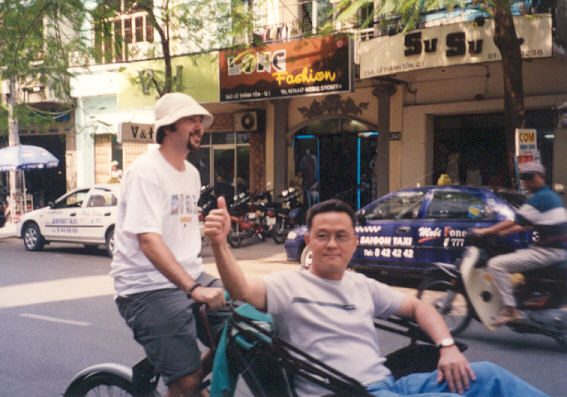
Still, I must say that the most outrageous and entertaining of all ISP's belonged to Mr. Ben who gave us xich lo (cyclo) rides around Ho Chi Minh City. Xich los are bicycle taxis that present a cheap method for travelling the city streets. The presence of Ben stirred up quite a bit of bewilderment among the locals. After all, one foreign student riding around in a xich lo is scandalous enough in neighborhoods where foreigners don't regularly gather, but when locals notice that a second foreigner is actually in the driver's seat, well that's just damn near unimaginable, and people fall to the ground in tears as they laugh the willies away. Ben would just give them a wink and continue on his merry way as onlookers watched in awe with open mouths and slapped their knees in disbelief. There was even an article in a magazine called Cong An, or "The Police", which broadcasted Ben's presence around Ho Chi Minh City, though no one ever interviewed him, and even he didn't know about it until the orange juice lady opened up the magazine and pointed to his picture. Translated, the article was titled something like "Westerner Stirs Up Trouble In Vietnam". I laughed till I cried when I saw the article.
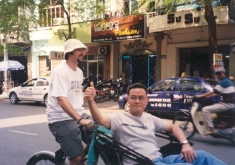
Ben's unique xich lo project didn't incorporate the standard report format that many of us concentrated on. Instead, he wrote poems about his experiences.






I'll never forget my journey through Vietnam. The lessons and the wealth of adventures that I've accumulated have become a porcelain collection, to be treasured always. I'd like to wish the best of luck to all my SIT friends: Tin, Hanaaa, Tung, Phuphu, Jack...oi!, Ben, Katie (I mean Kelly), Kelly (I mean Katie), My-Linh and yes her ou-ey too, Sara, Anh Tang, Anh Hung, and the Ever Elusive Stu Stu himself. I hope someday we can all meet again on some familiar road. Until then...
I sit beside the fire and think
of all that I have seen
of meadow-flowers and butterflies
in summers that have been;
Of yellow leaves and gossamer
in autumns that there were
with morning mist and silver sun
and wind upon my hair.
I sit beside the fire and think
of how the world will be,
when winter comes without a spring
that I shall never see.
For still there are so many things
that I have never seen:
In every wood in every spring
there is a different green.
I sit beside the fire and think
of people long ago,
and people who will see a world
that I shall never know.
But all the while I sit and think
of times there were before,
I listen for returning feet
and voices at the door.
--J. R. R. Tolkien