Scientists have been increasing the Earth's age for centuries: In 1770, George Buffon said the earth was 70,000 years old. In 1905, the world was 2 billion years old. Sixty-four years later, the Earth was 3.5 billion years old. Right now, the Earth is said to be 4.6 billion years old (5). But are these growing ages supported by science? More and more evidence is pointing toward an Earth that is between 4,000 and 10,000 years old, most likely around 6,000 years.
But why does it matter? "For particles-to-people evolution to have a speck of plausibility, Earth needs to be billions of years old" (2). Also, incomprehensible ages make evolution seem possible. Billions of years are impossible to test or construct; in other words, it's hard to be wrong when you're vauge. So in our examination of evidence, it is crucial that we examine evidence indicating the age of the Earth, fossils, and the Universe.
The following were taken from the newsletter Impact, by the Institute for Creation Research, and written by Dr. Humphrey; an associate professor of physics. The following excerpts are a few reasons why the the Earth and the universe could not be 4.6 billion years old.
"Galaxies wind themselves up too fast. The observed rotation speeds are so fast that if our galaxy were more than a few hundred million years old, it would be a featureless disc of stars instead of its present spiral shape." This obviously contradicts the galaxy's presumed age of over 10 billion years old. Evolutionists have known about this dilemma for fifty years, and refer to it as "The Winding-Up Dilemma." Yet none of these people have been able to explain it.

It's pretty obvious by now that there is a serious discrepancy between dating method results and the Biblical time scale. So far the Bible has held up under scrutiny, so the next logical step is to examine dating methods. The two main methods used by scientists is Radiometric dating and Carbon-14 dating, but "to derive ages from such techniques, unprovable assumptions have to be made" (2). Radiometric dating tests volcanic material and radioactive decay. It is not accurate. "For example, radiometric dating has shown certain rocks from volcanoes in Russia to be five billion years old, whereas it is known they were formed within the last 200 years" (20). Rocks and soil brought back from the moon were tested with four different radiometric tests, and the results were four different ages spanning almost 4 billion years (12). Scientists were disheartened that this test obviously wasn't working, so they bathed the rocks in acid to melt out all the lead, at the same time destroying other parts of the rock. They tested them again, and got a result of 3.8 billion years (12). They thought that was acceptable, so that is the presumed age of the moon. It is suspect at best.
Carbon-14 dating is not more reliable. In fact, "…archaeologists do not regard C-14 dates as absolute because of frequent anomalies" (2). This kind of dating tests the amount of carbon in things that used to be alive. But this is not at all accurate: it dated living mollusks to be 2,300 years old. It tested organic material in castle mortar that was known to be 787 years old to be 7,370. Freshly killed seals were tested to be 1,300 years old. 30-year-old dead seals were dated at 4,600 years old! (12) These kinds of discrepancies are usually credited to contamination by the evolutionary community. "However, contamination does not really account for such uniform levels of C-14 in all of these fossil and coal samples" (1) In addition, diamonds, "the most impenetrable material known could not be the result of contamination, and indicates they are younger than 50,000 years" (1).
In addition, scientists who claim that a subject that has been carbon dated at any number of millions of years is wrong. "…Carbon dating can give only thousands of years. So anyone who claims that carbon-14 dating proves billions of years doesn't know much about the subject. If anything were over about 50,000 years old, there should theoretically be no detectable C-14 left. That's why radiocarbon dating cannot give millions of years" (2).
Obviously, this dating method is extremely unreliable. Numerous natural occurrences skew results, most notably water. Water leeches Carbon from organic material, making it appear to be older (2). So if there were some global catastrophe involving water (like a Flood), carbon-14 dating would be useless. Another problem with C-14 dating is that the "C-14/C-12 ratio in the atmosphere has not been constant" (2). This is a problem because the ratio that is still left in the carcass of the subject is what determines the "age," and scientists cannot fully adjust to the varying levels of carbon (2). Plants may "appear to be older than they really are" because they take in less C-14 than C-12. Also, different plants take in different amounts of C-14 (2). Still another natural phenomenon that affects Carbon dating is the Earth's magnetic field. The magnetic field deflects some of the cosmic rays coming into the atmosphere. Since this determines the amount of C-14 present in the atmosphere, it affects dating. For example, the magnetic fields have been decreasing at a steady rate for the last 2,000 years, so more C-14 is in the atmosphere than two thousand years ago. "This will make old things look older than they really are" (2). There is yet another natural disaster that throws off Carbon Dating: "…volcanoes emit much CO2 depleted in C-14, and the Flood was accompanied by much volcanism, this would also affect the dates, making fossils formed in the early post-Flood period appear older than they really are" (2).
Scientists measure many other elements in addition to Carbon, yet are not accurate either. For example, using the potassium-argon method of dating, volcanic material in Hawaii that was less than 200 years old was tested at between 160 million and 3 billion years old. (Journal of Geophysical Research. July 15, 1968, pg. 4601)
Even if all these factors were removed, isometric dating would still not be reliable. It is based on three unprovable and untestible assumptions:
1. The amount of parent and daughter isotopes have not been altered by anything but radioactive decay.
2. The amount of daughter product at the formation of rock (usually assumed to be 0)
3. The decay rate has always been constant throughout history (8).
Consistent discordant rates indicate decay has not always occured at constant rates. For example, scientists use the rate at which Uranium decays into Lead. It is known that Uranium isn't stable, and produces alpha particles that lead to Heluim diffusion. This diffusion rate varies with temperature. Still, the rate of decay, when used as a dating method, is assumed to be constant (8). This is obviously bad science.
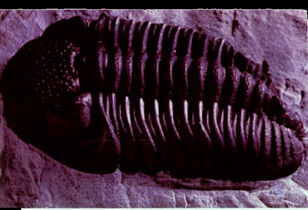
An index fossil is also a method of scientific dating. If a scientist finds a fossil of a certain creature, then the rock layer it was found in is assumed an age, since sedimentary rock cannot be dated (8). For example, if a trilobite (pictured at right) is found, then "the rock layer was probably formed 500 to 600 million years ago." (Holt Modern Earth Science, 1989, 290)
However, trilobites are not extinct. In fact, they have been found in Costa Rica growing 4-6 inches long. A scientist could dig up a fossil of one of a trilobite that is only 50 years old, and the scientific community would label it as being hundreds of millions of years old.
Another example is the Coelacanth fish. This fossil is an index fossil for 325-410 million year old rock. These are also still alive and thriving off the coast of South Africa. A final example is the Graptolite, which lives today, yet remains an index fossil for 410 million year-old-rocks (5).
Still another is the Coelacanth. It was presumed extinct for 60 million years until one was caught off the coast of South America in 1938. The significance of finding this fish was "like finding a living dinosaur" (4).
So the main methods that scientists use to date our Earth are simply not reliable. "And most of the scientists today point out very clearly that every other method they have for measuring the age of the earth suggests an earth that is very young" (11). The public is just now becoming aware of the "assumptions and guess-work involved in geologic dating," and that it is "not the objective analytical process we are led to believe [it] is" (1).

Evolutionists believe the universe is around 6 billion years old. Creationists believe the universe is much younger; around 6 thousand years old. The age of the universe is important because, like the age of the earth, it makes or breaks Evolutionary Theory. If the earth is too young, molecules-to-man evolution could not have happened. In the same way, if the universe is too young, then the earth is also too young to support Evolution.
It is logical to begin with our closest and most important neighbors: the sun and moon. Cosmic dust deposits on the Earth and Moon should be 50-60 feet deep if they were billions of years old. However, when Apollo 13 landed on the moon, it landed in only 3 inches, indicating an actual age of several thousand years (12). Another problem is the sun; it's getting smaller by .01 percent per century, which translates to 5 feet per hour. This means that 100,000 years ago, the sun would be twice the size it is now. One million years ago, Earth would have been too hot for life. 20 million years ago, the sun would have actually touched the Earth (10)! Another problem with the sun is Angular Momentum. "Angular Momentum should cause the sun to spin very rapidly. Instead, it spins slowly, while the planets spin rapidly around the sun. In fact, although the sun has over 99% of the mass of the solar system, it has only 2% of the angular momentum. This pattern is directly opposite to the pattern predicted for the nebular hypothesis." (Dr. H. Reeves, Dermott, S.F. Ed. John Wiley & Sons, New York in The Origin of the Solar System, 1978. 9.) "The amount of helium-4 in the atmosphere suggests that our atmosphere is less than 15,000 years old" (20).
Comets would also be gone by now if the universe was more than 10,000 years old. Evolutionists hypothesize that the "Oort Cloud," a belt of comets beyond Pluto, supplies them new comets. There is only one problem with this theory: there is no proof that the Oort Cloud even exists. "Oort proposed a cloud of comets surrounding the solar system based on mathematical errors." (The Non-existence of the Oort Comentary Shell, Astrophysics and Space Science, Vol. 31. 1974. 385-401) Also, Ganymede's (A moon of Jupiter) molten metal interior would have already cooled off if it was much older than 10,000 years old (5).
Other planets would also be much different if they were over 10,000 years old. Saturn's rings could only last 10,000 years. Jupiter is losing heat twice as fast as it receives it from the sun; it would have cooled off before billions of years went by. (Ackerman, Paul. "It's a Young World after all." In the Beginning, Walt Brown. 29,69)
Starlight is supposedly strong evidence in support of a universe that is billions of years old. Some scientists assert that it takes between 3 billion and 100 billion years for stars to go from a Red Giant to a White Dwarf. However, this is not true. Humans have observed the star Sirius become a White Dwarf. Egyption hieroglyphs from 2000 B.C. described Sirius as red. Cicero, in 50 B.C. stated Sirius was red. Seneca described Sirius as being redder than Mars. Ptolemy listed Sirius as one of the six red stars in 150 A.D. Today it is a White Dwarf, and it didn't take 3 billion years (5). There is also evidence that the speed of light is not constant, (13) so the light could have reached Earth sooner than anticipated. In addition, the methods astronomers use to measure distances in space is not very accurate. "Parallax can only accurately measure stars less than 100 light years away." (Hawking, Stephen W. A Brief History of Time. New York: Bantam. 1988. 37) In addition, the major method of measuring stars' distances from Earth (measuring the red shift) is inaccurate, as "red shifts do not indicate distance." (Halton Arp, Astronomer at Palomar Observatory. Former President of Astronomical Society of the Pacific.)

Many forces affecting the earth also provide evidence for a young age. For instance, Earth's magnetic field has decayed 14 percent over the last 130 years. 10,000 years ago, the magnetic field would have been so strong, nothing would have been able to survive. 30,000 years ago, the temperature would have been 5,000 degrees Fahrenheit (12). Obviously, Earth would have been very inhospitable to life at 5,000 degrees. In addition, "if the Earth were billions of years old, the Coriolis Effect would have created winds of over 1500 miles per hour" (5). Erosion is also a problem for evolutionary theory. It would only take 14 million years for America to be eroded below sea level (12).
Old Earth proponents cite geologic evidence that requires millions of years for a substance to form. Coal is one of these substances. "No source of coal has been found that completely lacks C-14" (2). This means that no coal could be over thousands of years old, or else there would be no detectible amount of Carbon in it. Therefore, coal doesn't take millions of years to form. The Argonne National Lab has shown that coal can form by heating wood, clay, and water at 150 degrees C for 36 weeks. (Organic Chemistry, 6:463-471. 1984) Oil does not take millions of years to form either. Scientists working in a lab produced a barrel of oil from one ton of garbage in only 20 minutes (5). Natural evidence also points away from the idea that these substances take millions of years to form. The gas pressure in oil wells can be up to 20,000 psi. The layer of rock above the layer of oil can only hold this amount of pressure for 10,000 years or less (5).
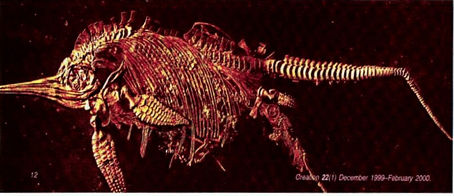
Old Earth supporters also say that other natural processes can take millions of years. For example, fossilization is one of these said processes. However, this is only speculation. Dinosaur bones have been found partially fossilized (for more information, see The Flood). A mother Ichthyosaur was fossilized while giving birth.
This shows that the creature was buried and fossilized very rapidly. Petrification, like fossilization, also does not take millions of years. In 1980, a petrified cowboy leg was found in a dry creek bed near the west Texas town of Iraan in 1980. Another petrified human was found after being buried 14 years in Gainesboro, Tennessee. "He died in 1881 and water ran through the grave and turned his body to stone." (Mary Robbins, Upper Cumberland Tourism Association)
Some scientists say that it takes millions of years to form canyons. This is not true. If a river erodes land over a large period of time, the result is a ravine, not a canyon. Despite this, the Grand Canyon is said to have been formed over millions of years. This is not supported by evidence. "The large-scale cross-bedding (sand-dune structures) shows that it was all laid down in deep, fast-flowing water in a matter of days" (2). In fact, it has been proven that the Grand Canyon could have formed in a mere 40 days (5).
After a recent eruption of Mt. St. Helen in March of 1982, a natural lake was formed from water vapor in the ash. A natural dam held back the excess water, but soon burst. The 20-mile-long mudflow from this lake cut a canyon 140 feet deep in only 16 hours. This canyon is even called "The Little Grand Canyon" because it is so similar to the Grand Canyon in Arizona. These similarities include "exposure of stratified rock layers along the canyon sides, flat areas in the highland surfaces of both canyon sides, and gully headed side canyons" (1). In addition, "a small river also now runs along the bottom of this canyon, but the river did not form the canyon, the canyon formed the river" (1). The reasonable conclusion is that these two canyons were formed in the same way; through a sudden burst of water cutting through soft sediment in a matter of hours or days, not through millions of years. The Great Flood, when the waters were receding could easily have cut the soft sediment that would later turn to rock and be called the Grand Canyon (John Roberts).
Other geologic evidence exists underground. "Strong geologic evidence exists" that the Cambrian Sawatch sandstone was "still unsolidified" when it was pushed up to the surface during the uplift of the Rocky Mountains. The problem with this is that it doesn't fit with the idea of an Old Earth; the Cambrian Sawatch sandstone was supposedly formed 500 million years ago, while the uplift of the Rocky Mountains was 70 million years ago. The sandstone had an alleged 430 million years to solidify, and it is "very unlikely" that it wouldn't. "Instead, it is likely the two geologic events were less than hundreds of years apart" (10). "In fact, there is no proof whatsoever that the world and its fossil layers are millions of years old" (7). "The rocks cry out, "Creation!" -Duane T. Gish, Ph.D.


Others believe both in the Bible, and in millions of years, and do not believe the two contradict. The "Day-Age Theory" states that the six creation days mentioned in Genesis are not literal days, but millions of years. The "Gap Theory" states that millions of years passed between each day. However, the Bible does not support these theories:
Those who believe in an old Earth believe that it was formed about 4.6 billion years ago, while humans were formed about one million years ago. If one believes both in the creation account, and also in an old Earth, then Jesus' teachings obviously don't matter. Jesus said: "from the beginning God…made them male and female." (Mark 10:6) Jesus is implying that the Earth and humans were created at relatively the same time, not 4 billion years apart. Either chose to believe evolution or design, do not destroy your ability to be respected by trying to mix the two. "Either God is the creator and ruler of the universe, or He is not. Such a position cannot be neutral… and brings an inevitable conflict with Christianity that cannot simply be dismissed or ignored" (1). And if you're a Christian, do not be afraid to stand up for your beliefs. Intelligent Design is a completely valid scientific alternative to evolution.
"The righteous man who falters before the wicked is like a murky spring and a polluted well" (Proverbs 25:26 NKJV).